Showing posts with label "stabilizers". Show all posts

Tuesday, May 12, 2020

May 2020: Back in FMY - Fixing Stab Overheat

Foreword:  We and the boat are back home in Fort Myers and we’re still being diligent about social distancing and hygiene practices.  Hopefully that’s true for all y’all, too.  But here in the USA, with most states proceeding with “re-opening” without much regard for science, we’re also preparing for a long slog with multiple setbacks looking very likely.  If you want a historical analog, go study the Spanish Flu outbreak of 1918…along with how & why it continued into 1920.  Mark Twain reportedly once said “History doesn’t repeat itself, but it often rhymes.”  It seems we’re destined to prove him right again.  But there is good news….have discovered if you keep a glass of scotch in each hand then you can’t touch your face.  That’s good hygiene.

This entry is all about a system repair and nothing else.  So unless you are a boat geek, or bored enough to seek almost any distraction, you’ll want to skip it.

Even though we’d had a very successful maintenance stop with Yacht Tech in Palm Beach, we still had ample boat projects to keep us busy on Ghost Rider.  But the priority problem-to-solve was the stabilizer oil overheating condition we had encountered at the midpoint of our journey back to Fort Myers.  After a few days at the dock we now had a much cooler engine room, allowing for a relatively relaxed and comfortable approach to troubleshooting…and the luxury of temporarily disabling the main engine without consequence.
The Red Arrow Points to the Main Engine's Heat Exchanger on the Port Side of the Maine Engine.  Tucked Under That, the Blue Arrow Points Out the Gear (Transmission) Oil Cooler.  The Yellow Arrows Point at the Pencil Zincs on the Heat
Exchanger.  And then the Green Arrow Indicates the Down Elbow....Just Underneath that a Small 5/8" Diameter Hose
Branches Off to the Cooling Circuit that Routes Over to the Stabilizer Oil Tank.
The design of the cooling circuit for our stabilizer oil tank is relatively simple. Ghost Rider is an exception compared to most Nordhavns….rather than being keel-cooled with a dry exhaust stack, our Nordy’s main engine is cooled via a raw (sea) water heat exchanger and uses a traditional wet exhaust.  That arrangement provides for a secondary cooling circuit that branches off at the bottom of the main engine’s heat exchanger and is then routed over to the stabilizer oil tank reservoir for additional cooling duties there.  After exiting the stab oil tank, that auxiliary cooling circuit empties into the sea via its own dedicated discharge thru-hull.  Except now we could not detect any outflow coming from that thru-hull opening….meaning no cooling flow.
The Stabilizer Oil Tank is Located in the Port Side Forward Alcove of the Engine Room.  The Yellow
Arrow Points to the Input Cooling Line that Branches Off the Bottom of the Main Engine's Heat Exchanger.
The Green Arrow Points to the Output Line that Goes to the Thru-hull Discharge.
So there is a minor flaw in that design:  while the heat exchanger itself is quite beefy, by necessity it utilizes two sacrificial pencil zincs (anodes) to prevent galvanic corrosion inherent with that salty seawater flow…and as those zincs decay (as intended) the shedding debris will descend to the bottom of the heat exchanger – right where that stabilizer cooling loop begins.  That loop uses much smaller diameter hosing and piping (5/8” ID), and occasionally is prone to clogging with that decaying zinc detritus.  When that occurs the result is hot stabilizer oil….rather than the normal 155F temps we were seeing nearly 200F on the leg to Marathon following the overtemp warning light.
Flushing the Line Going from the Heat Exchanger to the Stabilizer Oil Cooling Loop.  The Red Arrow Points to One of the Two Pencil Zinc Ports We Used for the High Pressure Flush Out.  The Yellow Arrow Indicates the Low Point of the Stab Cooling Circuit Where We Diverted its Feed Hose Into a Drain Bucket.
Rick decided to start the investigation where the stabilizer cooling loop originates at the bottom of the main engine’s heat exchanger.  After removing the two zinc plugs (they were due for replacement anyway) and disconnecting a segment of the hose feeding the start of the stab cooling circuit, he stuck a high pressure hose into the zinc ports for a flushing out.  While that netted some debris it certainly was not enough to cause a blockage or overheat issue.
After Disconnecting the Stab Oil Tank's Cooling Hose from the Thru-hull Discharge (Yellow Arrow) and Augering Out
a Significant Zinc Debris Blockage, We Observed a Good Cooling Flow from the Hose End (Green Arrow.)
After reassembling the main engine side of the loop, the next step was to check at the opposite end of the stabilizer cooling circuit, where it exited the boat via the thru-hull fitting.  It was a likely suspect since there was a 90 degree elbow where the outflow hose clamped to the thru-hull fitting – and in there Rick found enough stray zinc debris to form a very effective dam.  A stiff wire coat hanger server as a suitable plumbing auger, and in the end that blockage turned out to be the only culprit.  After clearing the clog and starting the main engine we observed good cooling flow exiting from the thru-hull discharge.
The Yellow Arrow Points Out the Resulting Normal Stab Cooling Flow from the Thru-hull.
The question now was whether such an event could be prevented in the future.  The zinc decay itself is a critically important feature that protects expensive diesel engine parts from dissolving through galvanic corrosion; it would not be wise to change that portion. One option was to design an entirely separate cooling loop for the stabilizer oil tank, which would entail a new intake thru-hull as well as a new electric water pump (and then sealing off the existing feed from the heat exchanger.)  But another path was just to insert a sea-strainer device into the existing cooling circuit to trap zinc debris, with periodic inspection and cleaning.  The latter sounded a whole lot easier and cheaper, at least as a first try.  So that’s the approach we’ve taken for now.  Rick installed a standard Jabsco PumpGuard strainer at the circuit’s low point, close to where it branches off the main engine’s heat exchanger.
The New Sea Strainer Inserted into the Stabilizer Cooling Circuit at its Low Point.  It's Positioned Just Under the Front End
of the Main Engine Where It's Readily Visible and Accessible for Cleaning When Necessary.
It was a relatively simple modification, but it needs to be sea-trialed to determine whether it still allows for an adequate flow rate for cooling the stabilizer oil tank.  A better long-term solution might also call for an inline shut-off valve just upstream of the strainer to allow cleaning of the strainer basket without having to first shut down the engine and drain the heat exchanger (that beast holds a LOT of sea water.)
Just What is a Heat Exchanger?  The Schematic Above is Generic, but is a Good Illustration.  It's Basically Like a Car's Radiator, but Instead of Outside Air Cooling the Antifreeze that Circulates Through the Diesel Engine, it Takes in Seawater to Perform the Same Function.  On Ghost Rider a Portion of the Seawater is Expelled Through the Wet Exhaust, but Another Portion is Routed to the Stabilizer Oil Tank to Perform Cooling Duties There.

Sunday, April 19, 2020

April 2020: Cruising Back to Fort Myers

Foreword:  Ghost Rider became our very own containment vessel for the few days it took us to cruise back to Fort Myers, staying offshore and stopping only at a couple of anchorages along the way.  There are worse ways to practice social distancing, and not many safer.  We would like to salute the front line medical workers and first responders who continue to put themselves in harm’s way. To once again quote Mr. Churchill: “Never in the field of human conflict was so much owed by so many to so few.”  Of course he also reportedly said something like “Americans can always be counted on to do the right thing…after they have exhausted all other possibilities.”  That one is looking dubious.

First Leg: Palm Beach to Rodriguez Key (Near Key Largo)
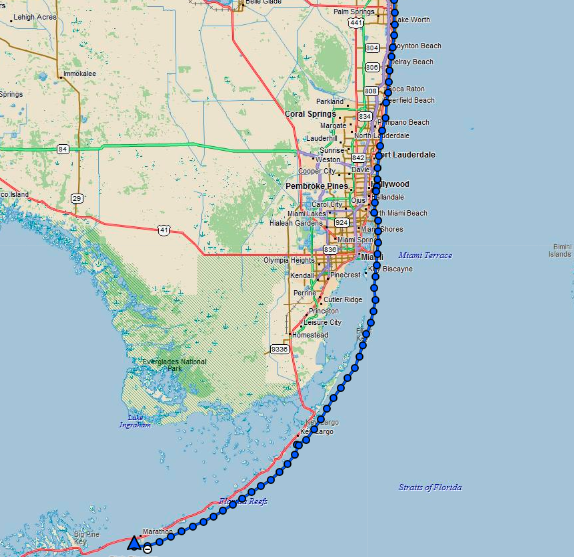
With Yacht Tech mostly shut down we had definitely reached a point of diminishing returns on the east coast of Florida, so on Tuesday, 14-April we departed Loggerhead Marina in Palm Beach Gardens and pointed Ghost Rider south.  Joe and Carole (from N40 Barefoot Girl) helped us with dock lines, which was much appreciated as our assigned boat slip wasn’t an easy one for Chelle to dismount and remount the boat, especially with a very stiff breeze from the southeast pushing us off the tall fixed dock.  Our planned itinerary included an overnight run south to the Rodriguez Key anchorage near Key Largo, then a shorter day trip to the Marathon anchorage, and finally another overnighter from there to home port in Fort Myers.  The planning logic was simple: there weren’t any marinas taking transients, so anchorages were our only option; and we wanted to get past the mainland and down to the Keys quickly enough to avoid a worsening weather forecast for areas north of there.

We departed just after 1500….timed such that we would reach our first anchorage shortly after sunrise the next day.  It was mostly sunny, humid and hot with the temp hovering at 90F, but the stiff breeze coming off the slightly cooler waters helped keep it comfortable on the fly bridge.  By the time we reached Lake Worth winds were at a steady 20 knots but we had timed the two ICW bridge openings perfectly and made good time.  And somewhat surprisingly, when we punched through the inlet and into open ocean, the ride wasn’t too bad – two to three foot square waves with plenty of wind chop on top, but Ghost Rider seemed quite happy to be moving again.  However that hefty wind (with higher gusts) regularly kicked salt spray clear over the fly bridge and up to the satellite antenna dome.
Pilot House View at Dusk Near the East Florida Shoreline
We had planned our initial legs down towards Miami to be about three miles offshore, the thought being we would avoid most of the near-shore fishing grounds, along with the busy inlets and anchorage areas at Fort Lauderdale and Miami.  Unfortunately, while NOAA was reporting the western edge of the Gulf Stream ten miles out, that did not appear to be the case.  After the turn south we found ourselves bucking a current of at least three knots.  Following an hour of crawling along, sometimes under five knots of SOG, we hung a hard right, detouring two and half miles to the west.  We began hugging the shoreline about a thousand meters off the beach and that gained us two more knots of forward speed for a while.  But come night fall we once again swerved back out to the three mile limit line, mainly for the traffic avoidance and safety factors near the busy ports….and back into that nasty current.

Chelle took the helm for the early night shift (1900 to 2130), then Rick took over for the graveyard shift through 0430, followed by Chelle again for the final four hours.  It was after 0200 on Wednesday, 15-April before we got around Lauderdale and Miami – and their offshore anchorage fields looked like parking lots. There was a lot of stranded tonnage there, collectively with enough lights blazing to totally destroy everyone’s night vision.  
Radar Screen Capture as We Skirted the
Lauderdale Offshore Anchorage Area

Overall the night running was mostly without stress, but approaching the Miami area Rick had to hail one cruise ship on the VHF to clarify safe passing logistics.  The big vessel was lingering about a mile to the east of the offshore anchorage, but unlike all the others its AIS readout did not reflect an “anchored” status and it showed a few knots of movement; we did not want to get run over….a distinct possibility at our reduced ground speed.  It turned out he was “drifting in place” and we agreed on a passing protocol satisfactory to both vessels.

Once south of Miami’s Government Cut shipping channel we again cut back west and closer to the mainland to join Hawk Channel and run inside the Keys’ reef tract.  Even there we were still bashing into a current, although one not nearly as strong as the Gulf Stream’s fire hose.

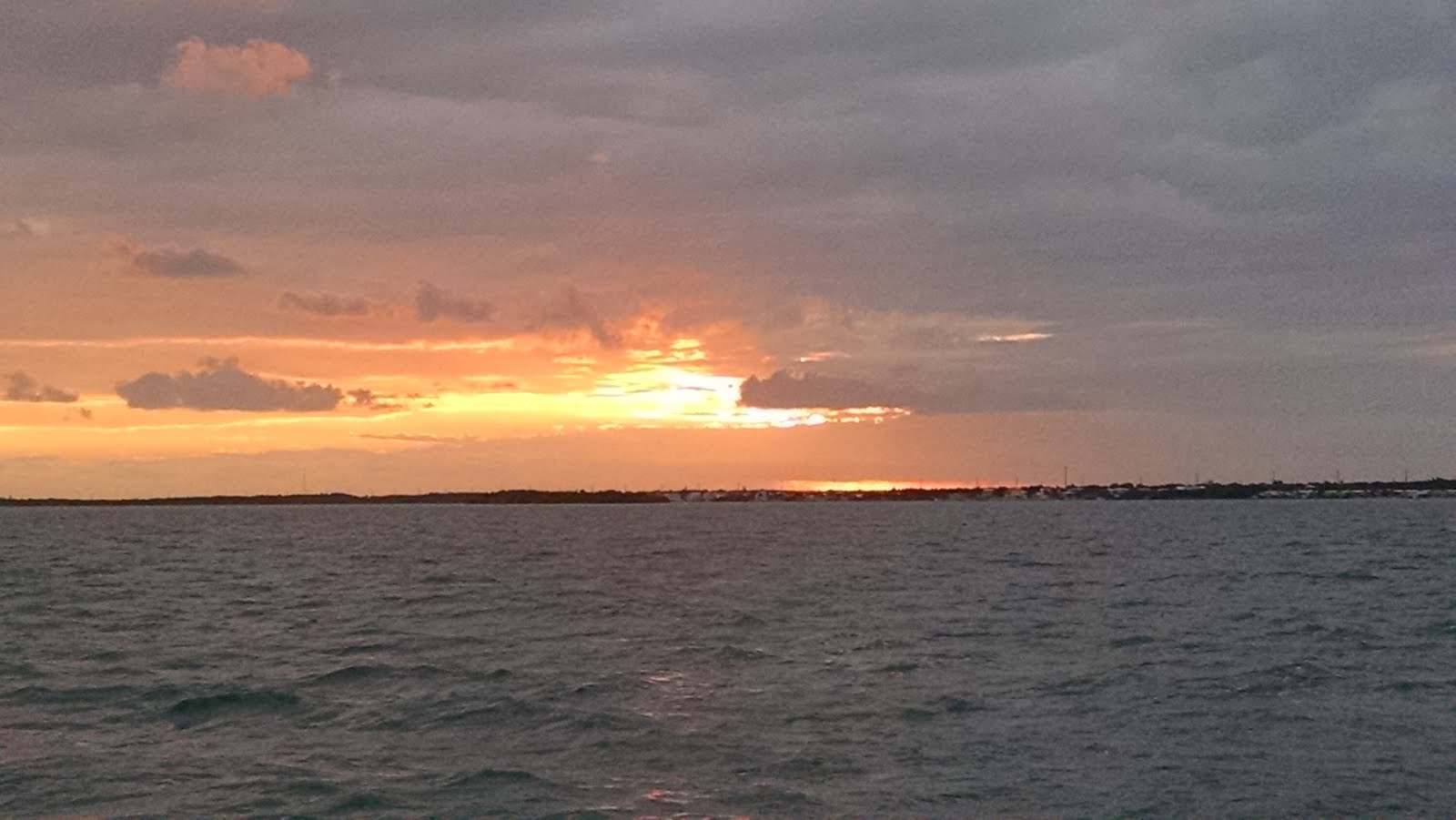
Throughout the sortie the winds never let up, and the atmosphere remained warm and muggy all night – temps never dipped below 82F.  So when we reached Rodriguez Key and tucked in behind it just before 0900 and dropped the hook, the generator and A/C came online fairly quickly.  That anchorage is one of our favorites in the Keys – good protection, fairly isolated, plenty of swing room, just enough depth with mild tidal changes, and always clean, clear water.  But we had never seen it so empty.  We tended to some minor chores, napped, read and caught up on the news (blech) via satellite TV, then slept like stones that night.
A Shot of the Rodriguez Key Anchorage Near Sunset.....It Was Pretty Empty
We were not in a big hurry the following morning, Thursday, 16-April, since we only had a short six hour sortie down to Marathon in the mid-Keys.  It was still warm and muggy outside even at 0830 – temp and humidity both in the mid-80’s – but we had kept the genset and A/C running all night, so had slept well.  After our coffee, email and news checks we cranked up Ghost Rider’s systems, hoisted the anchor and were back underway by 0930. 
Our Track from Rodriguez Key to the Marathon Area

Hawk Channel waters were docile, generally about a foot, and since the wind had diminished considerably overnight to around 10 knots, featured just a light wind chop on top.  We had to dodge occasional strings of crab pots, but otherwise traffic was light apart from the occasional pod of dolphins that would glide in the boat’s bow wave.

Water quality was as good as we’d ever seen it inside the reef.  No debris, and bottom features readily visible in varying shades of blue, green and turquoise.  We had read reports the same was true all along the coasts of Florida following beach and facility closures that had reduced human activity to nearly nothing.  Perhaps a silver lining in the Covid cloud.

The Anchorage Near Marathon & Seven Mile Bridge
But around 1400 the calm of our peaceful cruise down the spine of the Keys got interrupted by a bright red warning light on the stabilizer control panel – for “High Temp.”  Nuts.  Rick went to the engine room and used the infrared temperature gun to verify the oil tank temp was high (it was, well above redline), then centered and pinned the stabilizer fins, and shut the system down.  A quick check of the manual revealed it had absolutely nothing to say about troubleshooting this error, so Rick pinged James Knight via SMS text for his input. James called back within minutes, and had Rick check the relative temps for the cooling input and output lines at the stabilizer’s oil reservoir (both normal), and also verify that the output line’s thru-hull seacock was open (it was.)  Seas were still quite gentle and forecast to remain that way for the final leg home, so the absence of stabilization wasn’t a big deal.  Conferring with a few other N50 owners gave us a pretty good idea as to cause (clogging debris in the cooling circuit, likely from zinc anode shedding); that will require considerable disassembly and flushing, so we decided to leave the system disabled, and wait to address once back in port.

We turned the corner at Boot Key and pulled into a mostly empty anchorage near Marathon around 1530, and had the hook firmly planted shortly thereafter.  Initially we left the generator off and the boat open for a few hours to let the engine room cool down a bit, then ran genset and A/C for a spell and recharged the batts.  By late evening the predicted cold front shifted the winds to a northerly flow bring slightly drier air, making it comfy enough to shut down and sleep with natural ventilation.
Chelle Cooking up a Spicy Taco Dish at the Marathon Anchorage
By 0800 on the morning of Friday, 17-April the winds had clocked around to the southeast once again and the breeze helped as it was already quite humid with a bright tropical sun gradually amping up the heat.  We started the generator around 1030 and let it charge the house batteries and enjoyed some cooling A/C.  Our goal was to be underway by 1530 – enough daylight remaining to pass through some of the more dense crab pot fields visually, but not so soon as to arrive at the Caloosahatchee River in Fort Myers before daylight the following morning.  And that’s what we did, weighing anchor at 1515.
Our Overnight Track from Marathon to Fort Myers

Once Chelle had steered Ghost Rider under the Seven Mile Bridge and into Florida Bay we found smooth water, mainly just a light wind chop, and we were grateful for that with the stabilizer system shut down.  We weaved our way around Red Bay Bank and then aimed the pointy end north, settling down for the long run up to Fort Myers.  As expected we were dodging the crab pots in the southern part of Florida Bay, and we managed to pick out most visually and on radar, although the wind-chopped surface made the latter erratic at times.

We manned the helm with the same shift schedule as the previous overnight run, with Chelle driving at the sunset and sunrise portions, and Rick in between. (His stay-alert technique: two mugs of coffee and a whole box of Girl Scout cookies.  Thank you Grace and Alice.)  It was a black, moonless night, the proverbial “boating in an ink bottle” run; looking straight ahead you could see absolutely nothing….not even the Nordhavn pennant fluttering a short distance away on the bow.

Chelle Steers Ghost Rider Towards the Seven Mile Bridge
Looking up, however, it was a different story.  With zero light pollution that far out in open water, the night sky was a star-studded palette of brilliant pinpoint lights.  To our west Venus was initially bright enough to leave a narrow wake of reflective light on the bay, and nearby Sirius was almost as bright.  To the east Ursa Major stood out, pointing dutifully to Polaris. Rick’s “Star Map” app could be distracting, and it took some discipline not to continually scan the sky and stare at that thing.  Way off to the northeast distant flashes of lightning would occasionally strobe out far enough for us to see, but our XM weather display told us the cluster of storms that spawned them were at least 75 miles away and moving further east.

Duel Radar....Totally Void of Any Traffic
In the blackness Ghost Rider’s Furuno DRS X-Class radar served as our eyes.  As is our habit we ran one radar display at close-in range and the other looking out a few miles further, with a two mile Guard Zone set up.  This night we also ran with the autopilot in “Track” mode, also known as “Nav” or “Auto-follow” mode on some pilots.  In open water on long, nearly straight stretches it’s a no-brainer to let the computers drive the vessel on its intended course.

We did not see another boat on the water from Marathon all the way up to Naples, either visually or on radar.  Throughout the night our conditions stayed comfortable, with following seas at about a foot, temps in the low 80’s, and humidity close to that.  The breeze turned from southeast and around to the northeast just before midnight, which also helped with better airflow in the pilot house. 

XM Weather Display Showing the Cluster of TRWs
Between Lake O and the East Coast of Florida
On Saturday, 18-April, we arrived at the Sanibel Causeway around 0730, and at that point we finally witnessed a normal level of boating activity on up to Fort Myers...plenty of small leisure craft getting early starts toward the fishing grounds.  We coasted upriver on an incoming tide and pulled into Legacy Harbour Marina at 0915, docking without any drama in mostly calm conditions. Then we spent two hours hosing off several layers of salt from Ghost Rider, unloaded gear and food, drove to our condo, and called the journey complete.
Sunrise Over Fort Myers Beach as We Approached the Sanibel Causeway
Overall Ghost Rider had performed very well.  Apart from the stabilizer oil temp / cooling issue, the only other thing to break the entire way was the starboard side (green) navigation light; we carry spare bulbs so that was an easy fix (although Rick did cut himself when the old bulb shattered in his hand; nothing new there.)  And our dipstick leak repair was so far holding up very well.  While it was disappointing to have to skip the planned Bahamas cruising, the maintenance depot stop at Yacht Tech was satisfying, as was the safe journey back home.
The Repair on the Dipstick Housing Oil Leak Seemed to be Holding Up
Our Complete Return Track -- From Palm Beach to Fort Myers -- as Seen on Google Earth

Monday, January 14, 2019

Dec 2018 / Jan 2019: Holiday Time in Fort Myers

Winter in Our Fort Myers Condo is....Pleasant
Happy New Year! Since arriving back in Fort Myers back in late November we’ve grown accustomed to being dirt-dwellers once again, thoroughly enjoying time in our waterfront condo and visits from daughter Suzi, Chelle’s mom, and Rick’s sister and brother-in-law.  Southwest Florida is simply a fabulous place to enjoy the winter holidays and long overdue family visits.

It also occurred to us that with all the travels and blogging during the past year we had forgotten to mention a second interview we had conducted with James Ellingford of N62 Pendana fame, way back in June 2018.  For those of you who have not had a chance to browse through that exchange, you can find it by clicking HERE.

December Update
The Healthpark Hospital Lobby Looks More Like a Hotel but We
Would Have Preferred to be Elsewhere in December
We had hoped to use the month of December to resolve the few problems that had arisen during our November return to Fort Myers, but that didn’t work out. The week after returning to our home port at Legacy Harbour Rick took ill….severe abdominal cramps turned out to be a nasty intestinal infection with a complete blockage, resulting in a 24-day hospital stay and two surgeries to remove & otherwise untangle a real plumbing puzzle in the gut. The surgeon likened the procedure to “removing blocks of concrete” and then reassembling what was left.  Rick compared the surgical aftermath to having the entire 1st Infantry Division march over his abdomen in spiked boots. 

Recovery has been predictably slow but still has allowed us to spend some abbreviated time on the boat whittling down a long list of overdue but mostly minor Wheelhouse maintenance items that had accumulated over the month.  Towards the end of December we even managed to enjoy an inshore fishing expedition with one of our favorite local charters (LINK), although Rick was more a spectator than an angler at that point.  Nonetheless we boated seven nice Sheepshead (Wayne took honors for the biggest) which made for some delicious fresh fish dinners.
Bro-in-Law Wayne with a Very Nice
Sheepshead Catch...the Biggest of the Day
Chelle Boated This Nice Redfish....Which We Tossed Back to Fight Another Day
January Update

As the calendar rolled over to 2019 we began to progress with some of the needed repairs for Ghost Rider.  Our preferred technicians for the Naiad stabilizers (Stabilized Marine, link HERE) made the trip from Fort Lauderdale, diagnosing the actuator oil leaks as faulty feedback valves (again).  And after tearing apart the starboard side unit we discovered the source of the clunking noise:  its torque pin (which connects the hydraulic cylinder to the actuator yoke) had come loose and dropped down in its sleeve where it was striking one of the mounting bolts as it neared the center position.  It was a relatively simple fix to restore the pin and re-secure its set screw (with generous amounts of Loctite this time.)  During the ensuing system test we also noticed the fin position indicators in the pilot house were grossly inaccurate, which led to adjusting one potentiometer and replacing another.  But now the stabilizer system is finally back to ops normal.
The Red Arrow Points Out the Torque Pin That Had Worked Loose and
Caused the Starboard Side Clunking Noise.  We Were Lucky It Did
Not Cause Further Damage.

As for the wing engine’s messed up throttle mechanism, we had ordered and received a whole new Morse throttle assembly back in December, but we were slow to make any progress on remediating that.  There is a certain amount of “boat yoga” required to disassemble / reassemble the new control head and cable guides, so that got addressed in stages as Rick healed up.  He probably set a record for the most time needed to complete such an installation – several hours spread across several days – but in the end we got it done.  After verifying proper operation of of the gear (transmission) lever – forward, neutral, reverse – and RPM range for the throttle lever – from 700 RPM at idle to 2500 RPM at WOT – we declared victorious completion on 23-January.  And we put the vice grips back in the toolbox where they belong. 
The Shiny New Wing Engine Throttle Control Head

Along the way there have been plenty of other things to work on: Chelle has been systematically progressing on a thorough cleaning of Ghost Rider’s interior; we’ve coordinated the requisite monthly bottom cleaning services during our extended layover at Legacy Harbour with Adams Diving (LINK); and we also scheduled the boat’s annual “spa treatment” (shampoo, compounding and wax) with our preferred boat detailers, Frank & Pedro of Ultimate Marine (LINK); that got underway the week of 21-January.  Additionally, given that we and Ghost Rider will likely end up spending the bulk of the 2019 tropical storm season in Florida waters, we also joined the “hurricane club” at the River Forest Yachting Center in nearby Labelle.  If you are curious what that provides, information is available at this RFYC web LINK, but it guarantees us a haul-out and secure tie-down 35 miles upriver in the event of a big blow.

And a New Project

Lastly (for now), Rick decided to embark on another new, albeit minor, project to find an optimum way to use standard Bluetooth technology for piping music through the boat’s stereo systems.  Our two separate stereo systems – Sony in the salon, and Fusion serving the pilot house & fly bridge – both supported MP3 playback via USB memory sticks, but with over 8,000 tracks in our collection (and growing), the user interface for that input source was klutzy at best and not always reliable.  
The Red Arrow Points Out the New Fusion Bluetooth Module. Later
We Permanently Mounted It Further Inside the PH Equipment Panel

We wanted a PC-based or tablet-based media player interface with full screen navigation, and one that supported the standard album/artist protocols and custom playlists, but also folder-based organization as well as Internet streaming services…plus smart phone remote control.  The Fusion unit required a separate Bluetooth module installation, but that was a simple $45 Amazon order.  While installation required splicing new power and ground connections with new butt connectors behind one of the pilot house dash panels, that went smoothly enough.

For now we are using the freeware "MusicBee" media player on our Windows 7 laptop PC, and are pleased with the connectivity and sound through the Fusion and Sony stereo systems, both from our MP3 library and also using the Spotify streaming service. It can also be remotely controlled from our Android smart phone app. 
The MusicBee Player Has a Richer User Interface than the Stock Windows Media Player, but More Importantly Offers Better Organization and Control Options.  And It's WAY Better Than Tiny USB Scrolling Displays on the Small Stereo Units.
We've got more testing to do which we'll tend to once we move back onto the boat in mid-February and have a chance to "live with it" on an extended basis.
The MusicBee Android App Connects to the Full Screen Media Player on the PC.  It Uses a Reliable WiFi Connection
and Provides a Convenient & Functional Remote Control Anywhere on the Boat.

More to come later in February.  Happy 2019!

Wednesday, November 21, 2018

Nov 2018: From Palm Beach to Fort Myers

Our Track from OPC in Palm Beach to Marathon
After our week-long dirt-dwelling break visiting family in the Midwest we returned to Florida…..Rick to the boat in Palm Beach while Chelle stayed at the condo in Fort Myers for a couple more days.  During that spell Rick got caught up on a long list of overdue Wheelhouse recurring maintenance items while Chelle continued condo preps and coordinated some needed repairs at that location.

Our “boat business” maintenance list had been completed as planned with one exception (see footnotes at the bottom), so we turned our attention to planning the final legs to get ourselves and the boat back to our home port (Legacy Harbour) in Fort Myers; those sorties would also serve as our sea trial for all the repair work.  Sea conditions weren’t looking great, but they were good enough to make the trip “around the horn” – down and around to Marathon in the Keys, then turning back north and up the west coast of Florida.

So, on Saturday, 17-November, we departed Old Port Cove Marina in North Palm Beach at 0900 and started chugging south again.  Offshore conditions were forecast to be rather rough so we decided that first leg would once again be down the ICW on the “inside.”  That turned out to be a rather poor choice.
Departing Lake Worth Inlet and Heading South from There on the ICW

Temperature and humidity levels were quite pleasant, standard south Florida weather for this time of year.  But we had to constantly remind ourselves that we were getting a smooth ride; the tradeoff of dodging nutcase weekenders (who also did not want to be on the outside) and negotiating bridges – there were 24 of the damned things between OPC and Suntex Marina just south of Fort Lauderdale – plus the Manatee go-slow zones (effective 15-November through 15-March) – all combined for an absolutely miserable day.   We had to take evasive action on two occasions to avoid collisions with clueless boaters.  And as we were about to cross the Port Everglades turning basin the USCG shut down the waterway for 15 minutes while a humongous cruise ship lumbered away from the pier and they maintained a “security perimeter” around it.
Total Cluster F*ck at the Fort Lauderdale Turning Basin

All that nonsense led to an overly long sortie with the last hour in darkness.  Night runs on the ICW are essentially an emergency procedure, so we rigged for red, dimmed all the displays, and just tried to patient. 

To top it all off, about an hour before arriving at the Suntex Marina (approaching yet another low bridge) the throttle lever for our wing engine – upon which we depend for hydraulic power for the bow and stern thrusters – literally fell apart….springs, a ball bearing and a few washers departed from their assigned places and the throttle went limp.  Rick turned the helm over to Chelle and scrambled down to the engine room, found a way to prop open the throttle lever on the engine to maintain sufficient RPM for the hydraulics when needed, and we pressed on with that MacGyver-like solution for the remaining bridges and docking maneuvers.
The Wing Engine Throttle Goes Tango Uniform
But Down in the Engine Room Rick Found a Way to Set the Required Wing Engine RPM Using a Vise Grip for a Throttle Stop
We found the marina entrance without any issues and weaved pour back to our assigned slip – which turned out to be located in a fairway no wider than the length of Ghost Rider…it was a damned tight pivot to back into that slip, but we got it done without too much drama, albeit slowly and deliberately.  Rick logged another night landing in his logbook and eventually we called it a night.

We were underway once again by 0830 on Sunday, 18-November.  We had to negotiate another five miles of ICW before we could cut to the outside, but at that hour there was no other traffic and we were able to squeeze under all three bridges along the way by lowering the big sticks.   We hung a hard turn to port at the Haulover Inlet and got back out into the Atlantic Ocean.  At last.

The egress through the inlet was a messy affair, with a ripping outgoing current bashing into the wind driven waves, and initially we saw four footers on the nose.  But after getting far enough out into the big water to safely make our turn to the south conditions improved considerably….initially a two foot swell at one second intervals with a healthy wind chop on top, all on the beam.  After we got south of Biscayne Bay that smoothed out even further.  We and Ghost Rider were happy to be back in our element.
Sunset at the Rodriguez Key Anchorage

It was another pleasant day atmospherically as well – low to mid 80’s, 55% humidity, some sun and intermittent clouds, although the breeze stayed steady at 10 to 15 knots from the east.  We enjoyed lots of fly bridge time on the 65 mile cruise south to Rodriguez Key, where we tucked in behind the island and dropped the anchor shortly before 1700.  We got a good set on the hook on the first try, and then enjoyed a relaxing evening in calm waters.

We weren’t in a hurry the morning of Monday, 19-November, so we putzed around for a couple of hours before finally retrieving the anchor and getting underway at 1000.  We had less than 50 nautical miles to traverse enroute to Marathon and we had an excellent forecast for the day.  But you could tell we were now back in south Florida – air temps reached near 90F and humidity hung thick at 70%, with a 10 knot breeze out of the east.

Sea conditions were identical to the day before – quite nice with two foot swells and a light wind chop, again on the port beam.  Ghost Rider purred along happily at an average of 8 knots as we kept her fairly close to the Keys shoreline, anywhere from two to five miles offshore, staying inside the reef to avoid the northbound Gulf Stream current.  We did have to stay vigilant for crab pots (it was Stone Crab season) as some parts of Hawk Channel resembled a mine field.  But it still beat the hell out of the bridges and Manatee zones on the ICW.
Sunset at Our Marathon Anchorage

By 1600 we approached our targeted anchor site and dropped the hook, just south of the Seven Mile Bridge and near the entrance to Boot Key Harbor, in about 10 feet of  mostly clear water.   Our Manson Supreme anchor set on the first try (as usual) in the soft sandy bottom and by 1700 we had the genset cranked up, A/C running and the tender launched.  Chelle motored over to the dinghy dock at the Marathon Marina to get in some walking exercises while Rick tended to post-flight checklists and some preps for the coming overnight sortie to Fort Myers. 

Given the very warm temps and high humidity we decided to run the genset overnight with the A/C going full bore.  We then enjoyed a quiet and calm night at anchor.

At around 0630 on Tuesday, 20-November Rick shut down the A/C and genset since temps had moderated and fan-driven air was sufficiently comfortable, and we were having a tough time keeping the generator properly loaded.  After a couple more hours of sleep we finally slipped out of bed for good, had our coffee, checked emails and weather (still looking very good), and started in on chores and departure preps.

Rick removed the cover from the search light in anticipation of the overnight run through crab pot country, and also practiced gymnastics – climbing up and down the radar arch to retrieve the wind vane for inspection and repair….its wind direction blade had locked up, but we were able to disassemble, lubricate and get it working again.

Marathon Anchorage Looking North Towards Seven Mile Bridge
and the Entrance to Boot Key Harbor
Then it was time to take a swim and dive under the boat to examine the starboard stabilizer fin; an intermittent knocking noise at irregular intervals had developed two days ago in that vicinity and we wanted to see if something had wrapped around the fin’s pivot shaft.  Rick donned wetsuit and goggles and took the plunge while Chelle manned the ring buoy safety line.  Unfortunately we found nothing fouled, but Rick was able to replicate the knocking sound by manually moving the fin to its centered position – and it would not travel further than that.  That likely indicated a mechanical issue somewhere in the actuator and/or fin shaft, but we would wait for feedback from our friends at Yacht Tech.  Rick took a few minutes to scrub the scum at the waterline towards the rear of the hull and then climbed back aboard to dry out and rest.

Chelle took the dinghy back into town after that for a couple of hours for a walking and shopping expedition.  Shortly thereafter word came back from Yacht Tech recommending we pin and disarm the stabilizers to guard against potential (further?) damage.  So Rick spent time getting that done….we would have to make the run to Fort Myers without roll stabilization, but the sea forecast looked good enough to make that tolerable.  Around 1400, after Chelle had returned from her dinghy expedition, we retrieved the tender and secured it on the boat deck and then made a few final departure checks.  The anchor came up cleanly from the soft, sandy bottom and we were underway by 1500. 

Another Sunset -- This One as We Motored North Through Florida Bay.
You Can Also See Some of the Many Crab Pots We Were Regularly Dodging.
Air temperature was in the low 80’s and while humidity was still a bit soggy, the clear sky, bright sun and pleasant sea breeze made it very pleasant.  We crossed under the Seven Mile Bridge, zig-zagged through the shallow Banks area and pointed the bow north.  Florida Bay was absolutely flat with the only ripples coming from passing boat wakes, a good start to a long overnight sortie without roll mitigation.

The glass-like water surface made the task of spotting and dodging crab trap buoys easy at first – a very good thing as the damned things were everywhere.  A year ago we had previously tangled (literally) with a crab pot line on the main shaft and did not want to repeat that fiasco – on a slow-moving trawler swinging a 34 inch prop it’s amazingly easy to foul the running gear.

With sunset quickly approaching Rick spent about 30 minutes experimenting with the Furuno radar’s gain adjustments, eventually finding a combination of manual gain, rain clutter and sea clutter settings that resulted in a very useful display; the discrimination of the small and generally non-reflective crab pot buoys was surprisingly good.
Our Dual Radar Display.  The One on the Left is Set to Close Range and
the Radar Returns Displayed There Are All Crab Pots.

About 30 minutes after sunset that functionality came in pretty handy.  While we had nearly a 90% illuminated moon, the crab pots were impossible to acquire visually soon enough to take evasive action.  The main challenge was that a line of crab pots generally didn’t generate radar returns until they were within the .125 NM range circle (1/8th of a mile) so you had to be vigilant and pick your penetration path fairly quickly once they appeared.  So we set up our typical night running configurations with dual side-by-side charts on our 15” Furuno screen, and dual radars on our 17” Nobeltec screen, one for close range and one for longer range painting.

It worked quite well, and was a lot like playing the old Asteroids video arcade game,
although when seas started to get lumpy the job of distinguishing between crab pots and wave tops approached sensory overload.  Nonetheless, we continue to be impressed with Furuno’s DRS6AX digital radar array.

Chelle handled the initial watch from the anchorage until sunset, Rick took the first and third night shifts, with Chelle getting stuck with the middle “graveyard” shift from 0100 to 0500.  In the end it didn’t matter much as neither of us slept worth a damn.  We saw and heard almost no other traffic once we were a few miles north of the Keys island chain.  One exception was S/V Grace, who hailed us on the VHF while traveling in the opposite direction, asking if we had any weather data for the western Keys….they had departed Englewood the previous day and were headed to the Marquesas and Tortugas. Rick switched over to our XM Weather display screen, called up the zone forecast for that area and read it back to them.  They were pleased to hear the forecast for surprisingly benign conditions.
Another Shot of the Dual Radar Display....No Crab Pots on the Short Range
Screen But the Longer Range (6 NM) Shows the Rain Showers

Between 2200 and midnight we encountered some small storms and scattered rain showers in mid Florida Bay, easily discerned with the XM Weather and longer range radar displays.  We deviated about five miles to the east to avoid a small thunderstorm but otherwise it was a smooth and uneventful cruise….until we came around Cape Romano Shoals and near Marco Island early on Wednesday, 21-November.  That’s when we lost the land-blocking of the north wind which by then had picked up to near 20 knots and suddenly it went from smooth to waffle iron conditions – only three footers, but square and at nasty one second intervals.  Ghost Rider certainly didn’t care, but we pulled back the throttle a bit and slowed, mainly to allow better sleeping conditions.  Luckily it was all straight on the nose so the lack of roll stabilization was not a factor.
Sunrise Near Naples as We Chugged North to Fort Myers

After putting another 30 miles behind us the conditions calmed considerably as we regained some protection from the west curvature of the Sanibel, Cape Coral and Fort Myers land masses.  Sunrise brought clear skies and a temp of 68F which felt cooler in the 12 knot north breeze plus our 8 knots of forward movement, with one foot seas….an easy approach to and up the Caloosahatchee River.  We finally reached our home port, Legacy Harbour Marina, in downtown Fort Myers just after 0930 and docked up – slowly and carefully, we were tired – without incident.  According to our Garmin inReach tracker on this final leg we covered 134 nautical miles in just over 18 hours.

Ghost Rider was coated bow to stern and top to bottom with three days’ worth of salt, and while we were pretty much worn out we gave Ghost Rider a thorough wash down of her exterior, wiped down the windows, covered the fly bridge and dinghy, and double-checked the fenders and dock lines.  We packed some bags and headed home to our condo.  It had been 8 months, 1 week and 1 day since we had departed from the same dock.  4,000 nautical miles later we were happy to be back home.
Ghost Rider Back Home at Legacy Harbor in Fort Myers

** Footnotes on Boat Business

** Rick replaced the generator’s raw water pump….it had developed an intermittent water leak that only manifested after shutting the unit down, but it would have eventually failed.

** Alex Graham, our diesel tech, repaired two main engine oil leaks, one at the front bearing oil seal, the other at the base of the dispstick housing….Alex graciously did both gratis by extending his warranty period on his previous work.

** Randy Brenner replaced both the A/C compressor and air handler for pilot house…Randy is Yacht Tech’s preferred Cruisair tech, & he got this done with surprising ease…albeit expensively...not Randy's fault, it's the Cruisair parts that are pricy.

** As for flushing the A/C system with “Barnacle Buster”….Randy pressure tested the system and talked Rick out of this for now.

** The repair of a leaking line connector on the water maker turned out to be easy….it’s some kind of proprietary quick connect joint that we had “fixed” with a  wrap of rescue tape….turns out all we had to do is reseat the inner o-ring.

** Yacht Tech performed the annual hydraulics maintenance….replacing the cooling pump impeller & return filter, and lubing u-joints in the drive mechanisms & topping off the fluid.

** Yacht Tech also took care of the wing engine coolant flush & hose replacements, plus pencil zincs. (Rick will handle the same for the genset after we’re settled in Fort Myers.)

** As for the stabilizer actuators oil leaks….while we contemplated getting the Naiad techs to inspect and assess, we just decided to add some oil (that part is cheap) and see if there are any real performance issues…see next new item.

** New (Open) Item: The starboard stabilizer fin started making clunking / knocking noises on the leg to Marathon; we pinned and disabled the system for the last leg and now have to figure out what the hell needs to be done.

** Another New (Open) Item: The throttle lever for the wing engine fell apart; Rick wants to get the entire assembly replaced with a new unit if we can find one.

Our Final Track From Marathon North to Fort Myers.
That Little Jog to the East in the Middle of Florida Bay Was to Skirt a Small Thunderstorm.