Friday, March 23, 2018

March 2018: Final Preps & Departure


Before departing Legacy Harbour and Fort Myers we wanted to be confident that we had (a) an adequate supply of maintenance-related spares parts and (b) a full load of other provisions, including basic household supplies as well as food.  So while Rick focused on supplies of fuel & oil filters, impellers, pumps, belts and that sort of thing, Chelle zeroed in on her “hotel load” spreadsheet requirements.  Amazon and the local Publix loved her.
Periodically We Remove and Lubricate All Deck Plates.  This One for the
Manual Rudder Tiller Wouldn't Budge Because the Deck Plate Wrench
Wouldn't Fit in the Holes. Drilling Out with a Titanium Drill Bit Fixed That.

In the course of that order-and-wait process Rick also got a few minor maintenance items tended to, including replacing an erratic digital ammeter (related to alternator output) on the pilot house DC electrical panel, drilling out bigger holes in a recalcitrant deck plate, and replacing a GFCI outlet that went wonky back in the cockpit area.  Then, shortly after we had completed the sea trial for the dinghy we also took it for a spin up to the Fort Myers Yacht Basin to top it off (along with our spare fuel cans) with non-ethanol gas; that hopefully will sustain us for the upcoming weeks in the Bahamas.  Rick also did the same thing with our two propane gas tanks, being certain we had sufficient cooking fuel for the foreseeable future.

Final preparations included installing safety latches for the refrigerator and freezer doors, and then changing out the Racor primary fuel filters for the main and wing engines as well as the generator. 

Some March Fun Distractions

As usual we found sufficient distractions to give us some breaks from boat duties and trip preparations.  Legacy Harbor Marina throws an annual “Boater Appreciation Party” where they provide lots of free food and drinks, along with live entertainment on their large party deck.  It’s their way of thanking the long-term winter “residents” that make up the bulk of their annual revenues.  And yeah, it’s good marketing, too.  And, just a few days before we were planning to depart we finally got the chance to host Jim and Susan Hill aboard the boat, returning all the great hospitality they had shown us the last few months.  We had a nice happy hour on board and then enjoyed a very good pizza at Capone’s in downtown Fort Myer’s riverfront district.
Our Prized "Purple Heart Wood" Cutting Board, with Ghost Rider
Logo Now Mounted in the Salon

Lastly, we spent a little time mounting a unique and beautiful “Purple Heart” cutting board – a gift from daughter Suzanne – in the salon area.  Pictured to the left you’ll note the center strip of purplish wood that comes from the Purple Heart tree in the Brazilian rain forest.  You can read about the lumber HERE but it’s a plentiful tree and an amazingly durable wood.  And the Purple Heart motif holds special meaning for our family.  While it is now mounted quite sturdily to survive rough sea conditions, it can also be easily removed for practical use in the galley, too.

Tue 13-MAR…We’re Outta Here

On the morning of Tuesday 13-MAR we made a final check of the weather and found it good enough to go, and by 0930 we were underway and headed south towards Marco Island, our first planned stop.  While our winter months in Fort Myers were enjoyable and productive, it was good to be on the move once again.

The weather forecast called for relatively cool but clear conditions with winds around 15K from the northwest, and that’s pretty much what we got.  That also gave us a 3 foot following swell but at comfortable intervals and only a light wind chop on top, so it was a good ride with ground speed averaging just over 8 knots.
A View of The Marina at Factory Bay from Ghost Rider's Boat Deck

We had planned to stay at the Factory Bay marina for two nights but extended it to three due to an unexpected repair need (yes, another surprise.)  We had noticed a pretty good water leak (visually as well as per the bilge pump counter) in the forward bow thruster compartment, and it tasted pretty salty, so it became a priority to track down.  Eventually we traced it to the anchor locker, which is just forward and above the bow thruster area.  We had to dump a few hundred feet of anchor chain on the bottom of the marina to inspect and gain access to the bottom of that locker, and there we found a partially blocked drain hole and an encased hose run whose caulking had cracked and aged well beyond its point of effectiveness – giving water an easier path to inside the boat vs. the thru-hull drain.  Rick cleaned all that up and then applied liberal beads of Rescue Bond XL1 Pro (super caulk!)  That had to cure 18 to 24 hours before we could cover it again with all that chain, thus the extra night’s stay.  Once it had set Rick also covered the caulking seams with protective strips of 100MPH tape (see footnote below) and then we retrieved the chain the afternoon of 15-MAR.  We also found several deck bolts in that locker that were fairly loose and leaking water into that compartment from above, so we also tightened those, although eventually we would need to completely remove and re-bed those.
Inside the Anchor Locker After Removing
All the Chain; the Leaking Cracks Are Easy to See

While hanging out at Factory Bay we took the opportunity to make the short walk to one of our favorite eateries, Old Marco Pub, for dinner on our second night – the seafood is fresh and the steaks are tender, juicy and tasty there.  And as often happens in the cruising world we made some new friends – Mark and Sandy Holtsclaw pulled into the marina and docked right off our bow in their 42’ Kadey-Krogen, Karissa Leigh.  They hail from Michigan and are enjoying cruising in the relative warmth of south Florida this winter.  We toured each other’s boats and enjoyed back-to-back happy hour sessions in the process.

Fri 16-MAR…Down to the Everglades

We had yet another good forecast for our Friday departure and by 1000 we sortied away from the dock, made our way through Gordon Pass and then pointed Ghost Rider south, initially towards the mouth of the Shark River where we had planned to anchor.  But the conditions were so good – temps eventually got to 75F, seas were very tame, and we were seeing ground speeds on the GPS between 8 and 9 knots – that we decided to press further south to Cape Sable.  We had noticed an anchorage review in that area (via Active Captain) that was very positive for the anticipated conditions there – a light southeast breeze and flat water.

Our View of the Sunset From the Fly Bridge While Anchored at Cape Sable
By 1800 we had dropped the anchor in about 9 feet of water about 600 meters from the shoreline, right at the southwestern-most edge of the Cape, and set the anchor alarm.  There was not another boat or soul in sight throughout the night, and at this point we were “off the grid” – there is no cellular service there.  The sunset was spectacular as was the stargazing that followed…the near total lack of light pollution gave us unhindered views of numerous celestial features (thank you Google Sky Map).  We turned off the genset and went with fresh air ventilation overnight (with screens….there are bugs that will eat you here in Everglades National Park even in March), and were pleased to see the house battery bank only down to 88% capacity the next morning.

As for “boat business” (see further below) we still have a water leak in the forward thruster compartment, although at a slower rate and different location; that will get more investigation later, likely after we dock up in Fort Lauderdale later in the week.

Sat 17-MAR…From the Glades to Marathon

We fired up the generator the next morning to charge up the batteries (it took two hours to get them back to 97%, which is acceptable.)  We had a lazy morning on the hook as there was no rush to depart….it would be less than a 5 hour sortie to Marathon and we wanted to wait for a higher tide since at this point we only had about a half foot of water under the keel at low tide.  By 1100 we had retrieved the anchor and were motoring south at around 8 knots.  Weather was perfect, with temps in the 70’s, light breezes from the SE, and flat seas….an excellent St. Patty’s day in the subtropics.
Chelle Piloting Ghost Rider Across Florida Bay in Flat Seas

While enroute we tested our reverse osmosis water maker – that would be a no-go item for a Bahamas sortie if it wasn’t fully operational – and over a two hour span we confirmed the unit will produce about 28 gallons of fresh water with excellent quality; so we were quite pleased with that. (However: Rick learned a lesson about opening the correct water manifold valves, e.g., do that before you crank up the water maker unless you want copious amounts of RO product water on the engine room floor around the fresh water manifold.)  Apart from that exercise the day’s journey was pleasant and mostly about dodging the numerous crab pots that dot the seascape in these latitudes this time of year.

The Rebuilt Marathon Marina's Concrete Floating Docks
After passing under the Seven Mile Bridge (with a quick following current giving us 9 knots even at a reduced throttle) Rick steered Ghost Rider into Marathon’s Boot Key Harbor and the Marathon Marina just after 1500.  Their new floating docks are quite nice, by the way, and it looks as if they’ve recovered from Hurricane Irma damage quite nicely.  Coming in at low tide was a tad unnerving as the harbor’s entrance channel has some serious shoaling on the south side, but we hugged the green markers (north side) and kept the keel off the bottom.

Sun 18-MAR…From Marathon to Rodriguez Key

Rick Hanging Out on the Fly Bridge with Cigar
and Scotch at Rodriguez Key Anchorage
We waited for high tide before departing the next morning (around 1030) and that made our exit through the harbor’s channel a lot less stressful than the entrance the previous day.  We also should compliment Marathon Marina on the width of its main fairway – maneuvering in and out of our slip was straightforward.

We steered Ghost Rider south to get around the Boot Key land mass and once clear of that then turned her east to head up Hawk Channel in the general direction of Key Largo, where we planned to anchor on the inside of Rodriguez Key. The ride up the channel was delightful….smooth water, mild temps nearing 80F, and the crab pots weren’t as numerous as the previous two days, with only occasional evasive action required. 

When we arrived at Rodriguez Key the anchorage on the northwest side of the island looked like a parking lot….we counted 12 boats, all sail, already anchored when we arrived just after 1700.  But there was still plenty of room for us to find a good spot with more than adequate swing room, and the depth – even arriving at low tide – was good.  We dropped the hook, set it hard, and enjoyed another wonderful evening at anchor.

Mon 19-MAR…From Rodriguez Key to Fort Lauderdale

View from the Fly Bridge:  Rodriguez Key Anchorage at Sunset
While it was a peaceful night the next morning we were a bit disturbed by our house battery readings.  While SOC was solid at 87% after inverting off the batts overnight, the voltage seemed mighty low at 12.1 volts.  We didn’t have time to troubleshoot at that point, so we just fired up the generator and let it charge the house bank for the next 3 hours, and let the alternators take over from there.

We wanted to be underway by 0830, but when we said we had set the anchor hard, we weren’t kidding.  Judging by the amount of sand, mud and shells that was seemingly glued to the topside of our anchor once we had spooled it to the boat, we were thinking we should have had a dredging permit.  But Rick eventually got the anchor cleaned and stowed, and Chelle drove us out of the anchorage, pointing us north on our planned route to Fort Lauderdale. Initially seas were mostly calm, and once again we were blessed with excellent weather, allowing us to spend most of the day at the fly bridge helm.  We also were now far enough north (relatively speaking) that the crab pot dodging was drastically reduced, making use of the “navigation mode” of the autopilot much more practical.
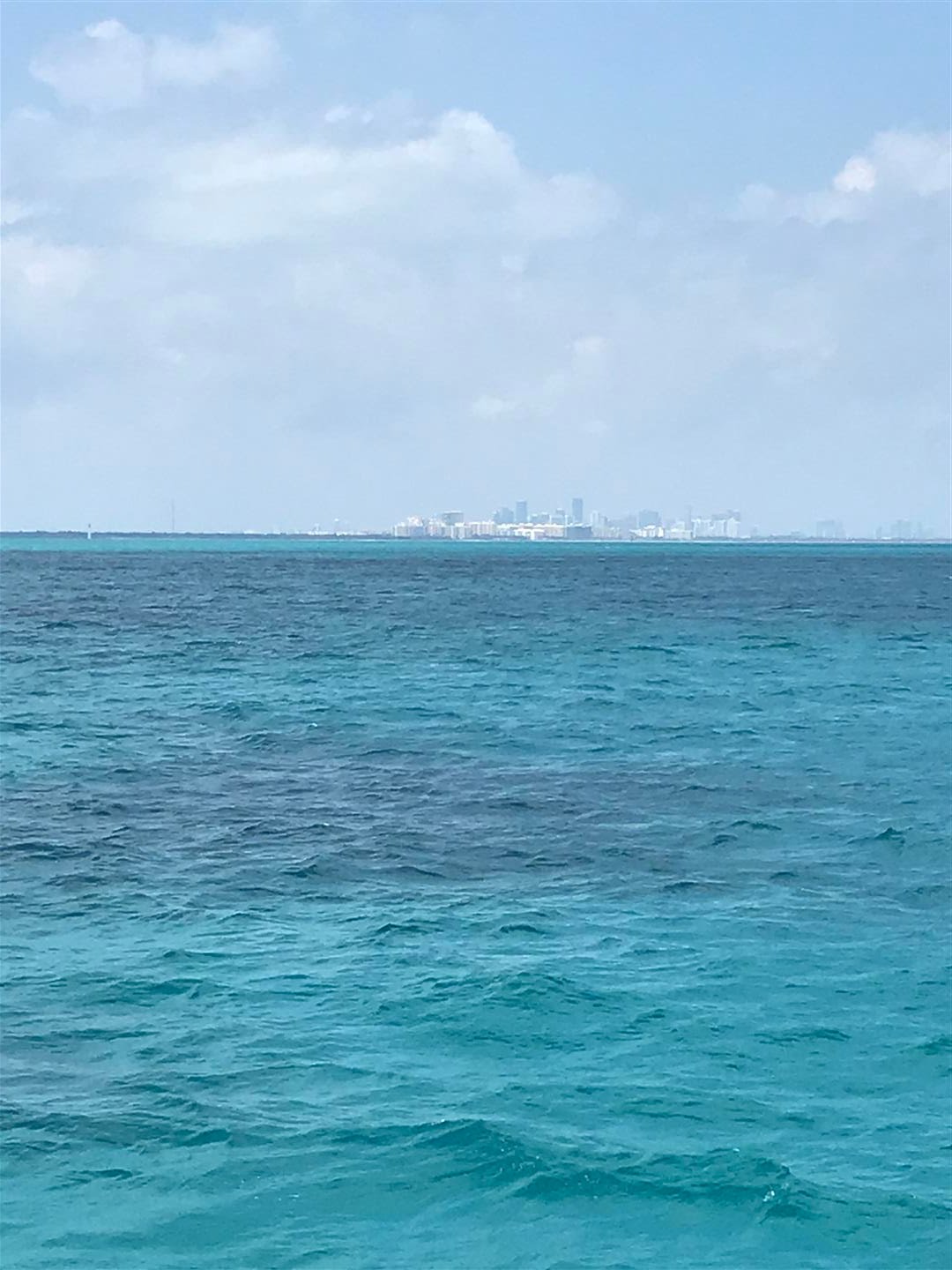
Passing Miami in Crystal Clear Waters Enroute
to Fort Lauderdale....Before it Got Rough

But later in the afternoon the winds and seas picked up; while waves were only 2 to 3 footers quartering on the starboard stern, they were at 2 second intervals and pushing the boat around.  The ride was smooth enough, but the autopilot struggled with holding the programmed headings, yawing +/- 10 degrees.  That wasn’t a big deal until it was time for our WOT (wide open throttle) run as we got close to Fort Lauderdale at the end of the sortie.

After Rick firewalled the throttle he turned the helm over to Chelle and was headed down to the engine room to make the usual WOT checks.  That’s when a bigger wave hit Ghost Rider from the rear tossing the boat’s bow to the starboard quite a bit, and the autopilot went bonkers, throwing the rudder into a hard-over starboard turn.  It’s actually pretty amazing how fast a Nordhavn 50 can snap into a 180 degree end swap ends…in seconds we were suddenly headed south instead of north.  We immediately throttled back and simultaneously disengaged the autopilot to regain control, but it was disconcerting.  Rick made visual checks of the rudder post, steering ram and autopilot pump / plumbing, but found all in order.  He also then made another short WOT run with manual steering and found nothing amiss.  So from what we can tell at this point it was an autopilot computer screw-up, and we’ll change our WOT procedures in sloppy following seas going forward.  Full displacement trawlers aren’t intended to be amusement park rides.

There Are Some BIG Boats at the Pier 66 Marina....Ghost Rider Was
Among the Smallest Ones There
Of course we had the same sloppy seas as we entered the Fort Lauderdale (Port Everglades) entrance channel; Rick manually steered Ghost Rider from the fly bridge, and it would have been mostly uneventful except for all the other boats doing stupid things heading in and out.  Two cruise ships, approximately the size of aircraft carriers, were headed outbound; a large sportfish towing its tender barreled past on our port side; two sailboats bobbed almost motionless in front of us; and then to top it off a small outboard-powered skiff dawdled off our bow blocking our path for any maneuvering….it was the first time that Rick made use of our very loud ship’s horn to warn a small craft we were about to run over them.

Nonetheless we were able to weave our way through all of that chaos and into the Pier 66 Marina for an uneventful docking.  Ghost Rider got a well-deserved wash down, as did we, and we called it a day.

Mon 20-MAR & 21-MAR…A Pause at Fort Lauderdale

We had a list of “boat business” things that required attention, but more impactfully the weather forecast for the next few days looked lousy, with a cold front bringing a squall line and stiff winds.  So we decided to just hang out at Pier 66 Marina for a couple of days, and that gave us some time to tend to some more “boat business” items.

More Boat Business

First we did another water leak check on and under the foredeck with Chelle wielding a pressurized hose above, and Rick down below checking for leaks and drips.  The only ones we could find were a couple of the aforementioned deck bolts, so we removed those, cleaned them and re-bedded them snugly with the Rescue Bond XL1 Pro caulk.  Another leak check the next day confirmed we had no more leaks from that deck area at least.
Three of the Six House Batteries (Port Side) Along with Our Testing
Tools, the IR Temperature Gun and the Multimeter

Next up was a drawdown test of the house batteries to assess the apparent low voltage condition we had witnessed after a night of inverting from batteries while at anchor.  Essentially we simulated the same type of anchorage conditions while at the dock – removing shore power and powering up minimal equipment.  Thankfully the cold front that passed overnight and strong northwest winds that followed kept the boat comfy without the A/C being active.  Every hour over a period of 6 hours Rick recorded the key data points: DC draws, AC draws, SOC and voltage at the LinkPro, then manual multimeter readings of battery voltages directly at each of the six house batts, along with battery temperature.

The Other Three House Batts (Starboard Side); the Lifeline 8DAGMs
Weigh About 160 Lbs and Cost Around $700....Each
The end result after those 6 hours running on batts / inverter was what one would hope for….SOC was at 92.5% and house battery voltage measured by the multimeter directly at the batts was at 12.78V (with 12.8V being the optimum, so not bad at all.)  The LinkPro reported 12.71V, so that is reading a tad low, but only by a .55% deviation.  Whether another 2-3 hours of testing would have resulted in significantly lower readings is an unknown, but doubtful given the consistent readings we saw.  (But we’ll still keep a wary eye on it next time we anchor out.)

The other two main issues, although still relatively minor, included a reappearance of the oil drip from the main engine’s oil pan gasket (forward end only), and similarly a return of the grease seepage from the bottom of the stabilizer hydraulic pump, and a new (currently just nuisance level) hydraulic leak on the starboard stabilizer actuator assembly.  Rick was tired of dealing with these, so we phoned our friends at Yacht Tech in North Palm Beach and told them we were headed their way to turn those problems over to them.  Thus NPB is our new interim destination while we wait on our window to cross over to the Bahamas.

Wed 22-MAR…From Lauderdale to North Palm Beach

Typical Stretch Along the AICW.....Bridges and All Manner of Watercraft
Departure and arrival point forecasts were just about identical – sunny, low 70’s, with winds down to 10-15K inland, but with gale warnings and 5 foot seas just off the coast.  Thus, we figured it was a good day to cruise up the ICW to Palm Beach, even though that meant dealing with 21 bridges, 14 of which we would have to wait on openings.  That could make the short 45 mile journey a good deal longer than the six hours the nav computer calculated, so we departed FLL at around 0900 and hoped the crazy boaters stayed away from us.

They did not.

The inland waterway was mostly just plain whacky….big boats that did not know how to time a bridge opening, small boats that had no clue they were sharing a navigation channel and couldn’t judge bridge heights, and sailboats that thought they had the right-of-way even when they were under power. Most with port-of-call registrations well north of Florida.  It was a circus.

Rick manned the helm most of the day from the fly bridge….although not because of pleasant weather – it was freakin’ cold up there with 15-20K winds from the north, but when combined with our forward speeds much closer to 25K, and with temps in the 60’s. But the better visibility and subsequent ease of maneuverability trumped the environmentals.  Chelle camped out in the pilot house helm chair to control the wing engine when needed for providing hydraulics to power the thrusters – which was often required as we waited on bridge openings in brisk currents and winds – and to relay or confirm upcoming bridge information.
Ghost Rider Tucked into Her Berth at Old Port Cove Marina

We would have much preferred to be offshore, but knew we would have been just as disappointed with the ride conditions out there.  It was a trade-off.  At any rate, we made North Palm Beach and Old Port Cove Marina around 1715, an 8+ hour sortie for the day, normally quite acceptable, but lousy time for such a relatively short leg.  We got the boat and ourselves cleaned up, enjoyed hot shrimp gumbo for dinner and then crashed into our lounge chairs.

Next Up

We’ll be hanging out in the Palm Beach area for about 10 days….it will take a while to line up the needed Yacht Tech resources and a visit from Stabilized Marine (the folks who service Naiad stabilizers), plus we have one more trip to make back to Fort Myers (via rental car) for some administrative stuff.  More on all of that later.

Footnotes

** What is 100 MPH Tape?  The commercial version of it is generally called duct tape, but back in WWII the U.S. Army had Johnson & Johnson manufacture the original version to milspec.  It’s like duct tape, but is olive drab in color and its weave it much tighter, plus its adhesive is stronger, and is waterproof…not the stuff you find at Home Depot.  The slang “100 MPH” tape came about because American GI’s swore it could hold broken parts on a Jeep together even when going 100 miles per hour.  You can also place it on a fabric tear, heat it (like with a clothes iron) and the stuff will stick for years.

** What's a WOT (wide open throttle) run?  The main propulsion engines on long distance trawlers, especially with Nordhavns, are continuous duty diesels (most, like ours, are Lugger brand, marinized by Northern Lights), designed for service lives in excess of 25,000 hours.  But normal cruising is typically done at low RPMs and therefor, low loads....and these diesels don't particularly care for that.  Carbon soot can build up in the cylinders, plus it will shorten oil life.  So the standard practice is, once every day, to throttle up to max RPM and run it wide open for a period of 7-10 minutes to blow out whatever may have accumulated.  We think of it like a thoroughbred horse that's been trotting for too long and just needs to enjoy a healthy sprint.  Plus it turns out to be a great time to examine certain health metrics about the engine and fuel system....such as exhaust gas temperature (EGT),  turbo boost pressure, various on-engine heat gun readings, and the fuel system's (Racor) vacuum gauge reading.

** Finally, a reminder on our tracking site, which you can HERE.  It's the best way to know if we are on the move and to where.  Note that we have filtered the tracking map display such that it will only show our more recent tracks (it was getting a bit cluttered.)  Over the past week it looks like this:


Friday, February 23, 2018

Mid-Feb 2018: Departure Preps & Other Fun

More February Boat Business

Our (Recertified) 4-Person Winslow Liferaft....a Compact 55 Pounds
After our early February conquest of the main engine’s stuffing box we were able to turn our attention to remaining departure preparations.  With boat systems at (mostly) tactical we now had the bandwidth and motivation to start getting serious about the final preparations for making our vessel ready to go voyaging again.

First up was our Winslow 4-person life raft.  We had a hard time deciphering the date stamp of its last tear down and inspection, but were fairly certain it was a good deal beyond the recommended three year interval.  So we had dropped it off at the local Winslow depot a few weeks back; after approving their estimate for repacking and restocking (it wasn’t cheap – but it does include a good supply of survival gear as part of the raft package), a couple weeks later we picked it up and had it back on board in a usable state.

Engine Room Fire Bottle With Its
ABC Inspection Tag Attached 
Next up was a USCG safety inspection for both Ghost Rider and her dinghy.  Our home marina (Legacy Harbour) sponsors that event each winter so we happily signed up for that.  Coast Guard Auxiliary officer Bill pronounced the vessel and tender as fully compliant, and  issued the stickers.  He also seemed to enjoy touring a Nordhavn for the first time.

After that it was time for our annual fire suppression system inspection.  While not required by any regulation, it’s generally recommended that both automatic and manual fire bottles be thoroughly examined and weighed every twelve months, so we engaged ABC Fire Equipment Corp for that exercise.  We found only one portable extinguisher that needed replacement (due to age), which was easily remedied.  All else, including the two automatic Fireboy bottles, checked out fine and were re-certified.

And then it was time for Ghost Rider to get her annual spa treatment.  While a Nordhavn 50 isn’t all that big (at least compared to most Nordys), when it comes time for deep cleaning, compounding, polishing and waxing…well, the thing seems huge.  (Rick has told Chelle more than once:  “If I ever say I want a bigger boat, just shoot me.”)  There is a lot of fiberglass and gelcoat both above and below the rub rail, not to mention many linear feet of bright work piping in her railings and stanchions.

Pedro & Frank Giving Ghost Rider a Spiffy Spa Treatment
We’d previously had an excellent experience using Ultimate Marine Detailing (LINK) here in Fort Myers, and they use high quality product (such as Collonite Fleetwax), so we once again we engaged Frank and Pedro (co-owners) to spend five days giving Ghost Rider’s exterior the full boat spa treatment.  And as before, they did a great job.

Now that the mothership was looking Bristol, the dinghy was looking….well, downright dingy.  Its Hypalon inflatable tubes were dark with dirty, irregular stains, with the only somewhat clean surfaces occurring only where the old registration numbers and boat name graphics had been removed….standing out and not in a good way.  At only 12 feet long Rick decided he would attack spiffing up the Caribe tender himself, and now has the sore shoulders, back and neck (and Ibuprofen) that go with a full day of scrubbing.  
Our Caribe Dinghy on Ghost Rider's Boat Deck
Following a Much Needed Deep Cleaning

A combination of Magic Erasers and Nautical Ease’s Spray Boat Cleaner eventually got the job done; with a follow-up coat of 303 Marine UV Protectant, our little runabout still doesn’t exactly look new, but it sure looks a lot better than it did.

One of the Reasons We Docked Stern In Was to Launch
the Tender, Which Can Only Be Deployed to the Starboard Side
With that behind us we could now launch and sea trial the Caribe and its little 25 HP Yamaha without being embarrassed by its looks.  We were – rightfully based on our experiences – a bit worried about how (or if) it would run after Rick had basically torn it apart and performed its annual service a couple of weeks ago.  It was past time to find out.  So we finally hoisted the tender over the starboard side with Ghost Rider’s Aritex crane and…it started…and ran perfectly.  Rick gave it a shot of carb cleaner for good measure and to clean some of the gum and varnish that inevitably builds up in the carburetor when an outboard sits too long between runs.  Keeping its fuel tank treated with Sta-Bil Marine Formula hasn’t hurt, either. Overall we were very pleased as the little Yammer eggbeater ran smoothly through its RPM range up to 5000+ RPM in a light chop, where the GPS clocked us at 15 knots.  It won't win any races but it gets the job done.

Disassembling the Windlass....and It Still Works!
Since things were going fairly well Rick then decided to attack the annual maintenance for the Maxwell 3500 windlass.  While not exactly rocket science -- treat underdeck items with CRC Corrosion Block, check fluids, then pull apart the topside windlass components to clean and re-grease -- the thing has a lot of rather foreign-looking parts.  

The easy part is pulling it all apart; the challenge (for Rick anyway) is getting it all back together without any leftover pieces.  Thankfully the manual has pretty good diagrams and post-op it is still functioning.

Some Mid-February Fun Distractions

But it hasn’t been all boat business and preps.  We had yet another opportunity to join our grand group of friends from the local Grady-White boat club for another outing, this time a group luncheon at the Charlotte Harbor Yacht Club.  Good friends Jim and Susan Hill invited us to ride along with them on their 257 Fisherman, and we had a drop-dead gorgeous day for the two hour run up the ICW, ditto for the return trip.  It’s always good to go 32 MPH again, and the big cheeseburger at CHYC wasn’t bad either.

Martin, Stephanie & Chelle @ The Lodge....Gotta Love Eating
Outdoors in February
Shortly after that we were finally able to reunite with Martin and Stephanie, owners of N60 Blossom, and good friends from our earliest Nordhavn days.  They have been busy renovating their new home in St. Petersburg, but found a break in their whacky schedule to drive down to Fort Myers and join us for a couple of days aboard Ghost Rider.  We got some quality catch-up time (and drinks) on the fly bridge during the afternoon and early evening, followed by a stroll to downtown Fort Myers for dinner at The Lodge (good BBQ), followed by more fun and relaxation (and drinks) back on the fly bridge.  Martin and Steph plan to head up to the Chesapeake in May to retrieve Blossom and bring her back south to Florida and their new home in St. Pete.  We hope to rendezvous with them again somewhere on the east coast during our cruising in the coming year.

Grabbing Breakfast the Next Day with Martin & Steph
at United Ale House
A few days later we turned our attention to wine-making.  Or more accurately, bottling the Zinfandel that we had formulated way back in November at Hangar 41 (LINK) here in Fort Myers.  Since that time it had been fermenting and stabilizing, and daughter Suzanne had been busy making our wine bottle labels.  We finally found a date where we had enough empty bottles (we had a good time emptying them) and could hook up with our wine-making cohorts, Ron and Erin, and at last it was time to fill and cork.  Ron and Erin joined us back on Ghost Rider to wrap up the day with happy hour on the fly bridge followed by a pleasant evening stroll to downtown Fort Myers for dinner.

Erin & Ron With Their "Harley Hootch" Wine

Ghost Rider Branded Wine
Lastly, we were fortunate to wrap up this segment of our winter prep window with the Edison Festival of Light.  This week long celebration results from Fort Myers’ historical attachment to famed inventor Thomas Edison, who wisely, along with his friend Henry Ford, called this area home during the winter months.  The week concludes with a very large night parade (largest in the southeast USA), followed by a spectacular fireworks display.  And Ghost Rider’s location at Legacy Harbour, immediately adjacent to the city’s Centennial Park, gives us about the best seat possible for those pyrotechnics.  A video of that taken from our bow is HERE, and there are a few additional photos below.  Thankfully the wind was blowing the smoke and ashes away from us.  Enjoy!

Fireworks at Edison Festival of Light
More Pyrotechnics at Edison Festival of Light
Edison Festival of Light Ends with a Bang

Wednesday, February 7, 2018

February 2018: Boat Biz Updates

Early February Boat Business

Main Shaft Zinc Anode....With Proper Clearance on
the Line Cutter and Cutless Bearing
While we've been anxious to get Ghost Rider out of her slip for a sea trial, Rick wanted to wait until the diver could get back to the boat and not only clean the bottom, but take photos of the zinc anode positions on both prop shafts.  That finally occurred on 06-Feb and everything below the waterline looked good.  We got a good tide later that afternoon, so we sortied out into the river and headed downstream on a lovely winter day in southwest Florida – sunny skies, moderate southeasterly breeze, with air temps in the low 80’s. 

We had a bit of a struggle backing out of our tight corner slip this time….it took Rick a few minutes to figure out the right combo of thrusting to port with a back-and-forth throttle in the breeze that was pinning us to the dock.  But we finally got out of there without kissing the dock or dinging the two boats beside and behind us.

When We Started the Sea Trial This Was the Position of the Stuffing Box's
Pusher / Follower Collar....With Inadequate Water Flow.
Eventually We Had to Back Off the Follower By a 2x Factor, Pumped It
Back & Forth, Then Reset to Its Original Position.
But within the first 30 minutes of the sortie the main shaft’s stuffing box was already above 100F in water temperatures that hovered around 72F….even at a low 1200 RPM.  Not catastrophic by any stretch, but the drip rate was insufficient and that mark was certainly above Rick’s preferred target of ambient plus 20-25 degrees.  So once again Chelle manned the helm and Rick went to work in the engine room making a series of stuffing box adjustments.  It took another 30 minutes before he got it figured out, but eventually we got to the point where the main stuffing box was holding steady at just under 92F – even at wide open throttle.  We (finally!) were able to declare victory on that item.

We did not have a lot of time to play with the wing engine’s shaft, but a short run revealed too-warm temps and insufficient water flow….we’ll schedule another sea trial where Rick can focus on and play with that one, but after some more dockside adjustments.  Wing engine stuffing boxes tend to be temperamental, even without alignment issues, so that one is not a big surprise.
The Final Result Was a Reasonable Drip Rate and
a Very Good Temp Reading Even at WOT.

All other systems were tactical on this sea trial sortie…basically it was a good day.

Upon return to Legacy Harbour Marina we decided to dock up stern-in to our corner slip vs. bow-in.  This was mainly to position Ghost Rider so we could launch the dinghy into water vs. onto the concrete dock, as we wanted to be in position to perform some sea trials on the tender’s outboard engine -- we have not run it since we left Palm Beach in late October.  Rather surprisingly the docking went quite smoothly, with zero drama.  That made it a very good day.
Ghost Rider Sterned In to Give Us Room to Float the Dinghy
Which is Limited to a Starboard Side Launch

After we got Ghost Rider tucked in, plugged in and cleaned up, Rick pinged James over at Yacht Tech via SMS to let him know the results; typical of James he immediately called back to Q&A about the details of the anode inspection and sea trial results, and make some recommendations for the wing engine.  Classy guy.

The next day we turned our attention back to the water heater.  Craig from VIP Marine came to the boat in the early afternoon as previously scheduled. We managed to extract the big anode pipe from its near-permanent thread sealant, and replaced it with the new magnesium anode.  Rick also asked Craig to test the unit’s pressure relief valve while he was there as we had concerns with its discharge valve – it did not drain very well, nor did it appear to be fully closing once the lever was released.  Turns out it was pretty much shot. 
Located Underneath the Master Stateroom Bunk, the Water Heater With
the Old Anode Removed (On Top) and the New Anode Installed

A faulty pressure relief valve on a water heater can be dangerous – water heaters actually make pretty good bombs when that valve fails to meter temperature and relieve pressure.  (When your bunk is located right on top of the thing it makes you ponder such matters.)  We found a replacement valve at a nearby hardware store and swapped it out.

Next up:  we've still got a few weeks to tend to some home-based administrative and social obligations while we also work through the remaining minor and preventative maintenance items for the boat, and continue to provision for the upcoming journey.

It Hasn't Been All Boat Maintenance...We Thumbed a Ride on Dan &
Cher's Gorgeous New Grady-White Last Weekend
Captain Dan at the Helm of His New "Baby Grady" Heading to Brunch in Charlotte Harbor
Another Shot of Ghost Rider Moored Stern-in at Her Slip at Legacy Harbour in Fort Myers

Wednesday, January 31, 2018

January 2018: New Year Boat Business in Fort Myers

Our Continued 'Boat Business' Adventures

Somebody once said a boat owner is just somebody who has more money than common sense.  There just might be some truthful wisdom in that.
Visual Evidence of Common Sense Disorder?

Thus here we are a month following our last post – having moved out of the condo and back onto Ghost Rider – and we are still trying to resolve the overheating stuffing box issue.  Actually that situation had worsened….on our last sea trial (after yet another repacking) not only did the main engine shaft’s stuffing box get overly warm, but the wing engine’s unit was absolutely cooking.  We could have baked bread on its small shaft.  We had barely made it to the first bridge down-river when we had to turn around and limp back home.  Rick once again spent more hours in the engine room while we were underway trying to adjust tension and water flow – while also running a stream of cooling water from a garden hose on the shafts – but to no avail.

So James Knight from Yacht Tech made another trip across the state to see if he could figure out what the hell was going on.  Our working theory on the main engine’s shaft / stuffing box was that the crab pot tangle we experienced way back in November put enough uneven force on the shaft to cause yet another alignment issue.  (In hindsight, running the boat even at reduced RPM for those few days probably was not wise; we should have sought out a diver in Key West.)
James Back at Work in Ghost Rider's Engine Room

So we once again pulled apart the main engine’s stuffing box, removing the follower collar completely, and first assessed water flow.  While we saw decent volume it was uneven….not enough flow on the top of the shaft unless we raised the level of the shaft with some manual muscle power.  So that led us to another realignment attempt, removing the clamps that held the shaft hose in place and rotating the entire mechanism until we got even water flow around the entire shaft.  We then torqued everything back down, satisfied that we had minimal friction and a symmetrical flow of sea water around the entire shaft circumference.  And, thankfully, once again our bilge pumps kept up with the sea water influx. 
Pulling Apart the Main Engine's Shaft Tube and Stuffing Box...Followed
By Plenty of Sea Water Flow

After that we attacked the wing engine’s stuffing box.  The level of difficulty there is significantly higher as the working area space is severely constricted to just a few inches of clearance between the wing engine’s transmission and the floor pan.  But eventually we were able to remove its follower collar and remove the old packing rings – which looked pretty gnarly and felt just about petrified (from overheating, no doubt. Rick was willing to bet they were the original packing rings from 15 years ago.) Unfortunately, even with all that removed we weren’t getting very good sea water flow.  So we double-tied our dock lines, put the wing engine in gear and then applied throttle.  That eventually forced an acceptable rate of water flow (and expelled years of unidentifiable crap from the shaft tube).  Fortunately we didn’t rip out any of the dock cleats or ram the dock in the process.  We installed two new rings of 5/16” packing rings, but kept the follower collar fairly loose to let those PTFE rings settle in while keeping water flowing in the shaft tube.
Wing Engine's Disassembled Stuffing Box....We Discovered Its Shaft
is an Aquamet 22 -- Better Quality than the Main Shaft's Aquamet 17

Packing Rings Removed from the Wing Engine's Stuffing Box -- They Were
Most Definitely Shot to Hell
At this point, however, a combination of a full / super moon, along with an extreme low point in the tide cycle and a brisk north wind, was providing us only a few inches of water under the keel….so while we would not have sank very far if the bilge pump(s) had failed to keep up, we couldn’t sortie out yet for a good sea trial.  The tide / moon and wind conditions should improve after a few days, and we’ll be anxious to get out of the marina to exercise and adjust both stuffing boxes – we’ve learned from experience those are not one time “set and forget” items.

In addition to all of that shaft and stuffing box fun, we’ve also continued to address other routine maintenance and remediation items, learning more about Ghost Rider and her various systems nearly every day.

  →  Rick replaced our Aigean WiFi AN-7000 booster with a new and upgraded version of the same thing; it was a volunteered freebie from the manufacturer, can’t beat that kind of service.

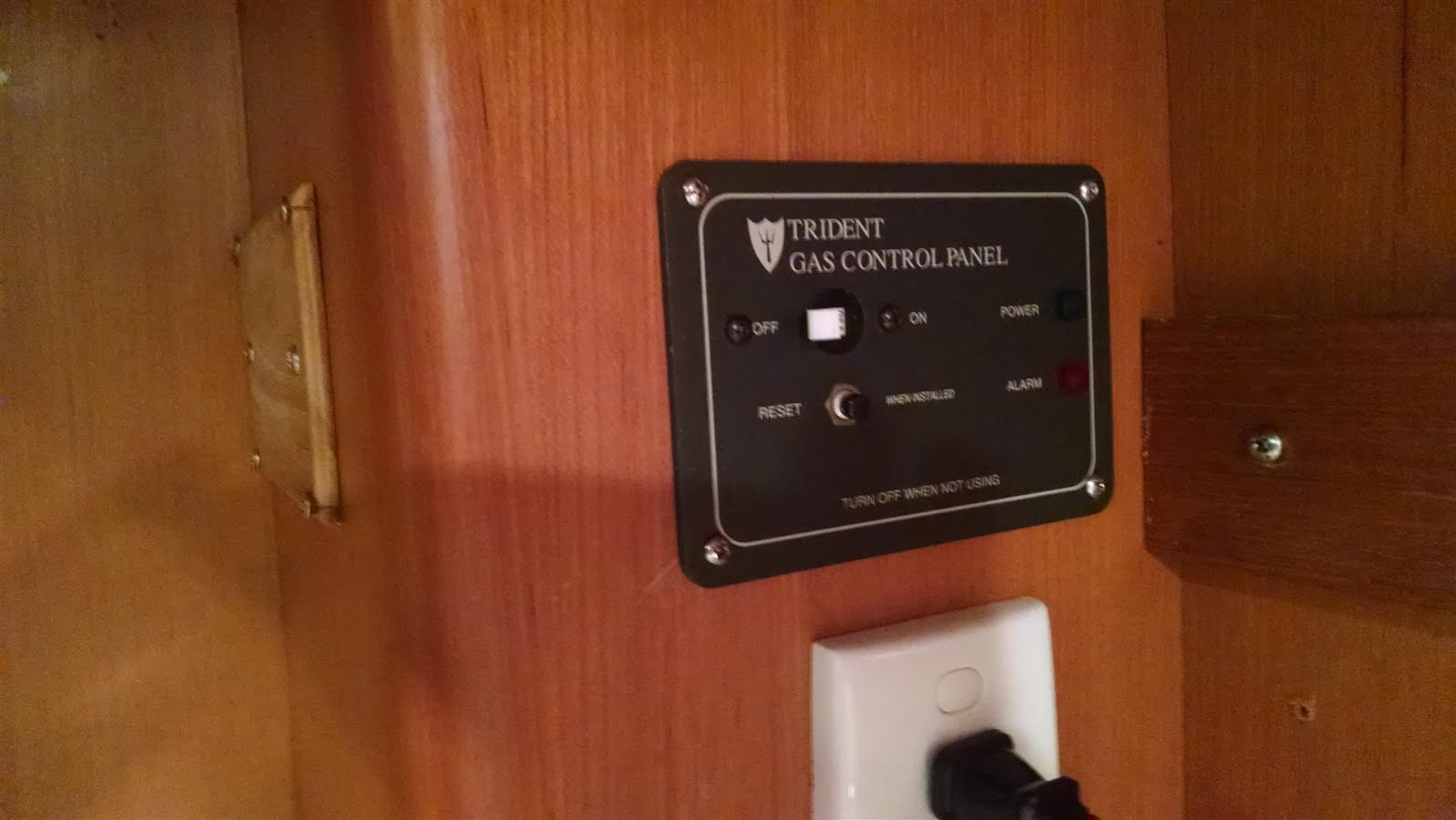
LPG Control Panel in its New Location in the Galley; Its Previous
Location is Visible on the Left
     We had some LPG troubleshooting to pursue after the gas range started having intermittent issues; turns out one of the previous owners had relocated the galley control panel to a new location, but one that lacked enough clearance for the switch wires, resulting in bent terminals and odd behaviors.  Rick was able to repair and relocate the panel and the stove is once again tactical.

   →  Our Wheelhouse maintenance program reminded us that it was time to have our Winslow life raft serviced and repacked; that’s recommended at 3 year intervals.  Fortunately Winslow has a full service center nearby so we were able to drop it off vs. having to ship 55 pounds of bulky raft packing back and forth.

   →   Wheelhouse also was nagging us that our dinghy’s Yamaha outboard was due for its annual servicing.  It’s nearly impossible to get a qualified Yammer tech to come out to a marina to work on a small outboard anymore, so Rick decided to tackle the job himself.  It took nearly a full day but the oil and filter change, lower unit oil change, two fuel filter replacements, anode replacements and new spark plugs all got accomplished without too much drama and only a minor mess.

   →   During our latest monthly bottom cleaning the diver noted that both prop shaft collar zinc anodes needed to be replaced, resulting in a bit of a scramble to find the correct sizes; that took some sleuthing as the boat’s manual isn’t very good on specifying those particular part numbers, but we finally got it done.
Engine Room with Red Fire Bottle on the Right...It's 32" Tall and 7"
in Diameter.  A Simulated or Real Discharge Will Make the Engine
Room a Suddenly Quiet Place.

   →   Yet another Wheelhouse maintenance reminder told us it was time for the annual test of the Fireboy fire suppression system.  This was an interesting exercise: first you start all three diesel engines and energize all engine room ventilation fans; then you disconnect the lead wire at the engine room and lazarette fire bottles (separately) and verify that the engines and fans shut down (they do); then you place the fire suppression toggle switch to its “override” position and verify that you can restart the engines (we could).  It’s a pretty slick safety system and we were pretty happy that none of that experimentation resulted in a fire bottle discharge.

Our 20 Gallon Raritan Water Heater Cleverly Hidden Beneath the Master
Berth. That Big Rod is the Magnesium Anode that Needs to be Installed.
   →   Lastly, it was also time to replace the water heater’s sacrificial anode; the tank is oh so conveniently located beneath the master stateroom’s bunk, and that rod is a beefy 16” by ¾” hunk of magnesium located in the hot water discharge pipe.  After depressurizing and partially draining the tank, this should have been a straightforward task.  But not on this boat; someone had used permanent pipe thread sealant on the existing anode threads.  That resulted in a call to a real plumber who could apply a blow torch to that connection & soften it enough for removal. (Scheduled but not yet done.)

The other – and nearly perpetual – set of activities that continues is provisioning….Michelle has been stocking the boat with all manner of food and beverage, and apparently in sufficient quantities to make the boat list quite a bit to port.  Rick is trying to offset and balance that with the appropriate spares and pales of oil plus some fuel transfers, but so far is losing that battle.

Still....the fact that we continue to stock the boat at least means we must be optimistic about getting Ghost Rider away from the dock and cruising sometime soon….hopefully in early March, or at least that's our target. J
Note to Family....Ghost "Gaucho" Resides in Our Pilot House Now

Sunday, December 24, 2017

December 2017: Hanging Out in Fort Myers

DECEMBER UPDATE

In the past we have mentioned that “BOAT” is actually an acronym that stands for “Break Out Another Thousand”, and thus we’ve talked about spending in increments of “Boat Units” rather than dollars.  Lately we are considering the acronym may also represent “Broken Or About To (be).” 

As we sought some dates early in the month for our sea trial we had to settle for a single three hour river run in advance of a cold front that was bringing significant winds and generally unpleasant weather to our part of the Florida peninsula.  (We’ve gotten accustomed to lousy and untimely weather patterns in 2017….and hoping that 2018 will be different.)  The results of that three hour test flight were a mixed bag:

The Good:
  • The main engine shaft/prop vibration was gone; very smooth at all RPM following the removal of the tangled crab pot line.
  • The Naiad stabilizers appeared to be ops normal; a river run isn’t a great stress test, but the fins were active and effective in the few boat wakes we encountered.
  • The main engine oil pan leak also appeared to be under control; after 3 hours Rick noticed only a small seep on the right side of the pan gasket, so he put some more torque on those bolts.
 The Bad:
  • The engine-driven hydraulic pump for the Naiad stabilizers was still leaking grease through its aft seal even after torquing down the rear housing’s attaching bolts.
  • The Furuno chart plotter in the pilot house was showing the boat’s position as somewhere in the Atlantic off the coast of Miami….although we were in the Caloosahatchee River on the west coast of Florida.  WTF.
  • The damned stuffing box on the main engine shaft was showing signs of overheating again after just an hour underway…up to 133F.  WTF times two.
 The Ugly:
  • The dishwasher sprung a leak….we had (lots of) water on the galley floor and under / in the galley cabinets.  (Love our wet/dry shop vac.) 
The New Gasket Should Fix This Grease Leak
The continuance of the hydraulic pump grease leak wasn’t a real shock.  Since we had previously ordered a replacement gasket for the rear housing, once back at the dock Rick replaced that in short order without drama….although it will require a more extended sea trial to ultimately verify the fix.

That the pilot house Furuno chart plotter seemed hopelessly lost – we were about 200 miles west of where it showed our position, and the heading was at least 90 degrees off as well – was initially a real head scratcher.  As it turns out (and this took some sleuthing) somehow the Furuno’s MFD default settings had gotten all whacked out and its “Demo Mode” had been switched on; turning that off returned sanity and accuracy to the display.

No Quicker Way to Get Navigationally Disoriented Than
Accidentally Getting into "Demo Mode"
As for the damned stuffing box temps….grrrr.  We had fought this battle for two months earlier in the year, and thought we had it solved after good behavior during the week long sortie from Palm Beach to Fort Myers.  Guess not.  Rick spent over an hour in the engine room on this last sea trial trying to get it back under control.  Ultimately we got the temp down from 133F to 106F (at SST’s under 80F) by drastically loosening the box’s follower collar while underway (while Chelle ran the boat on the wing engine), but most assuredly something was still amiss. 

Once back at the dock Rick disassembled and repacked the stuffing box yet again, but this time using the Gore GFO packing material instead of the traditional PTFE (Teflon) rings.  We had used GFO previously with success on our N47 to solve a similar issue, so we figured it was worth another try.  This material isn’t without controversy – it’s expensive, and contains graphite, which is quite high on the galvanic nobility scale: don’t even think about using it on a bronze propeller shaft, unless you want to watch your shaft melt away as a sacrificial anode.  But it’s as slippery as duck guts on a door knob, and the Aquamet stainless steel shaft on Ghost Rider theoretically should hold up to it.
Tearing Apart the Stuffing Box Again

Stuffing box surgery is always a bit dicey while the boat is still in the water (recall our in-water shaft realignment?) because removing the follower collar and packing rings will get you get plenty of sea water into the bilge unless you work quickly.  (If anyone ever invents a seacock for shaft water flow, we will buy it.)  Unfortunately the Gore 3/8” packing size was too small – even with four rings inserted we could not adequately stem the water flow.  Next we tried the Gore 7/16” size and found that too big to fit the groove.  So we reverted back to the original packing yet again – it actually looked to be in good shape, water flow and alignment looked good as well.  We are guessing that the crab pot tangle may have had an impact – either the vibration itself, or perhaps some debris ingestion into the shaft gland (hopefully now flushed out.)  We’ll know more after the next sea trial.

The dishwasher leak turned out to be relatively simple to locate – once the lower access panels were removed we could see water leaking (at an alarming rate) from one of the pan gaskets for the heating element; its attaching nut was a flimsy affair with a crack in it and consequently quite loose.  Obtaining the replacement part took a couple weeks, but once it arrived the fix was straightforward, and Chelle is once again happy with the galley.
The New Furuno BBWX3 SiriusXM Weather Receiver

Being somewhat masochistic, we also decided to tackle a new project while all this was going on: installing SiriusXM weather functionality for the Furuno navigation system.  We’ve had that (or WxWorx which is very similar) on the last few boats and have found it extremely valuable to have near real time weather graphics overlaid on the chartplotter…especially during summertime cruising when we want to detect frontal and/or thunderstorm activity beyond the range of the boat’s radar.  When combined with the GRIB file capabilities already onboard, the SiriusXM functionality would round out our meteorology tools nicely.  Furuno uses a black box called the “BBWX3” to interface the SiriusXM weather antenna to its network and MFDs, so we purchased one of those, and Rick spent a few deliberate hours getting it installed.  That installation is fairly straightforward – just mount securely with a few screws, hook into a 12V power tap, run the Ethernet cable to the hub, and then attach the Shakespeare SRA-50 antenna cable; lastly power it up and activate the Sirius weather account.  Simple, right?
New Network Switch Sitting Atop the Old Furuno Hub

Not so much.  After four days of post-installation troubleshooting we still were not receiving any weather data.  Only after bypassing the Furuno hub and connecting the weather unit’s Ethernet cable directly to the MFD did we get weather data to display.  A call with Furuno tech support revealed they were aware of a problem with their Ethernet hub, and they suggested we remove and send that unit to them (out on the west coast) for an update of some kind.  With five other Cat-5 cables plugged into that thing we weren’t too keen about crippling our nav network, so Rick substituted a standard 8 port desktop switch for about $25 – and that seems to work quite well so far.  That Furuno hub is for now just a backup spare – although we can buy about 13 Cisco switches for what Furuno charges for one of their hubs.  
Finally...a Weather Display That Works.

We sacrifice what is known as “power synchronization” (turning all other Furuno devices on or off with a single switch) but that’s a feature we weren’t using anyway.  All that's left to do there is test network speeds to be sure we have not accidentally introduced any performance issues.

Finally, Rick also managed to finally find and install a replacement battery temperature sensor (BTS) for our legacy Xantrex charger / inverter unit.  That will enable us to re-test the LinkPro battery gauge setup with and without the automatic charge relays engaged, and get more definitive about the cause of the LinkPro undercharge readings.

Scott, Kaitlin, Kelly & Riley in Party Mode on Ghost Rider
Despite all of that "boat business" we've still been enjoying the occasional time on the boat during our dirt-dwelling months at the condo.  We recently had the pleasure of hosting good friend Scott Schatzle and his young family for a fun evening aboard Ghost Rider (Sangria for the adults, reindeer cupcakes for the kids!)  Riley, at just 7 years, seems to be a budding engineer and kept Rick busy with some pretty penetrating questions about the boat's systems.  Perhaps she should examine our stuffing box.

And now it's time for some Christmas relaxation and fun. As has become our tradition, we are hosting Chelle's family for the holidays and finally enjoying some very pleasant weather in south Florida....plenty good enough for a 4 hour fishing charter the other day that netted us a tasty haul of Redfish and Spotted Seatrout for dinner.

We hope y'all have a blessed Christmas, fun holidays and an excellent New Year.