Sunday, March 22, 2020

March 2020: Underway Again

We were finally ready to get moving again.  Our initial goal was to get Ghost Rider around to the other side of the state to Palm Beach for a rendezvous with Yacht Tech (LINK), for whom we had accumulated a lengthy punch list of service needs. After that the plan was to head over to the Bahamas where we hoped to deliver some much needed supplies to the All Hands and Hearts disaster relief team in Marsh Harbour (LINK).  Following that we wanted to go explore some of the out islands around Eleuthera.
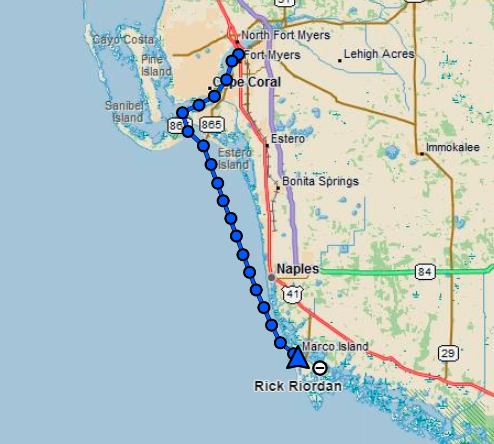
Our Path from Fort Myers down to the Keys, then Back Up the East Coast
to North Palm Beach and Loggerhead Marina....About 320 NM.

With provisioning largely complete and (at last) a decent weather window opening up after weeks of windy conditions that had been churning up the seas, we made the move to the boat on Wednesday, 11-March and settled in.  Chelle finished stowing the final haul of provisions, and Rick completed our preflight checklists, updated our charts and verified our routes.  It was time to go.  We would go south to the Keys, then "around the horn" and up the east coast...Lake O was too shallow at this point for Ghost Rider's deep draft.

Thu, 12 Mar….From Fort Myers to Marco Island

We finally departed Legacy Harbour Marina a 0900 on Thursday, 12-March, and pointed the boat's bow south.  With an outgoing tide we picked up a nice trailing current and easily averaged 8.5 knots even with a leisurely 1400 RPM setting on the main engine.  We had sunny skies, with temps in the low-to-mid 70’s, a mild east wind and flat water.
Ghost Rider Docked on an Alongside Tie at Factory Bay in Marco Island

Our modest goal for the day was to reach Marco Island, a fairly easy day cruise of 50 nautical miles down the west coast of Florida.  We ran the boat from the fly bridge in perfect conditions, dolphins vectored in and out of the bow wave but without lingering too long, and the boat ran well.  With the light winds and flat seas even the Marco River inlet was refreshingly boring at a high tide.  Chelle wasn’t feeling well most of the day – an apparent reaction to a recent vaccination – so Rick did most of the driving and handled the docking at the Factory Bay Marina (LINK) just before 1600.  Mindful of the emerging pandemic situation we ate dinner on the boat that evening and just chilled out.

Fri, 13 Mar….From Marco Island to Shark River

We did not dally at Marco and got underway the next morning before 0900.  Weather conditions were again near perfect, with light easterly winds, clear skies and low relative humidity.  We thought the outgoing mid-tide conditions would be suitable for exiting the inlet, but as it turned out Ghost Rider’s keel bumped the bottom twice in rapid succession – smack in the middle of the well-marked channel and very near the outer markers.  By the time Rick reacted with a neutral throttle it was over and we were back in deeper water.
We had a Grand Banks Following Us and a Defever in Front of Us On the
Sortie Down to Shark River

Fortunately that was the only “aw shit” for the entire day.  Once again we were blessed with smooth water and a following current, making for an easy cruise around Cape Romano Shoals and all the way down the southwest coast of Florida and into Everglades territory.  Chelle was also feeling much better and handled much of the helm duty from her perch on the fly bridge.  We also had company – a Defever (Inshalah) and a Grand Banks (Tuscarora) were headed to the same destination, so we had a rather loose 3-ship formation for much of the day.  Some dolphins joined in for part of the sortie, and a sea turtle about the size of a truck tire made a brief appearance as well.
Sunset at Our Shark River Anchorage....It Never Gets Old.  But No
Green Flash This Night.

We arrived at the mouth of Little Shark River around 1530, motored a few hundred meters south of there and dropped the hook, letting out 100 feet of chain in ten feet of water, and obtained a good set on the anchor about a half mile off the Glades shoreline.  We figured that would be smooth water for the night (correct) and far enough off to avoid the bugs (incorrect.)  After briefly opening the salon door a moth-like creature the size of a small bird zoomed into the galley, putting an end to that strategy.  We closed up and ran the generator and A/C for a while.  But later we were able to open a few portals and hatches that had screens and shut down the genset for a quiet and comfy night.

Sat, 14 Mar….From Shark River to Marathon

The next morning broke clear and mild once again (we were digging this boring weather) although the easterly breezes freshened a bit and temps eventually warmed into the upper 70’s, topping off around 80F.  The house battery bank was still at 85% SOC which was a very reasonable draw down for the 10 or so overnight hours.  We cranked up the generator to start putting a charge back into the batts, picked up the hook and got underway by 1000.
Chelle at the Fly Bridge Helm

While the wind chop had picked up with the increased breeze it was still a very pleasant ride south towards the Keys.  Inshalah, the Defever 48 from the day before, fell into a trail formation since they were headed to Marathon as well, and together we dodged numerous crab pots for most of the day’s sortie.  We were punching into a head current most of this day, so we only averaged around 7.5 knots.  While enroute we also ran a water maker test for about three hours and it cranked out about 40 gallons, quite satisfactory for our upcoming Bahamas touring.

The Marathon Anchorage Just Off of Boot Key Harbor Was a Bit Crowded
After crossing under the Seven Mile Bridge we curved around to the east and headed into the anchorage just outside of the Boot Key entrance channel – and the place was already packed by 1545.  We squeezed Ghost Rider into a rather tight slot between the channel and a small sailboat, dropped the hook, let out 100’ of chain and set the anchor rather hard.  We spent the first hour verifying the set with range finder readings and monitored our swing room, but it all worked out.  The only downside to the location was nearly constant boat wakes from vessels going in and out of Boot Key.

We ran the generator and A/C for a few hours, enjoying another nice meal on board, and another lovely sunset.  The mild temperature and stiff breeze allowed us to shut down systems again for the overnight period with just a few hatches and portals open to the night air.
Sunset at the Marathon Anchorage with Seven Mile Bridge in the Foreground.

Sun, 15 Mar….From Marathon to Rodriguez Key

Weather-wise Sunday morning looked a lot like Saturday evening, which was a good thing, although we anticipated the 15 knot wind from the east would be chopping up the Atlantic side of the state.  By 0930 we had retrieved the anchor and snaked our way out of the crowded anchorage; an initial southerly heading brought Ghost Rider into Hawk Channel and there we turned her east.

Another Anchorage and Another Sunset, This One at Rodriguez Key with
the Key Largo Area in the Background.
Once we had left the lee of the Boot Key land mass, the wave action got a bit more frisky as expected and predicted, generally from two to three feet but rather square and at narrow intervals.  But we weren’t pounding and regardless the boat didn’t care.  Crab pot avoidance was the order of the day again, but surprisingly they weren’t as numerous as we’ve historically seen in this area.  Wind and waves backed off a bit the final few hours of the sortie, and with air temperature reaching into the low 80’s it was another fine day of helming from the fly bridge.

By 1600 we had tucked in behind Rodriguez Key and set the anchor in ten feet of very clear water; the anchorage was somewhat crowded but there was still plenty of room to find a comfortable slot with plenty of swing room.  We repeated our generator and A/C routine from the previous two nights, able once again to shut everything down for the overnight period – after appreciating another gorgeous sunset.  That just never gets old.

Mon, 16 Mar….From Rodriguez Key to Fort Lauderdale

This would be our longest single day run (70 NM) so we got an earlier start, pulling out of the peaceful anchorage at 0815.  It was another typical south Florida day in mid-March – sunny sky, brisk easterly breezes, temps approaching 80F with a moderate humidity level.  For the first 30 or so miles we were still running (mostly north now) with a reef to our starboard, so the seas were quite reasonable and comfortable at around two feet.  But as we approached the Miami area and left the reef protection behind, the washing machine action started.
We Had to Dodge This Departing Cruise Ship As We Came Into the Port
Everglades Inlet.  Notice the Empty Decks.

Seas were now running 3 to 5 feet with plenty of vertical wind chop on top, and the wind clocked a bit to the northeast, so Ghost Rider started to pound into the head sea component.  The boat didn’t care, but we did.  We had also picked up a stiff following current and speed-over-ground (SOG) was showing 9 to 10 knots.  So we backed the RPM down to just under 1400, still got nearly 8 knots out of that, and the ride improved considerably in the sloppy seas.

At Fort Lauderdale’s Port Everglades inlet an outgoing current was bashing into the inbound wave action making it a real mess; Rick hand steered to negotiate the inlet entry as the autopilot’s counter-rudder response just isn’t up to that task, and we got between the breakwater jetties without incident.  About that time we also encountered two large cruise ships departing and heading out to sea – and they were both empty of passengers, looking like gigantic ghost ships.  It was a very weird sight, indicative of the pandemic panic that had started to sweep the globe.
Chelle on Ghost Rider's Forward Deck After Docking Up at Pier 66.

After some evasive action to avoid those big boys we passed under the 17th Street Bridge and then turned into the Pier 66 Marina basin (LINK).  That turned out to be more challenging than normal as the place was packed with enormous vessels parked in odd and inconvenient places, and Rick had to be careful during the five 90 degree turns it took to get Ghost Rider sterned in to her assigned slip.

But we got tied up without incident and then spent a full hour hosing the salt crust off of the boat.  Continuing to respect the unknowns around the viral outbreak, we dined in and relaxed onboard for the remainder of the evening. 
Pier 66 Marina Was Packed.  This Nordhavn 120, Aurora, Parked at the Entrance to Our Fairway, Didn't Help Matters Any.
Tue, 17 Mar….From Fort Lauderdale to North Palm Beach

By the next morning you could not tell that we had given the boat a decent bath the evening before.  The marina had a lot of construction in process and the boat had a layer of dusty, dark grime on it; a brief although light rain shower then turned that into a layer of pasty mud just as we were preparing to depart at 0915.  We delayed that plan by about 15 minutes to let the rain pass, but we only had 48 NM to our Palm Beach destination, so the pause was not a concern.

Chelle at the Helm in the Pilot House En Route to Palm Beach.
Rick carefully maneuvered Ghost Rider through the tight turns to get out of there and shortly thereafter we were outbound in the Port Everglades shipping channel; and it was rough.  An another outgoing tide was bashing into waves driven by easterly winds that were clocking 15 to 20 knots, and the boat was doing its best imitation of a poorly designed roller coaster, with the bow diving into 7 and 8 foot holes and throwing spray well above the boat deck level.  Rick retreated from the fly bridge and down to the much drier pilot house.

At the end of the channel we saw half a dozen ships in the deep anchorage area – basically quarantined – and maneuvered around them to finally get Ghost Rider pointed north.  That put the rough seas on the beam, where the stabilizers could at least mitigate some of the bouncy action rather than the bulbous bow pounding directly into the turbulence.  Seas were steady at four to five feet with the occasional six footer, and at least one eight footer that rearranged some furniture and a variety of other small gear.  But again we had 80F temps, mild humidity and sunny skies.
Our XM Weather Display Reporting Sea Conditions

Nevertheless, Ghost Rider kept fairly steady on her northerly heading, slowly passing by mostly empty beaches at Lighthouse Point, Deerfield, Boca Raton, Delray and Boynton Beach, and Mar-a-Lago – where Rick was dreaming of launching a cruise missile or two.  By 1500 we were transiting the Lake Worth inlet inbound, where an incoming tide made the channel fairly tame, and shortly thereafter found ourselves in the welcoming calm of the ICW.  We had to wait on two bridge openings (Parker and PGA) because of a high tide that gave us less than the needed 23 foot clearance (with the big sticks lowered) but still made Loggerhead Marina before 1630. 


Our assigned slip was a roomy one that required a bow-in approach to keep our boarding door oriented correctly, but it was also a fairly high fixed dock that made getting on and off a gymnastic exercise.  But Paul (from Yacht Tech) and two other Nordy owners were there to take lines and help us tie off, so overall it was quite uneventful.  Ghost Rider got another much needed wash down to shed all the dirt and salt, then we settled in for a quiet and air conditioned evening, and slept very well.  It was a good St. Patty’s Day night.  Erin go Bragh.

Wed, 18 Mar….At Loggerhead Marina in North Palm Beach

The next morning we were happy that we didn’t have to go anywhere and just relaxed.  Bob and Paul from Yacht Tech stopped by as promised to review and discuss our punch list – with us adding a couple of new items that had developed the night before – and we began to flush out a rough work schedule.  We’ll have more details on all of that in the next blog post.  From the news we’re getting on the developing virus scare it seems we’ll have both the need and perhaps some time to figure out what’s next.

Stay tuned.


Ghost Rider at the End of "B" Dock at Loggerhead....All Cleaned Up and Ready for Some Maintenance

Tuesday, March 3, 2020

Feb 2020: Departure Preparations

Our February, as expected and planned, was all about making sure the boat would be ready to cruise again come March.  And as it turned out, multiple cold fronts accompanied by strong winds out of the north combined with our rather typical low winter tides to keep Ghost Rider pinned to the dock…frequently with at least part of the keel on the river’s soft, silty mud bottom.
Nordhavn 46-54, Beverly S, Moored at the End of 'B' Dock at Legacy
Harbour.  We Enjoyed Our Time with Owners Larry & Sue.

But we also started the month with a very pleasant surprise.  Another Nordhavn, Beverly S (N46-54), showed up at Legacy Harbour, and we had the distinct pleasure of meeting owners Larry and Sue Tomback.  We exchanged happy hour visits, war stories and cruising plans and overall just hit it off.  Larry and Sue are veteran cruisers, having started out on the U.S. west coast and following a recent transit through the Panama Canal are now exploring the east coast.  Beverly S (named after Sue’s late mother) is a gorgeous example of the original Nordhavn trawler that originally set the standard for power boat voyaging.

The Genset's Racor Housing After a
Thorough Flush Out.
Throughout the remainder of the month Chelle continued to provision Ghost Rider with the usual galley supplies and durable food stores.  It’s easy to tell when that’s in process as the boat sits a few inches lower in the water once she’s done.

Rick of course kept busy with maintenance and related system preparations.  That included our annual inspection of the fire suppression systems, oil and filter changes for the main engine and generator, flushing some accumulated asphaltenes from the genset’s Racor fuel filter housing, and the annual maintenance on the dinghy’s outboard engine (oil change, new fuel filters, and a new start battery.)  The water maker also got a fresh set of prefilters.  Notably, this is the first time we've had to perform time-based oil changes (annual vs. hours-based) on the main engine and generator.  The boat's bottom and running gear also got a thorough scrubbing.

Additionally, we also decided to order two new (vertical) LPG cylinders for the boat.  After previously discovering that our existing tanks were restricted to horizontal mounting – yet had been installed vertically back in 2002 – we had experimented with a single cylinder with a proper horizontal mount.  That worked well enough (and was a whole lot safer) but there was room for only one tank in that orientation....and we could not find a safe place to store the second spare tank (which, according to ABYC standards, is subject to the same safe storage standards as a tank-in-use; we simply do not have such an additional space on Ghost Rider.)  The 20 pound LPG aluminum cylinders are NOT inexpensive, but the unsafe alternatives easily justified the spend.
Our New (Vertical) Aluminum LPG Cylinders.  We Had to Get Creative with the Mounting Brackets -- Turns Out that
'Galvanized Deck Post Ties' from Home Depot Are a Perfect Fit After Drilling Holes to Match the Mounting Studs.
Lastly, we continued to coordinate with the All Hands And Hearts organization on what supplies we could mule over to the Bahamas aboard Ghost Rider.  Right now that appears to be numerous boxes of roofing materials, mostly screws and hurricane clips and perhaps rolls of peel & stick roofing membranes.

At this point we’re mostly waiting on a good weather window to make the trip around Florida to Palm Beach.  After a maintenance depot stop there we’ll pick another window to cross over to the Bahamas.  But for now the windy conditions continue to exacerbate the low tidal waters in addition to boiling up the coastal waters, making departure somewhere between a non-starter and a bad idea.  Apart from the winds, however, the sunshine and temps are quite nice, so it looks like this is a good time to take in some MLB spring training games.

Thursday, February 6, 2020

Jan 2020: Projects in Port & in the Abacos

Happy New Year!  We welcomed 2020 still confined to port, as poor weather had intervened and prevented our planned cruise up to Sarasota for Christmas week.  That meteorological mess consisted of a cold front accompanied by gusty winds and rain for several days, and was enough of a deterrent to keep Ghost Rider tethered to the dock.  One of the many nice things about retirement is the flexibility to pick our weather windows….our car got us to Sarasota and the planned family rendezvous just fine.  The remainder of our time since our last blog post has mostly been occupied with out-of-town visitors escaping the cold winter weather to the north.  And Chelle took a side trip back to the Abacos….more on that further below.

That also gave us time to turn our attention to a few more boat projects….some expected, some not.
We Replaced Four of These Poly-planar Speakers
Due to Splits in the Speaker Cones
First up was replacing some of the stereo speakers in the boat.  Ghost Rider has three pairs of these (salon, pilot house and flybridge), and both pairs of interior speakers were in dire need of replacement – the speaker cones had deteriorated with splits and cracks and the distorted sound was getting annoying.  (We don’t know the age of these, but strangely the exterior flybridge units are holding up better.)  At any rate, it was easy enough to find drop-in replacements (Poly-planar 6x9 200W on Amazon), and with only six screws and two wires each were easy to remove and replace.

Having to replace yet another Whale fresh water T-fitting was an unpleasant surprise.  During one routine morning boat-check Rick glanced at the bilge pump counter and saw “36” – where normally we expect to see something from zero to five over the course of a day and that’s only if the A/C has been running.  Uh-oh.  After scrambling to check the bilge level (normal, so the bilge pump was keeping up) the scavenger hunt began….from where was that water coming?  While checking various under-floor panels we heard the fresh water pump kick on and run for an extended period; a quick check of the fresh water tank level showed a significant decrease from the previous day, too.  So now we knew we were looking for a fresh water system leak.  We turned off the breaker for the water pump, and eventually Rick found the culprit, one of the many Whale 15mm T-fittings scattered throughout the boat….this one immediately adjacent to, and on the supply side of, the fresh water pump in the engine room.  We carry spares, so the replacement fix was relatively quick and easy.
The Yellow Arrow Points to the Whale
T-Fitting That Was Leaking

Then it was time to call out an A/C tech to the boat once again.  The air handler in the master state room had (again) started to throw “HI PS” errors and shutting itself down.  Previously Rick had been able to clear that error with strainer cleanouts and running reverse cycle heat; but those techniques were proving fruitless this time.  Using the infrared heat gun we found compressor coil temps reaching 156F (normally around 120F) and the unit would shut itself down after a few minutes of runtime. Craig from VIP Marine (LINK) found a hole in his busy schedule to make a visit and after hooking up his manifold pressure gauges (finding high-side pressure way above the normal range) he quickly diagnosed the problem as clogging in the fresh water cooling loop.  We really had no idea if or when that plumbing had last been scoured out, but in an oft-used A/C system in these warm waters it’s not uncommon for raw water loops to get sclerotic with barnacles and other unwanted nasties.

Our first step was to remove the hose from the thru-hull intake, where we found the equivalent of a small tree growing; we cleared that out using a long screwdriver as a rigid drain snake.  Next up was to remove the four raw water manifold hoses downstream of the pump and run an acid cleaner through those.  A loud “pop” and debris coming from the port side discharge was evidence we were progressing with removing considerable sclerosis from the cooling loop.  After a few hours of effort followed by a leak check of the reassembled plumbing, the A/C system was pronounced healthy again.  The improved water flow, pressure and temperature checks confirmed that.  Rick followed up with a “Barnacle Buster” soak over the following days as additional preventive insurance.
When We Removed the Hose and Elbow Coming Out of This A/C Seacock We Found a Small Tree Growing
Inside the Thru-Hull.  First Step Was to Unclog That Mess.
Another project involved updating the ship’s Nobeltec computer.  That device is a Silverstone DC-powered computer running the TimeZero Professional navigation software; unfortunately that’s a mission critical system running under the Windows 10 (Pro) operating system, which is at best only a consumer-grade platform, and not particularly conducive to high availability needs.  Once huge drawback is Microsoft removed almost all ability to control the frequency and timing of its software updates, which occasionally can be quite disruptive.  To manage that we generally keep that PC’s Internet connection turned off, and on top of that we run a 3rd party utility that effectively interrupts that “phone home” behavior.

Thus periodically we need to manually check for OS security updates and functional upgrades/fixes, but only when we have the time to manage possibly adverse consequences.  And that did not go well – after twice applying updates, and then rolling back to recover, the computer turned into a brick. It took Rick three days to recover it – performing a BIOS reset and fresh install of the latest build for Windows 10, followed by reinstallation and configuration of our Nobeltec TimeZero Pro navigation software.  At least we were able to recover routes and other data files from our backups.  On the other hand the newer version of Windows 10 would not recognize the computer’s PCI serial I/O card (which feeds backup NMEA 0183 navdata to the TimeZero software) even after reinstalling new drivers.  A newer I/O card and driver set finally resolved that.
The Ship's Navigation Computer is a 12 Volt Small Form Factor Silverstone Model.  It's Tucked in the Pilot House
Console Locker, a Challenge to Access.  This Pic is with Its Cover Removed to Provide Access to Its Innards So
the PCI Serial I/O Card Can Be Replaced.
Additionally, in the category of “better late than never” we made an interesting discovery regarding the boat’s LPG system.  Ghost Rider carries two aluminum 15.8 pound (empty weight) gas bottles to feed the galley’s gas stove and oven, a common arrangement in long range cruisers – alternative electric units are energy (battery) hogs. The LPG bottles have been securely mounted (vertically, side-by-side) in an isolated and ventilated cockpit locker mostly in accordance with ABYC standards.  Suspecting one of the bottles was approaching empty and requiring a refill, we removed it to weigh it on a digital scale – and for the first time took notice a label on the bottle that read “horizontal cylinder.”  After researching exactly what that meant we realized the heretofore vertical installation violated a rather significant safety measure (and probably interfered somewhat with consistently reliable operation.)  Rick bought some stainless hardware and drilled new studs in the floor of the locker to allow for a secure horizontal mount – although only one bottle would fit in there with that orientation. 
The Revised Horizontal Mount for LPG.  The Yellow Arrows Point to the Two New Stainless Steel Studs and
Wingnuts that Were Required.  The Red Arrows Indicate the Previous Studs Used for Vertical Mounting.
The second (spare) LPG bottle got strapped down in the lazarette storage area.  The better longer term solution would be two new bottles designed for vertical installation – but those aluminum things are pricey and that can wait.

As for Chelle’s side trip…to the Abacos:  Not being one to take the traditional approach to retirement, she has yet to master the skill of being laid back.  After accommodating holiday visits by her mum, then her sister and entire family, then our daughter, followed shortly thereafter by four of her gal pals, she headed off to Marsh Harbor in the Bahamas for two weeks of disaster relief volunteer work.  Via the All Hands and Hearts organization (aka AHAH, LINK), their gritty manual labor efforts are targeting the reconstruction of schools, a clinic and library, and teachers’ homes.  

For more details on that experience, check out the separate blog entry at this LINK.

What’s next:  We’re not planning any significant sorties until the March timeframe, at which time we are hoping to cruise around to the east coast for a (brief?) visit to Yacht Tech’s yard in palm Beach, and then heading off to the Bahamas again. February will be preparation month – provisioning all sorts of supplies and food, along with pre-departure oil changes and other system preparations.  We're also looking into using Ghost Rider as a "mule" to haul needed supplies to The Abacos relief efforts.  More on all that in the next blog post.  

Once again, we wish all a Happy New Year and best wishes for a safe, healthy and enjoyable 2020.

Jan 2020: A Side Trip to the Abacos

As mentioned at the end of another blog entry, Chelle has trouble sitting still.  After the hectic holiday visits she headed off to Marsh Harbor in the Bahamas for two weeks of disaster relief volunteer work.  She hooked up with the All Hands and Hearts organization there (aka AHAH, LINK) joining their volunteers already on the ground working on the reconstruction of schools, a clinic and library, and teachers’ homes.   

When Hurricane Dorian parked over The Abacos and Grand Bahama for a couple of days while spinning viciously at Cat-5 strength, it pretty much flattened those islands.  And afterwards, Marsh Harbor was basically a pile of waterlogged toothpicks, and those soon turned into moldy ones.  
Chelle headed over there in mid-January, and upon return she was exhausted.  AHAH doesn't mess around -- they're not just a gaggle of volunteers, but rather they bring experienced program managers, project managers and team leads to organize and direct the teams of volunteers, and utilize disciplined direction to get defined and palpable results.  Work days start at sunrise and go nearly to sunset.  Clearing debris, scrubbing mold, vacuuming, disinfecting and rebuilding is really hard and cyclically repetitive work.  If you're on a "muck and gut" team (like Chelle) you don't sleep each night, you pass out.
But it's very, very rewarding.  In addition to the videos above, below you'll find a sampling of the collection of photos Chelle managed to snap off while there.  They will give you an idea of the destruction and despair, but also the hope, optimism and good work going on over there.

AHAH specializes in mold remediation which consists of the following process also known as “Sani”:

** Scrub - Each piece of wood is scrubbed three times with a wire brush on each side of the exposed piece of wood: 1) scrub with the grain – usually vertical, 2) scrub horizontal, 3) scrub in a circular motion.  One of the pictures below depicts an AHAH volunteer scrubbing up in the rafters.  One thing learned after two days of scrubbing was to pick a large room with lots of long runs of studs and rafters; cubbies and nooks are a bear to scrub.  In another pic you’ll see Chelle equipped with respirator mask and scrub brushes getting ready to work an 80 year old man’s home.

** Vacuum – Each piece of wood is vacuumed in two passes (vertical then horizontal) with wet vacs using whatever attachments are needed (or available).  Unfortunately AHAH needs to do a full inventory of the wet vac attachments and re-order.  We were really hurting for the right attachments to fit into nooks & crannies and some of the attachments had to be duct-taped onto the vac. 

** Chemical Treatment – This is done with a solution called Shockwave (ammonium chloride) which is sprayed over all the exposed wood.  It requires wearing a Tyvek suit in addition to the respirator mask used for scrub & vac.


** Muck & Gut – In one of the pictures you see a child’s toys and toddler shoes on the floor of what was their home.  This particular 2bed/1 bath home, the right side of a duplex, had 50% of its roof blown off.  For AHAH, it was a complete muck & gut meaning removal of all drywall, door & window trim, countertops, cabinets, bathroom tub & sink.  In the left side of the duplex they had roof damage but nothing torn off and we mostly needed to only muck and gut the lower half of everything in the home due to water damage.  The owner of both duplexes had allowed extended family to move into the left side duplex so we were trying to work around all their belongings.  However, we ultimately gutted the entire kitchen so we’re not sure they continued to stay there or not.  One of the pictures shows Chelle with crow bar in hand tearing off door trim.

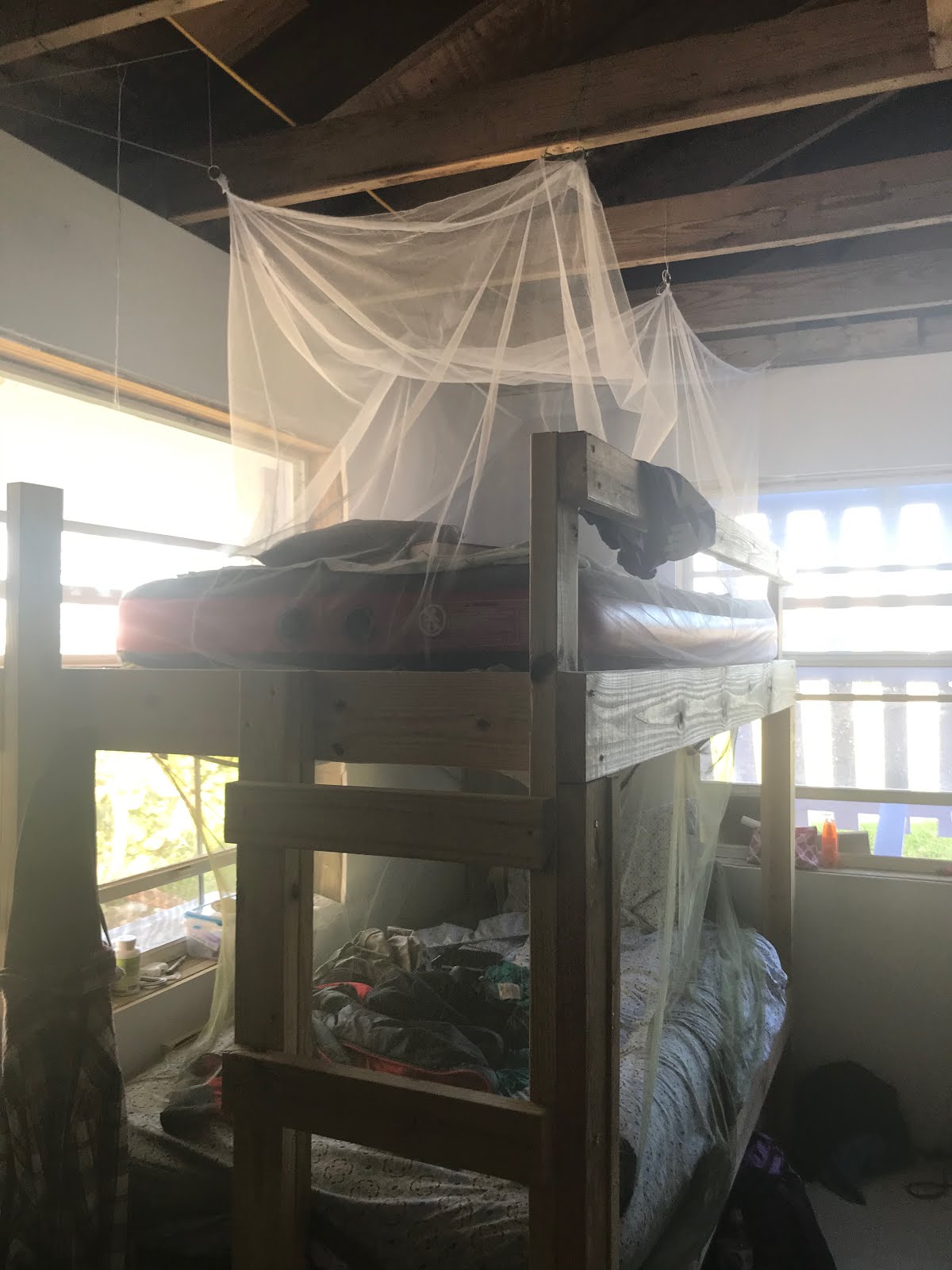
Part of the AHAH Base camp is the Every Child Counts School, which is the only school for special needs children in all of the Abaco Islands.  The school suffered a lot of damage which AHAH is working to repair while using the school as a base of operations for now.  Chelle stayed in Seydel Hall along with 31 other bunk mates.  Luckily she scored a lower bunk but was surrounded by two especially heavy snorers and with earplugs that would not stay in her ears (a week in a half into her stay a fellow volunteer shared some silly-putty-like ear plugs that could be molded and stayed in place – at last some sleep).  You can see from the pictures that the bunk beds have mosquito nets that the volunteers bring with them – all bedding is supplied by each volunteer and many will leave things behind; that was fortunate for Chelle since her checked bag with air mattress, sleeping bag, sheet, pillow and mosquito tent did not arrive when she did and had to be picked up the next day.

Soon AHAH will be opening a new barracks facility at the base camp, an interesting structure donated by Sprung (and locally nick named the Taj Mahal) – the video below will give you an idea what that looks like.  All of the communal bunk beds will be moved there and house up to 90 people.  One can only imagine the cacophony of snoring that will bounce of those walls.
At Base the day starts about 5:45 AM for most; get dressed in your bunk bed in the dark and hope you put everything on the right way.  Grab your headlamp or flashlight and wander to the “mess hall” which was set up as a kitchen plus two long plywood tables for making breakfast and lunch sandwiches.  Chelle lived on PB&J sandwiches for breakfast and tunafish or canned chicken sandwiches for lunch for 11 days.  Thankfully, they had coffee so you quickly got your business done and everyone met up in the outdoor dining area at 6:45 AM sharp – PPE in hand (Personal Protection Equipment – hard hat, safety glasses, respirator mask, work boots & gloves), ready to grab job site supplies, load up the trucks and be rolling to the job site by 7:00 AM. 

At the job site the Team Lead conducted a stretch circle each morning – each volunteer selected a favorite stretch and introduced themselves to the team for that day.  Your teams changed daily so it was a great way to meet your fellow volunteers (there were 90 some volunteers the day Chelle arrived and around 60 something upon departure – constant turnover of people on base).  Then, off to work whether that be Sani (scrubbing or vacuum or spray) or Muck & Gut, or roofing, or some lucky people got assigned to work at World Central Kitchen or the rebuild of St. Francis School getting it ready to reopen in the next month.  You were at the job site until about 3:45 with an hour break for lunch (at the site; there was no transportation once dropped off and typically no ‘facilities’).  A truck arrived around 3:45 to 4:00 PM to bring you back to base which allowed about 45 minutes to clean up and shower before the mandatory daily 5:00 PM meeting in the outdoor dining area.  It was important to Chelle to get showered before that meeting since the showers were outdoor and cold-water only, and by the end of the 5:00 PM meeting it’s really dark in the showers.  Those cold fronts that blew through Florida in January blew through the Abaco Islands as well, and that shower could be really cold. 

The 5pm meeting was to greet & meet new arrivals, walk through the day’s work results and discuss the next day’s assignments – all documented on the work board; there were about 9 to 12 job sites in progress most of the time.  After the meeting everyone lined up in the mess hall to grab a hot plate of food (same dinner rotation every week – spaghetti, chicken curry, burgers & fries, chicken souse, tuna pasta, BBQ chicken); each volunteer is on their own for dinner on Sunday, the one day off each week.  After dinner, everyone just socialized a bit and got prepared for the next day.  AH&H provided a clean volunteer t-shirt each day; there was one washing machine on base strictly for washing the t-shirts which were then hung to dry.  Any personal clothing to be washed was your responsibility in a bucket with a stick to use as agitator.  Volunteers hung their personal wash wherever they could outside the buildings.  Chelle was usually in her bunk by 8:00 PM to read and wind down before the 9:00 PM lights out and quiet hours.

Sunday was our day off and 8 of us decided to drive an hour south to Sandy Point which had sustained only relatively light storm damage.  A staff member was kind enough to drive us down there Saturday night and we got four rooms at Oiesha’s “Resort”, which was much more like a Motel 6 but we LOVED it: electricity, a real bed, a real bathroom with toilet and hot shower AND she let us use her washer/dryer for our clothes. (Chelle knew there was a washer & dryer and recommended to everyone to bring their stuff – we all threw it together into two loads – heaven!) Oiesha’s was across the street from a beautiful beach and we spent the day at “Nancy’s” restaurant and bar on the beach.  Lots of folks from base arrived on Sunday for the day.  Our group had planned to take a taxi back to base but managed to grab a ride with some of the others from base that had come for the day.  Then on Monday it was back to work!

Chelle was so very ready to return to Florida the following Sunday – exhausted from the work, the Spartan living conditions, and lack of restful sleep.  But, she hopes to return again; although next time will be a shorter stay as 2 weeks was a bit much.  She’s currently reaching out to AH&H to determine what supplies they might need when Ghost Rider journeys back to the Bahamas in April.  We are also working with Stokes Marine in Fort Myers to haul some of their collected supplies to the Hope Town area on Elbow Cay.

AHAH is committed to recovery in Marsh Harbour for two years (until Oct 2021).  There was a big difference in activity levels from Chelle’s first week and her second week; people are coming back, there’s far more traffic and school buses are beginning to run.  The Bahamian Government is finally (after five months) starting to take action and is targeting to have electricity working by sometime in March of this year.  They also finally allowed AHAH to begin rebuilding the public schools there (to date, AHAH has been restricted to rebuilding private schools); they were just awarded the rebuild of CAPS – Central Abaco Primary School – the largest school in the Abaco Islands serving 800 students.

Of course All Hands and Hearts is not just working on disaster relief in the Bahamas….they have active teams on the ground around the globe, in Texas, Florida, Puerto Rico, Australia, the Phillipines, Peru, Mozambique and Nepal.  They do good things.
Some of the Devastation in Marsh Harbour on Great Abaco Island
More of the Damage & Devastation
Interior Structures Are Embedded with Mold
More Devastation
Not Uncommon....Nobody Knows for Sure Where the Boat Originated
There Are Tragic Stories in Every Pile of Rubble
This Served as Our Barracks Building
These 16 Bunks Served 32 Volunteers
Close Up of the Bunks....the Mosquito Netting is Important
Outdoor Showers....and COLD Water Only
Gearing Up for Battle -- Sani Duty (Mold Remediation)
Work Board - with Team Assignments
The Only Special-Needs School ("Every Child Counts") in All of the Abacos...Now Being Renovated
Sani Work (Mold Remediation) in the Rafters
"Muck & Gut" -- Crowbarring Off Trim & Drywall
Another Worksite....Muck & Gut in Progress, New Roof Coming Next
Ditto
But We Did Have One Day of Rest...Beach & Break Time (Sandy Point, About an Hour's Drive
 South of Marsh Harbour)
Some Day It Will All Look Like This Again (From Our Last Visit in 2018)

Sunday, December 8, 2019

Nov-Dec 2019: Back to FLA & a Short Cruise

We Sustained Two Deep Gelcoat Gouges on This Area of Starboard Bow During 
Our Throttle Failure Experience.  But After Mike Worked His Magic 
on the Light Grey Gelcoat It Was Hard to Discern.
By the time we returned from our visit to the Midwest to our southwest Florida home the fall season was finally making a debut in Fort Myers.  Within a few days we were seeing highs in the low 70’s instead of lows near 80F, but having just departed single digit temps it still felt blissfully warm.

We spent about a week getting the boat ready for some overdue cruising.  That included getting Ghost Rider detailed once again by Frank at Ultimate Marine (LINK), and Mike Peters of Brightworks completing the gelcoat repairs on the starboard bow, and of course keeping up with the usual routine maintenance items that Wheelhouse would point out to us.  The most significant of those was replacing the raw water pump’s impeller on the wing engine, a once-a-year proactive task. Rick decided to try out one of the Globe “run-dry” soft rubber impellers this time which theoretically will last longer, although to be fair the hard rubber Jabsco that we replaced still looked very good.
Frank from Ultimate Marine Giving Ghost Rider the Spa Treatment

Of course we (meaning Chelle) had lots of provisioning to do since we had mostly emptied the boat of food, drink and personal items over the past year.  But since we were waiting on the detailing and bottom cleaning work anyway, we had time to get that done without getting too rushed.

Then, as soon as Ghost Rider’s monthly bottom cleaning was completed we were ready take advantage of a good weather window to point the bow south.  Instead the cold and flu bug hit us (meaning Rick) and a lengthy recovery pause followed.  By the time we felt healthy enough to get back underway we were into early December and waiting on another weather window.  The delay had another advantage -- Red Tide has returned to the southwest Florida with a vengeance, but by the time we did  get underway it had largely dissipated, at least in the direction we would be going.  (North of us it was still bad.)  We also took some solace in the fact that we had passed the official end of hurricane season with nothing more than a strong breeze affecting us locally.
Ghost Rider is a Dolphin Magnet

We finally departed Legacy Harbor and Fort Myers on the morning of Wednesday, 04-December at around 0915 in fabulous conditions: a very slight northerly breeze, clear skies, temp around 60F and low humidity.  It was jacket weather up on the fly bridge but it was nonetheless quite comfortable, and the outgoing tide gave us a following current heading down-river.

Our destination was Marco Island, about 50 miles to the south.  Even with the pushing current it took nearly two hours to get all the way down the Caloosahatchee River, and while there was only sparse boat traffic we enjoyed multiple dolphin formations on both sides of the boat and in the bow wave.  By the time we entered the Gulf of Mexico our bottle-nosed friends had split off on a lunch-hunting vector and temps had reached the mid 70's.  Winds also picked up a bit, clocking around to the WNW, and after passing south of the Sanibel lighthouse so did the seas.  Forecast was for 2-3 footers but we saw 4 to 5 foot swells most of the way, mostly quartering on the starboard stern and occasionally right on the beam.  Intervals were mostly comfortable but the stabilizers still got a workout.  It was pleasant enough to steer from the fly bridge all day.
Ghost Rider ran perfectly the entire way, loping along just under 1500 RPM and averaging about 8 knots SOG.  Rick made some  minor adjustments to the shaft's stuffing box, tightening its adjusting nuts just a bit to reduce the drip rate, and was very happy with the resulting 95F gland temperature in the 75 degree gulf waters.  Our Wheelhouse maintenance program had been nagging us to "performance test" the water maker's membrane, so we also took the opportunity to run that for a couple of hours in the clean waters of the Gulf; it produced about 27 gallons of good quality (<200 ppm) fresh water in a two hour span, which is pretty much spot on its specs.
Our Track from Fort Myers to Marco Island

We reached the entrance to Big Marco Pass just after 1500, and as expected it was a little adventurous with the 4 to 5 foot rollers on the stern; such wave action in the inlets tends to push around a full displacement Nordhavn like a bathtub without a rudder.  The autopilot isn't particularly useful in such conditions but we've learned the art of manual steering and throttle adjustments, and thankfully the tide and current were going with us.  After we reached the calm of the inner bay Chelle took the helm from the fly bridge station and steered Ghost Rider around the corner to the Marina at Factory Bay (LINK) for a smooth docking maneuver on their t-head floating dock.  We got tied up and cleaned up in short order, with the usual attentive help from Craig the dockmaster.  Temps cooled rapidly again after sunset, making it a good night for Chelle's crock pot chili.
Ghost Rider on Her T-head Tie-up at Factory Bay
We spent the next two days (Thursday, 05-December and Friday, 06-December) just hanging out and relaxing at Marco Island as the idyllic fall weather continued. Chelle got a loaner bike from the marina office and spent time cycling around and checking out the beaches.  Rick got a lot of small projects done on Ghost Rider -- rolling back a bad Windows 10 update on the ship's PC; tightening the hinges on two overhead hatches; exercising & leak-checking the hydraulic davit; and a few other minor tasks.  Thursday night we walked the short distance to our favorite restaurant here, Old Marco Pub (LINK), to enjoy lobster tails and a tender filet.  Late Friday afternoon we hiked a bit farther down to the Snook Inn (LINK) for some early cocktails (the Passion Fruit Mojito is good) and an appetizer (tasty conch fritters which also have shrimp chunks and the mango habanero sauce packs a punch.)
The Old Marco Pub Doesn't Look Like Much from the Street but Inside
It's Comfy with a Good Bar and Excellent Food

The perfect weather continued on our departure date, Saturday, 07-December.  We started engines just after 0900, departing the dock shortly thereafter, wound our way out of Big Marco Pass, and pointed Ghost Rider north back towards Fort Myers.  Temps started in the low 60's but quickly warmed to the mid 70's, under a clear cobalt blue sky, with a light northerly breeze that yielded smooth seas.  Waves barely measured a foot with wide periods and only a light wind chop on top.  It was a bit cool on the fly bridge cruising upwind, but a light jacket and Chelle's hot chili for lunch made it comfy enough.  As with the trip down Ghost Rider purred along happily and without issues on the return sortie.
The Snook Inn Located on the Northern Tip of Marco Island

We bucked a light current most of the way but still averaged just over 7.5 knots and made Legacy Harbour in Fort Myers right at 1600.  The light winds allowed for a smooth stern-in docking with minimum fuss, followed by quick post-flight checks and an equally quick hose down of the hull.  Then it was pizza and college football time back at the condo.

We now need to ready the boat and the condo to receive holiday visitors, but also plan to take another short cruise soon.  That should be about two weeks out when we hope to sortie north to Sarasota for a Christmas rendezvous with family.  More on that later.

Tuesday, November 5, 2019

Oct 2019: A Couple More Boat Projects

Updated Port Side Fly Bridge Seating
Chelle didn’t want to be left out of all the recent “boat business” fun so in parallel with the whole throttle replacement spend fest she embarked on a couple of new projects…as if we weren’t already spending enough B.O.A.T. units.  There is probably a cure for us out there somewhere, but for now at least we are slow learners in that particular area of fiscal responsibility.  The "Sea Notes" continue to flow.

The first of these projects involved updating the vinyl cushions for Ghost Rider's fly bridge seating areas.  We had the helm seat rebuilt and recovered two years ago, but now all the other seat cushions were looking pretty ratty, too. And lately they had been absorbing and retaining more rain water than their covers were repelling.  We bought the new foam filling and marine vinyl from our own sources – with the material and color matching what was used for the helm seat do-over (Sea Oyster vinyl) – and then engaged Cape Canvas & Cushion (LINK) in nearby Cape Coral for the handiwork.
The Updated Fly Bridge Cushions Now Match the Helm Chair

They aren’t particularly fancy, but they are functional, much more water resistant than the old ones, and no longer pockmarked by mildew stains.  We treated with 303 Aerospace Protectant which should help with long term survivability.

Four Sliding Shelves Make The Pantry
Area Much More Accessible
The next project was aimed at upgrading the galley pantry.  Ghost Rider has two tall, narrow and very deep cabinets just to the right of the fridge/freezer.  Each has multiple shelf levels and they can hold a lot of stuff, but they require you employ a ladder and a flashlight and have telescoping arms to reach all of the spaces.  It was a fine place to store food related things that you didn't care a great deal about ever seeing again.

The solution was to install some slide-out shelves.  Having seen Rick’s carpentry skills before – essentially he has none – Chelle hired Dave Purcell for the job, who is something of a maritime handyman with good credentials in this area (as well as a USCG 500 GT licensed delivery captain.) She ordered the shelving units from Slide-a-Shelf (LINK) who custom built them to our measurements.  (Note that discounts are sometimes available by ordering through Costco or Amazon.)  And then Dave went to work on fitment, finishing and installation.  He is a bit of a perfectionist so he even crafted a fascia for each sliding shelf and stained them to match the boat’s interior teak woodwork.  They look good and definitely improve accessibility.

With the Stainless Steel Button Latches
Added to Prevent Movement When Underway
To prevent them from sliding forward and banging against the cabinet doors during lumpy seas we used the same stainless steel "button latches" that we had employed on the fridge and freezer doors.  We just need to remember to engage the latches....which is not a given.

On the lowest shelf in the bottom cabinet we chose to forgo the sliding shelf option and instead went with a false bottom on furniture sliders; that preserved the deeper storage area at the base for larger items.

AND SOME ROUTINE MAINTENANCE
Amidst these boat projects we also had to tend to some routine maintenance activities.  The first of those was refreshing a few Racor fuel filters.  While we had not reached an engine hour trigger, there is always some concern about filter effectiveness with the passage of time.  Does a filter element not being used much but still soaking in diesel fuel eventually undergo a change in filtering properties?  At some point the answer is likely yes, but exactly when can really only be determined when the vacuum gauge rises above seven inches HG.  Rick would rather not deal with that while underway, so we change ours after a year if we haven’t yet hit the magic 500 hour mark. That’s overly conservative, but at $10 apiece it’s cheap insurance and peace of mind.  So both main engine Racor 900 filters got changed as did the Racor 500 for the genset.
The Dual Racor 900 Units for the Main Engine.  After Installing the New Filter Elements We Label Them with Both Date
and Engine Hours.  Same Goes for the Smaller Racor 500's on the Generator and Wing Engine.
Next up was the six month windlass service.  Our hydraulically powered Maxwell 3500 will probably outlive us, but the above-deck components still require periodic attention – basically dismantling down to the lower clutch cone and crank collar, liberally lubing all accessible parts with a good lithium grease, and then shooting a grease gun into the main bearing’s zerk fitting.  Upon disassembly we found the unit clean and still well lubricated, not too surprising given its limited use and exposure this year.  But we know its ready to go and hoping for some use in the next couple of months.  After reassembly and checking for leftover parts (none, yay!) we exercised the unit to confirm smooth operation.
Disassembling the Windlass Deck Components....Not a Difficult Task But It's a Messy, Greasy One When Rick Does It
Another rather mundane item that our Wheelhouse software reminds us of on an annual basis is checking the integrity of the DC and AC electrical panel connections.  While inspecting for chafing is a part of that, it's mainly verifying that all attachment points are still tight -- and there are a LOT of them.  But with a couple of different screw drivers and plenty of patience it only takes about an hour.  Before checking the AC power side it's highly recommended that you turn off the shore power 240V/50A circuit breaker first.  It doesn't take much of a slip to turn the rear of that panel into a rogue defibrillator; don't ask Rick how he knows this.

To wrap it all up we sortied Ghost Rider a short distance upriver to the Fort Myers Yacht Basin to take on 400 gallons of diesel fuel.  That brings our current tankage up to around 1100 gallons in total, which will get us through the foreseeable future and avoid the (much) higher rates down in the Keys.

Next up:  We'll be heading inland up to Missouri and Illinois for a much anticipated visit with family and friends, plus our favorite annual charity event.  Packing will be interesting as it much cooler there - it's still damned hot here in southern Florida.  But it will still be great fun in the Midwest.  When we return we hope to get Ghost Rider underway again and head down to the Keys for a spell.  More on that later.
Looking Behind the DC Electrical Panel....Lots of Wire Attachments
That Require Integrity Checks Once a Year.
Looking Inside the AC Electrical Panel....More Attachment Points to Check,
and Most of Them Pack Quite a Punch.  It's No Fun to Become a Human Fuse,
So Disconnecting Power is Highly Recommended.
When We Returned from Our Short Sortie to Take on Fuel, We Parked Ghost Rider Nose In at the Request of Our
Fiberglass Repair Tech.  That Gives Him Easier Access to Patch the Scratches on the Starboard Bow Section.