Northstar Marine was subcontracted by SeaTow to dive the
boat, sling it, and then raise it using their large barge-mounted crane. (Northstar, by the way, has a solid reputation in the
industry, which included a significant role in the BP oil spill recovery
efforts.) There would be some
understandable delays here….divers were working with very limited visibility,
as well as very narrow time windows where the current was at a manageable
velocity. Raising a 95,000 pound boat in
30 feet of water is a complex operation under the best of conditions.
 |
| Hauling Out |
By the time all parties were in agreement and equipment was
in place, and divers had rigged the slings under the boat, it was a full week later, Monday (15-Aug). The first lift attempt did not go well….as the boat got to the surface one of the slings either broke or in some fashion
failed. The surveyor commented that what
he saw of it – before it went back down – didn’t look good….the boat was awash
in mud and silt, and the mast had suffered significant damage during the lift
attempt.
On Tuesday (16-Aug) they tried again….but it wasn’t until
the next morning (Wednesday, 17-Aug) that they were able to fully raise the
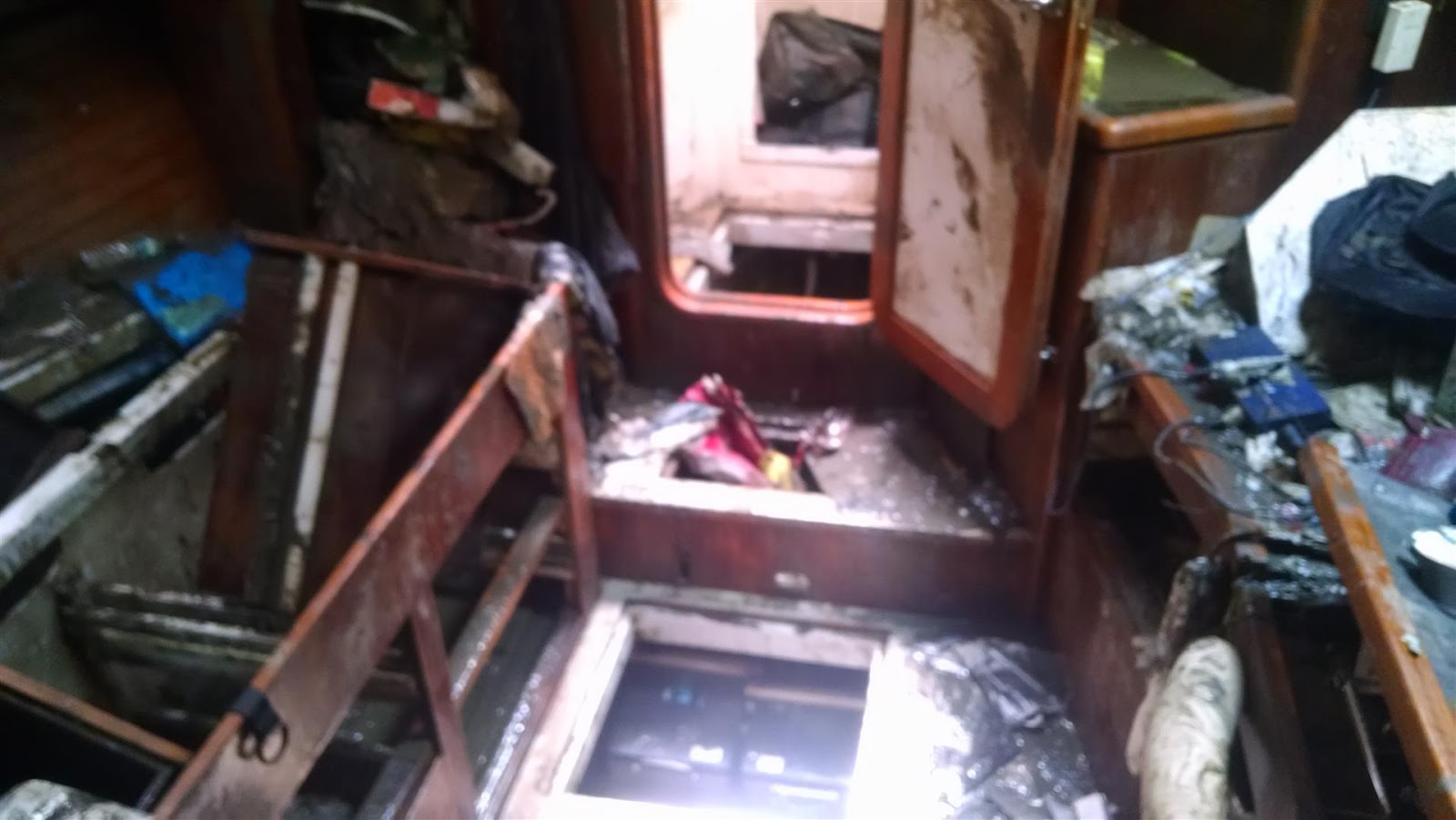
boat. It was, as expected, an absolute mess. The radar mast had snapped in half, the
dinghy’s chaps had shredded, as had the fly bridge bimini top, most of the headliners inside were down, and
everything was coated in silt & mud.
They applied a temporary patch to the holes in the hull, kept the dewatering
pumps available (not needed as it turned out), and towed it on the barge’s hip
down-river about 30 miles, then a few more miles up the Maurice River to one of
Northstar’s facilities (Boat World) in Leesburg, NJ. Before hauling it
out, we and Phil Risko, owner of Northstar Marine, discussed pumping out the
boat’s fuel and water tanks, removing the anchor, anchor chain and dinghy – all
to reduce weight as much as possible given their travel lift would be close to
its maximum capacity.
 |
| Hauled Out |
We drove down to the salvage yard the next day (Thursday, 18-Aug) to
meet the surveyor, examine the extent of the damage, and determine what of our
personal belongings could reasonably be salvaged. From an exterior perspective, the boat
actually survived the ordeal reasonably well….it was certainly mud-stained, but
still looked rather good above the waterline apart from the broken mast and
several stretches of deck railings that were mangled or missing; the salvage
crew admitted all that was due to the way the lifting straps were fitted,
essentially strangling the boat as they lifted it (twice) with the barge crane.
 |
| Starboard Stabilizer Askew |
As for below the waterline, the starboard side stabilizer
fin was askew 90 degrees, and the port side stab was deflected about 10
degrees, but both were intact and had never developed any kind of leak. The hull sported two holes….the first was
directly on the nose, about 3 feet below the waterline, clearly at the point of
initial impact; it had been patched with a concrete mix, but was relatively
small – approximately 4” by 4”. In
retrospect, we’re fairly certain that is where the initial and relatively low
volume water intrusion occurred; but as the stern had settled lower and the bow
rose with the falling tide, it wasn’t long before that hole was well out of the
water.
 |
| Busted Radar Mast |
The second hole – and the one that eventually sunk the boat
– was at the bottom of the keel at the amidships point….where the boat rocked and
jostled on the jetty wall as the tide ran out and ship wakes rolled her. Over time (e.g., 16 hours) that was just too
much weight stress for even a Nordhavn’s thick and sturdy hull. We often wonder what the outcome would
have been had more air bag buoyancy been available under the stern. (As an aside, both the surveyor - Steve Mason
of Mason Marine - and the owner of Northstar Marine - Phil Risko - marveled at
the sturdiness of the boat, relaying stories of other brands that simply
buckled and fell apart under similar circumstances.)
 |
| Chelle in the Salon |
Over the next three days (through Saturday, 20-Aug) we spent
long, hot hours in hazmat suits retrieving and scrubbing personal belongings and
various add-on equipment which had gone down with the boat. Once you got past the stench, though, it wasn't too bad. The real challenge (and occasional debating
point between us) was at what stage do you just say the hell with it and recognize there
is a point of diminishing returns? We
finally both agreed we had reached that point late Saturday afternoon...we stuffed
everything we had retrieved into our rental SUV, and said our final good-bye to
Ghost Rider at 1630 on that Saturday. We then spent the following three days driving
back home to Fort Myers.
Post Mortem
Throughout this ordeal, apart from some scrapes and cuts on
Rick’s hands and forearms sustained during futile attempts to plug the ragged
hole(s), nobody was hurt – although our egos and psyches took a solid
beating. Eventually, after a period of several more weeks, the boat was formally declared a CTL - a constructive total loss.
Back in a July post Rick wrote
this, plagiarized from an unknown author, and it seems oh so relevant once
again:
“Experience is a harsh
teacher: She gives the test first and
then teaches the lesson later.”
 |
| What's Left of the Guest Stateroom |
We’ve had some time to examine the events that led up to the
tragic loss of
Ghost Rider, and the
thing that starkly stands out is a departure from our normal routine, in both
the planning and the actual execution of that sortie. Typically one of us would lay out the day’s
route and the other would then review and perform detailed checks on depths,
hazards, Active Captain comments, etc., switching among multiple chart types,
making tweaks as needed. In the days
leading up to the event we had been changing destinations and routes on a daily
basis; we ended up at the Summit North Marina the day before because our
desired anchorage was both too small and too full. We had barely squeezed into that particular marina due
to its skinny depths, so the following day we decided to depart late afternoon to hit
the highest tide possible during egress.
 |
| View of the Muddy Engine Room Thru Salon Hatch |
That meant the next day’s sortie was going to be very short…with a 1500-ish departure, and less
than three hours to the next anchorage, since we did not want to run in
unfamiliar inland waterways in darkness.
It was to be a short run with nothing but daylight, deep water and good
weather along the route. What could possibly go wrong? Well...we had omitted our standard cross-check of
multiple sources, and had also failed to cross-check them again as we
approached the anchorage area…where Rick in particular became afflicted with
target fixation (mostly depth contours.) In the flying game,
such a lax approach can produce even more dire results.
Looking back, we also feel the boat might have been saved; had the flotation bags been deployed earlier, and with much more inflation, the grinding of the hull on the pivot point on top of the jetty would have been mitigated, and the severity of the breach would have been less...and perhaps survivable. Whether it could have also survived the large wakes that ultimately dislodged her from the rocks is pure speculation, but is certainly in the realm of possibility.
Regardless, the root cause still comes back to our mistakes.
 |
| The Hole That Sunk Her |
We were both taught that if we weren’t making them,
we weren’t trying hard enough. Risk taking had always been encouraged, as was the requirement
to deal with the consequences of that….eventually you are defined by
how you handle the consequences when under pressure. We think we did OK with the latter, and
eventually we will reconcile with the rest of it. (The other
infamous thing Rick’s father once told him, only somewhat tongue-in-cheek, was
“
don’t beat yourself up over a mistake….unless of course I’m not there to do it for
you.” Roger that.)
So that’s the whole story, and this is our last post in the Ghost Rider chronicles. Our thanks go out to all who have been so
supportive throughout the ordeal. There have been too many to mention here, we have an amazing support net.
 |
| Close-Up of the Hole |
On this three month voyage we had journeyed 1,800 nautical
miles. Since last October, when we first
started actively cruising
Ghost Rider
two months after acquiring her, we had covered over 3,000 miles, putting 700
hours on her main engine – which, by the way, never missed a beat. We owned her for one year and one day before
we lost her…and were just starting to think perhaps we had finally reached a
comfort point in our knowledge of, and ability to, manage her complex systems,
and just maybe had finally caught up with the break/fix expense curve. Or maybe not…that all might be romantic or
wishful thinking.