Wednesday, May 24, 2017

May 2017: The Leg to Bermuda

PRELUDE
We are in Bermuda and back online for a short spell.  This is a “catch up post” that summarizes the past week that we’ve been at sea and mostly off the grid.  I say “mostly” because we are able to communicate on a limited basis with Silvio’s satellite phone if needed, and also text messages via our Garmin inReach device.  Both have come in handy for occasional “ops normal” reporting, as well as a few technical assistance items that popped up along the way (with James at Yacht Tech (LINK), who was very responsive and helpful, as was Bob Senter.)
Our inReach Tracking & Messaging Site

We also can – and usually do if Rick remembers – post at least a daily message to our inReach tracking web site (LINK)….when you visit there to view our track and current position, if you look in the left pane and expand it by clicking on the arrow (>) you will see a list of the messages we have transmitted along the way.  Or in the map display, message boxes will appear along our track – just click one those for quick status updates when we are otherwise incommunicado.

TUE 16-MAY
Relish Departing Nassau
At the captain’s briefing on Tuesday morning (16-May @ 0830) we got a weather forecast good enough to make launching on our planned D-Day a “go”. We had calculated the ETE to join the five other boats at the rendezvous (RZ) point at about 25 hours; and with their scheduled departure time of 0800 the following day we came up with a departure time of 1130.  That made for a leisurely morning for us to insure that all pre-departure checklist items were covered, and also gave the crew time for some familiarization training in Relish’s engine room to prep for the shared duties of periodic engine room inspections while underway.
Chelle & Gary on the Fly Bridge

Even with some extra time spent trying to figure out the complexities of Relish’s auto-start generator system (which is pretty sexy) we still were underway by 1115.  The waters surrounding New Providence were relatively calm as we exited Nassau harbor and pointed the vessel to the Northeast towards the RZ point.  As the day progressed wind and seas gradually increased to the 15-to-20 knot and 4-to-5 foot range, but quartering on the beam so the stabilizers handled most of the rolling.  When we turned Relish more to the northwest after rounding the Berry Islands we were mostly going downhill with the waves, so the ride was good.

Chelle Prepared Great Dinners for Us...and We
Always Ate as a Crew in the Pilot House
One of early and fairly critical checks in the sortie was powering up the water maker to be certain we would have plenty of fresh H2O for the upcoming long legs.  Many if not most ocean crossers consider a water-maker problem to be a “no-go”, at least at the outset.  Relish has a top of the line unit – a Newport 700 MKII which can run off of 24V DC power (as well as 240VAC) and can pump out 30 gallons of fresh water per hour.  And – nuts – we found it was leaking at one end of one of the membranes.  But a couple turns with a wrench on a small end nut solved that and we were in business.  Otherwise our first day of mechanical checks were fairly routine and the boat ran fabulously.

With 4 crew members our night shifts were fairly pleasant – Silvio took the helm from 2100 to midnight, then Gary until 0300, followed by Rick from 0300 to 0600, and then Michelle for the last slot from 0600 to 0900.  During the daytime hours we used the informal “who wants to drive for a while?” approach vs. scheduled shifts, and it all worked well.

WED 17-MAY
Our Rendezvous with the NAP Fleet
While our departure weather forecast was acceptable, it wasn’t ideal; as predicted the winds started kicking on Wednesday afternoon…right about the time we came within AIS and VHF radio range of the five other Nordhavns comprising our NAP fleet.  Seas went to 6 feet with occasional bigger holes in the water as the winds cranked up on cue, and that cut short Rick’s fishing in the Gulf Stream.  Shortly thereafter we were in consistent 6-to-8 foot seas at nasty 6 second intervals, so everyone strapped in.  Our rendezvous with N55 Angela, N55 Moxie, N52 Aeoli, N50 Tivoli and N47 Roam was mostly uneventful, apart from the fact that we were about 30 minutes early and thus had to slow down and execute some S-turns to weave our way into the formation.

One of Our Buddy Boats
Eventually the 8 footers @ 6 second intervals had impacts on the fleet, as the smaller N47 and N50 had to slow down to keep fuel burn and comfort to a tolerable level.  (A good rule of thumb for tolerable sea state:  add 2 to the wave height, and if your intervals are less than that number, you won’t like the ride.)  So Roam and Tivoli fell back into their own two-ship formation while the rest of us continued on, playing follow-the-leader (Angela) in a loose diamond formation.  And Relish caught her first fish without the benefit of a fishing pole – a very unlucky flying fish had the misfortune to launch itself at the top of one of the bigger waves and came to a sudden stop on our fly bridge (which is at least 20 feet up.)
Flying Fish Crash Lands
on Our Fly Bridge

Relish continued to perform well in the sloppy conditions, but after our daily wide open throttle (WOT) run – which is performed daily to help exercise the big diesel engine – our engine room temperatures were escalating (reaching 130F), and that caused the stack blower to thermal out, and the SeaFire fire suppression bottle wasn’t too happy either based on its pressure gauge reading.  Neither caused any serious problems other than some elevated blood pressure, as eventually we got it under control by slowing and opening the lazarette door to let its blowers bring more of the cooler air in.  Rick also changed the fuel valve positions to return unused diesel from the engine to the original feeding fuel tank rather than the engine room supply (day) tank, and that also helped – those tank temp readings went down from 150F to the 110-118F range as a result.

THU 18-MAY
We had used the same overnight shift schedule as the previous night and again that worked well for the crew.  By daybreak seas had subsided to 2-to-4 feet. 
Our Nav Chart with Revised
Weather Routing

Those of you tracking us via our inReach online tracking map (LINK) likely were wondering about our initial route segments – mostly north up the U.S. coastline vs. a direct shot at Bermuda from our RZ point (although still 100+ miles off the coast).  The reason for that was twofold:  first to take advantage of the Gulf Stream’s pushing currents for as long as we could (at one point saw 13 knots speed over ground, which for a 150,000 pound full displacement trawler is quite fast); and secondly to find the most comfortable route possible that still allowed all boats to make the journey with adequate fuel.  By extending our route even further north than originally planned we added about 100 miles to the journey but were able to minimize the time spent in that pressure gradient that kicked up those 8 foot seas.
Fishing in the Lumpy Ocean

With both the sea and boat condition improving, we were also able to spend some more time in the cockpit with a couple of lines out to troll for fish – Mahi in particular.  The first fish to bite had to be rather large, as it nearly spooled Michelle’s reel in a very short time; we tried a bit more drag to stop the fish’s high speed run, but with 250 yards of line already out and all the “water drag” that entailed the 40# line just snapped.  Nearby one of our buddy boats hooked into (and landed) a small marlin (estimated at 60 pounds), so we guessed that we had hooked something similar.  And we definitely did not have gear beefy enough for one of those.
Fishing with the Fleet

Silvio contacted our weather briefer at Commanders (LINK) for a mid-day update, and generally that confirmed the previous forecast and routing decision, so the expectation was for calmer seas by the next morning.  And Relish had passed its halfway point between Nassau and Bermuda with over 550 miles under her keel by the end of the day, averaging better than 8 knots along the way.

FRI 19-MAY
When Rick came on watch at 0300 the ride was already starting to smooth out, and by daybreak we were in beautifully smooth, deep blue seas.  Temperatures had dipped into the 70’s with mostly clear skies as well.  We had the fishing lines out by 0700, and while it took a couple more hours we got a strong hit on the short-line port side rig.  Michelle was on cockpit duty and she did a great job of getting the fish – a 40-inch Mahi (Dorado) – to the boat; rather than gaff it Rick grabbed the leader and pulled it into the boat.  These boats don’t have fish boxes, so we just covered it with a large yoga mat to settle it down (best use I’ve ever seen for one of those things).  We clubbed it, but for the next fish we’ll pour some alcohol into the gills for hopefully better – as in less hectic – results.
Michelle & Her Nice Dorado (Mahi)

During the course of a long cruising day there are always some maintenance and/or boat operational tasks that need tending to – today Silvio and Rick wanted to give the 20KW genset a rest and test out how the new battery chargers and the big 175 amp alternator would behave – beautifully and correctly as it turned out.  We also needed to troubleshoot two minor hydraulic leaks on the ABT active stabilizer fins – one at the pump’s manifold and the other at the starboard actuator assembly.  Since we had pretty flat seas we first turned the stabs off to give them a rest and check for static leaks (none found).  A bit later we reactivated using only the port side fin and then monitored for leaks overnight (the ABT stabilizer system performs nicely using only one of the two fins, attenuating roll up to 75% efficiency); the seepage returned but we were making troubleshooting progress, and it still appeared to be minor as the hydraulic reservoir remained at or above the full mark.

That evening we enjoyed some VERY fresh Mahi as an appetizer, but saved the bulk of the filets for a planned potluck dinner when we get to Bermuda.

SAT 20-MAY
As of Saturday morning we had traveled 770 nautical miles and had another two and a half days to go to reach Bermuda.  Overnight watches were completely and blissfully uneventful with light winds and seas that continued to be smooth under mostly clear skies with temps in the low 70’s.  The graveyard shift boat drivers shared fishing stories and tips to while away the time, and when Rick’s watch was over he had the lines deployed once again, this time by 0630.  Our last weather briefing called for at least one more day of benign weather, but after that we would likely run into the next pressure system that was forecast to kick up the winds to 20K and seas to 5 feet.  So we wanted to make the most of this fishing time.
Sunset from the Cockpit in the Middle of an Ocean

Silvio and Rick spent some time on a few more operational and maintenance items, all relatively minor and fairly routine.

But the bulk of the day was spent swapping off helm duties, routine engine room checks every 3 hours, monitoring the fishing rods in the cockpit (no action this day), and grabbing sun on the foredeck or just chilling out on the fly bridge.

SUN 21-MAY
It was another beautiful daybreak, once again greeting us with light and variable winds and very calm seas.  We had the fishing lines deployed before 0600.  But fishing activity was light at best until later in the day.

On this day Silvio and Rick got some power management lessons from the new inverter(s)…revealing that not all 120V galley equipment can be run simultaneously, with the convection setting of the microwave being the main violator of excess amps.  That and a slight dishwasher issue complicated galley operations for a spell, but we finally figured out a combination of power settings (and cleared the dishwasher fault), making Michelle considerably happier.
WOT Instrumentation Readings All
Good Except for that EGT Reading

As you may recall we had some concerns from our previous wide open throttle runs, so afterwards we had conferenced via Silvio’s sat phone with diesel guru Bob Senter, whose expert opinion was that our EGT sensor (pyrometer) was faulty, since all other engine parameters were completely normal.  So today’s WOT went fine as long as we ignored the EGT gauge, and the exhaust from our big Lugger diesel was lacking any signs of accumulated soot; but we still kept it to 5 rather than 10 minutes just to be safe.

Silvio's Mahi
As our day was winding down with another spectacular sunset and we began our usual preparations for night watches, the port side fishing rig went off, and this time Silvio was available to man the rod and he reeled in a nice 30” Mahi – his first ever, so a great conclusion to a fine day.

MON 22-MAY
Our streak of glorious early mornings came to an end as we passed through a line of light showers towards dawn, and daylight broadened with grey skies, light mist, and a brisk breeze with lumpy water.  The rain clusters we had seen on radar in the hours before sunrise decreased in strength, which was actually unfortunate, as we were hoping for a fresh water wash-down of the boats before nearing Bermuda and St. George’s Harbor.

But none of that prevented us from deploying the fishing lines once again at 0630.  The port side line went off again just after 0700….unfortunately we had tangled with an overly curious sea bird rather than a fish.  Rick donned the gloves and was able to capture the gull and untangle its wing from the fishing line without damage to the bird or the fishing rig.  Our total catch count was now 2 flying fish, a seagull and 2 nicely proportioned Dorados.
Land Ho - Bermuda on the Horizon

Relish continued to hum along like a thoroughbred as the odometer rolled over past 1100 nautical miles on this initial leg.  The seas were churning up as the day progressed, eventually getting back into the 4-5 foot range, before settling down a bit later in the day.  As we came into sight of land our formation fell into a single file with closer spacing in preparation for the approach to St. George’s channel.  After waiting for a large freighter to exit the harbor around 1730 at the request of Bermuda Radio, we all motored over to the check-in pier and processed through customs.  It was a slow process with 4 crews in the line, but the customs personnel were kind and courteous.  
Four Nordhavns Lined Up for
Customs Processing

When that was finally complete we motored over to nearby at St. George’s Dinghy docks and “Med-moored” Relish just as the sun set. We were exhausted but happy to be securely tied up in an impressive looking row of Nordhavn yachts.  After hooking up the passerelle, taking a shower, grabbing a short meal and a drink, we all crashed into our respective bunks for some much needed – and uninterrupted – sleep.
 
Med Mooring at St. George's
TUE 23-MAY
Weather wise Tuesday was a delightful day – bright sunshine, temps in the low 70’s, some fair weather cumulus and a steady 10 knot breeze out of the east.  During the night the fleet’s other two boats, Roam and Tivoli, had arrived and processed through customs, so now all 6 vessels were together once again.

View of the Bay From Our
Fly Bridge
This was maintenance day for us – Michelle and Gary went to work giving a salt-encrusted Relish a much needed bath, while Silvio and Rick worked in the engine room to transfer some fuel from port to starboard to correct a list that had gone unnoticed in the rough seas.  But the larger task was to change the oil and oil filter on the main engine, a big L1276A Lugger diesel….it takes 44 quarts of oil and an enormous spin-on filter that looks more like a small SCUBA air cylinder than an oil filter canister.  It isn’t a difficult operation, but it takes some time to complete based on sheer volume alone.  We also made our list of needed parts to order for delivery at our next port (Horta in the Azores) and Michelle made a brief re-provisioning run to the local market.

The Wahoo Bistro
The rest of the day was spent relaxing and socializing with the other members of the fleet.  Our next door neighbor at the dock was Cameron McColl who had piloted his gorgeous N57 Jura to Bermuda from BVI, and would now join our NAP fleet for the journey to the Azores.  That evening we piled into his dinghy to head across the bay to have a meal at Wahoo’s Bistro, where we enjoyed some very fresh and tasty fresh fish for dinner (the Red Hind there is outstanding, as is the Wahoo.)

After that it was chill time back on Relish, followed by another night of blissful, continuous sleep.

WED 24-MAY
Today is a holiday here….”Bermuda Day” (LINK) 
Chelle Walking the Plan, aka
the Passerelle
an annual celebration on the island marking the unofficial start of the summer season.  Thousands of people will crowd the streets of Hamilton to celebrate Bermuda's rich heritage with a parade, music, dancing and other festivities that stretch long into the night.
  This year it also coincides with the 35th America’s Cup racing events, a battle for the oldest trophy in international sport. Racing starts with the Louis Vuitton America’s Cup Qualifiers on 26th May and the top Challenger will meet Defending Champions in June.
Relish on Her Med Mooring

The latest weather reports indicate that conditions will go to hell on Friday, which was our planned departure date; so it appears we’ll be hanging out in Bermuda for an extra day or two.  In addition to TRWs, we’ll have winds in excess of 25 knots, and when that happens here you have to leave the dock and anchor out in the bay.  We’ll probably execute that move tomorrow (Thursday) when we also head over to the fuel docks to top off for the long leg to the Azores. 

More to come later, perhaps before we start on the next leg; but if not, stay tuned to our tracking site for the very latest.  We'll also be posting to the "official" NAP blog in the next few days as well.....likely after we get settled at anchor while waiting for the next weather window.

Monday, May 15, 2017

May 2017: Final Preps for Departure

On Wednesday 10-May we once again drove back to Palm Beach, this time in a one-way rental car loaded with our travel bags.  We stopped at Old Port Cove marina to grab a couple more spare parts from Yacht Tech for Relish, and then the next day (11-May) caught a flight out of PBI back to Nassau. 
Relaxing Dinner in Relish's Cockpit

Untangling the Jordan
Drogue Chute
With just less than 5 days remaining before our planned departure date we went to work on final departure preps.  They were all relatively minor items:  troubleshooting the GFCI outlet for the fresh water pump, tightening the couplings on the transmission drain/fill lines, laying down new absorbent pads for the main engine, preparing and then securing the Jordon drogue chute, topping off the wing engine’s day tank, and mounting a coolant recovery tank for the wing engine….plus a few other nits here and there.

Who the Hell Put a
GFCI Back There?
We also prepared clipboards for the Pilot House with appropriate checklists and communications protocols for the crossing, and made final tweaks to our safety equipment – primarily configuring life vests with signaling devices and then topping off the ditch bag.  Over a couple of days we loaded our planned routes into the ship’s navigation systems, as well as a couple of backup laptops, and double-checked waypoints for accuracy and clearance.
Michelle Loading Routes Into the
Furuno System

Of course we also took time to get off the boat and walk to some of the local eateries nearby.  Silvio had found a local favorite just a short walk from the marina, so we enjoyed some of the best conch salad to be found anywhere, along with some spiced Bahamian shrimp, and for a third course a pile of seasoned vegetables over a whole snapper -- all washed down with plenty of Kalik (a good local beer.)
Local Nassau Dive for Conch
Salad & Kaliks

On Sunday we also made a final grocery run which primarily consisted of loading up the galley with fresh produce, fruit and dairy from the local market. The prices were eye-popping….Nassau is not an inexpensive place to shop for such things.  Gary Brace, our 4th crew member for the leg to Bermuda, flew in that evening and joined in on the preps.

Final Shopping Run in Nassau
On Monday morning (15-May) we participated in the first of the final two captain’s briefings via cell phone and Skype.  Bernie Francis chaired the meeting, introducing all captains and crews to each other, and going over final checklists for departure.  We followed that with discussions about individual crew member responsibilities in the event of an MOB event and a few other emergency situations.

That evening we experienced a significant fresh water leak under the galley sink when the filtered water (plastic) faucet connector snapped at its threads.  We scrambled to turn off the fresh water pressurizing pump and use other faucets to relieve pressure and drain the lines....but we still dumped a LOT of water into the boat and down into the engine room below. Lacking a good plumbing repair kit we had to improvise some of our own parts and cap off two fresh water hoses.  We now have high praise for JB Weld's "WaterWeld" product.
Farewell Fireworks Over Nassau Harbor

After all that it was all about checking for a good weather window, and we were pretty much ready to launch by the next day (16-May).  We have another captain's briefing at 0830 that day, and that will determine the ultimate departure timing and rendezvous with the rest of the fleet 200 miles to our northwest.  We won't have time for another blog post before then, so stay tuned to the tracking site to verify launch:  (CLICK HERE).

Saturday, April 29, 2017

April 2017: Taking Relish Back to Nassau

Our inReach Track to Nassau
On Monday 24-April we drove back over to Palm Beach once again, with the goal of completing another round of provisioning as well as getting Relish’s punch list completed and moving her back to Nassau. By late morning on Wednesday, 26-April, we were ready to go.  On the way out of the Lake Worth area we stopped for fuel, taking on about 1100 gallons of diesel (bringing our total to 2800 gallons) and then headed out into open waters.  (Click HERE for our tracking site.)

Onboard were James Knight and Scott (from Yacht Tech), Gary Brace (our 4th crewmember for the upcoming sortie to Bermuda), plus Rick & Michelle.  On the first leg of the route we sailed due south hugging the coastline, mainly to minimize the impact of the Gulf Stream current.  Then at Fort Lauderdale we turned Relish eastward towards the Bahamas.  

inReach Track....with Messaging
Detail Displayed
During the remaining daylight hours we spent our time testing systems, otherwise known as sea trialing.  Both the main and wing engines got a good workout, as did the two diesel generators, air conditioning system, water maker, galley appliances, plumbing, pumps, and of course all the nav/comm gear. 

This was a fabulous opportunity for us to get to know the boat a bit better.  While a Nordhavn 60 bears some resemblance to our N47, it is in other ways a very different vessel – Relish is both bigger and more complex, and also has very different nav/comm equipment….mainly Furuno NavNet 3D augmented by Nobeltec TimeZero. The primary differences and complexities that stand out are the generator auto-start system, modifications made to accommodate European shore power differences (50 HZ AC power vs. 60 HZ), as well as an extensive Maretron monitoring system (which is very sexy.)
Two Radars Active at Different Ranges Plus the Chartplotter

During daylight hours everyone took informal turns at the wheel.  After the crew enjoyed a good dinner of stuffed peppers together in the pilot house just before nightfall, we then split up into our overnight shifts. Gary manned the helm until 2200, then Rick & Michelle took the next watch from 2200 to 0200, followed by James & Scott until 0600.  At about that time we experienced a battery charger issue that required attention (later rectified by replacing a 100 amp fuse), although a backup unit was still functional. 
Plus the Maretron Screen....One of Many Available

Sea conditions tended towards the sloppy side much of the night and following day; with the wind cranking around 20K from the NE, seas built to 4 feet at short intervals, with the occasional 5 foot hole in the water. But overall the hobby-horse ride wasn’t too bad.  Rick and Michelle got to experience sleeping in a forward state room in lumpy seas:  doable when you have a good mattress & pillow (we did), don’t mind dozing in a constantly moving rocking chair (we didn’t), and ignore the occasional air between your back and the mattress (that took some practice.)
N50-21 Get Away Punching Thru the Waves

We had a buddy boat in trail for most of our journey.  The Get Away is a Nordhavn 50 recently purchased by Greg and Michelle Dreiling, and our trip to Nassau turned out to be a good sea trial opportunity for them as well, following a couple months of refit work performed by James’ Yacht Tech yard in Palm Beach.  Get Away performed beautifully, and she looks as good as she runs.  It’s a 15 year old boat that looks and runs like new.  For a video of Get Away taken from Relish Click Here.
Michelle Filming Get Away Getting Spray Over the Bow

Silvio was eagerly waiting for us when we arrived at Nassau Yacht Haven shortly after 1700, and he was very happy to be reunited with his beautiful boat.  He treated us all to a great dinner at the marina’s restaurant (The Poop Deck), and we all crashed into our bunks shortly after that for some much needed shut eye.

The inReach's Trip Summary
We were all up early the next morning and used the time to troubleshoot some of the minor issues that had cropped up….everyone’s circadian rhythm was whacky anyway.  We also in-processed through Bahamian Customs (they had already shut down the previous evening) before scrambling to the airport to catch a flight home – probably setting some kind of record for the shortest time between in-and-outprocessing through customs and immigration.

We have a short break now – until 11-May – before we fly back to Nassau to make final preps for the ocean crossing.  So more to come, stay tuned.  If you have time click over to the NAP Blog site to see the latest there.

That's James Bracing himself in Relish's Pilot House Door Taking Pics of Get Away as She Came Alongside
Enroute to Nassau. Notice the Bow Up (Pitch) Angle of Relish at That Moment.

Wednesday, April 19, 2017

April 2017: All About N60 Relish

Firstly, as promised in the last blog entry, here is the link information for the blog site that covers the larger “Nordhavn Atlantic Passage 2017”…note there are two NAP blog entries already posted as of today, the first providing an overview of the boats involved and the general schedule, the second offering insights into what sort of preparations are involved for such a journey: 


You will also note that in the upper right hand corner of the sidebar there are a couple of new links that point to the NAP web site and our satellite tracker (not much to see on the latter yet, but it is up & live if you want to test out access to it.)

Since Michelle and Rick are also responsible for the NAP blogs you will find some occasional overlap between those and our personal Ghost Rider blog, but we’ll try to avoid that where possible.  Once you’ve had a chance to peruse the NAP coverage at the links above, come back here and we’ll share some information about Relish, the Nordhavn trawler on which we are crewing, as well as some of the preparations with which we are assisting.

Relish, a Nordhavn 60
About Relish
Relish is a 2010 Nordhavn 60 (hull #52).  Our friend Silvio purchased her in St. Petersburg, Florida in 2016, and as you will see from some of the pictures included here she is a drop-dead gorgeous vessel.  Relish is one of the early N60 production boats, which is actually a stretched version of the now discontinued N55.  The extra five feet is at the stern of the boat, providing a much roomier cockpit and lazarette than its predecessor.

Salon & Galley
With an overall length of 63 feet, a beam of 18 feet, and displacing 120,000 pounds, she is a beefy ocean-going trawler that can hold her own in the toughest of conditions….waaay more than her occupants can withstand.  And with a 2,800 gallon fuel capacity (she has the optional long range tanks) Relish can go a very long distance without refueling….around 4000 nautical miles on average.  So in theory she could make the entire Atlantic crossing without refueling - although that isn’t the plan.

Pilot House
Relish has three staterooms and three heads, along with a comfortable salon and well-equipped galley area, plus a very spacious cockpit for outdoor seating.  Its fly bridge and pilot house boast state of the art nav/comm equipment, including redundancies appropriate for an ocean-crosser.  She is powered by a single diesel power plant, a turbocharged 340 HP Lugger L1276A, but also has a backup get-home engine, along with two diesel generators.

Preparations to Cross an Ocean
Roomy Cockpit
As you will read about in the NAP blog, getting a boat and its crew ready to cross an ocean is not a simple exercise - the amount of planning and provisioning that go into it can sometimes seem overwhelming.  But given enough time and money – and an organized approach – it can certainly be done.

Stowing Spares in the Laz
Around the time we first met Silvio on his boat (December ’16, in Nassau) we were also in the process of building provisioning worksheets for our next boat.  We offered those up for his use, and eventually, at his request, we became the equivalent of his “purchasing agent” here in the U.S., since Silvio had to return to his home in Switzerland.  At about the same time Relish was sortied back to the U.S. for various preparatory maintenance tasks at Yacht Tech’s yard in Palm Beach.  So we went to work inventorying what was (and wasn’t) present on the vessel, and started to fill in the gaps.
Oil....Lots of It

Rick handled basic boat supplies, fishing gear, tools, lubricants and the like, while Michelle focused on crew quarters & the galley – both equipment and food.  The latter also involved developing meal menus for the entire month-long journey, which had to take into account the crew’s likes, dislikes and allergies.  We’ve since loaded much of these provisions aboard Relish – had to, Rick’s office wouldn’t hold any more stuff, nor would our vehicle – although at this point only non-perishable foodstuffs have been a part of that.  The perishables will wait until just before the departure date for the crossing.
More Oil

Getting Relish Back to Nassau
In addition to all the preparatory activities, we are also planning to sortie Relish from Palm Beach back to Nassau (New Providence in the Bahamas) soon – likely some time the week of 24-April.  
Relish Getting New Bottom
Paint at Yacht Tech

We’ll use that opportunity as a mini sea trial, with an approximate 26-hour and 200 nautical mile non-stop sortie to Nassau’s Yacht Haven marina.  James Knight, owner of Yacht Tech, will captain the ship, and we’ll wring out all the systems.  (If something should go awry James is the guy you definitely want on board with you.)

By the time we reach Nassau we should have a fairly good idea if Relish is ready to make the long trek across the big pond.  That will also give us a chance to perform another test on our Garmin/Delorme inReach tracker.  After that we’ll publish another blog with instructions on how to access and use that tracking site.  So stay tuned.

Wednesday, April 12, 2017

April 2017: Ghost Rider Redux?

The DeFever 53
It has been a long time since our last post, but all along we've been busy trying to figure out a way to get back into the boating business with a Ghost Rider II.  We've actually been scouring the boat brokerage market since last October, and in that span we've been on at least 13 prospective boats.  One of those, a DeFever 53, caught our fancy. But after a very extensive survey and sea trial revealed some unanticipated issues, we decided to pass on it. So the search continues.

Relish - A Nordhavn 60
Nevertheless, in the midst of all the boat browsing we've been making preparations for a crossing of the Atlantic ocean on a Nordhavn 60, named Relish. The Nordy community is a tight one, and one where it's common to make new friends on a regular basis.  In this case we befriended a relatively new Nordhavn owner who, after buying the boat of his dreams here in the U.S., wants to get it back to his home waters in the Mediterranean.  And he needed some crew to help him do that.

Nordhavn Atlantic Passage
Beginning in mid-May 2017 several Nordhavn trawlers will make the long trek across the Atlantic ocean....from the east coast of Florida to Gibraltar. We're calling this the "Nordhavn Atlantic Passage 2017", aka NAP.  And we're jazzed to be a part of it.

The total journey will traverse approximately 3,900 nautical miles of open ocean, and will take us about a month to complete.  Our schedule is noted below. Bernie Francis (see link here) is our group leader aboard the flagship. Bernie was also our mentor and trainer in the early days of our Nordhavn ownership experience.  Ideally, assuming no weather delays, the trans-Atlantic passage will be completed once all vessels arrive in Gibraltar on or about 16-June.

As we chug across the big pond we'll be able to post near-real-time tracking via our Garmin/Delorme inReach satellite device; plus Michelle and I will be one of the flotilla's bloggers.  We will post the web site URLs for both the tracking device and the NAP blog once we get those finalized.  In the interim, here is the general current crossing plan:
  • Depart Palm Beach, Florida on Wednesday 17-May for a 5 1/2 day passage to Bermuda.
  • Arrive in Bermuda on Monday 22-May and stay 4 nights.
  •  Depart Bermuda Friday 26-May for an 11 day passage to Horta, Azores.
  •  Arrive in Horta on Tuesday 6-June and stay 4 nights.
  •  Depart Horta on Saturday 10-June for a 6 day passage to Gibraltar.
  •  Arrive Gibraltar on Friday 16-June.
One oddity to note....while Palm Beach will be the departure point for most boats, our vessel (Relish) will actually be departing from Nassau on New Providence island in the Bahamas.  That will require us to depart on 15-May to intercept the other boats departing from Florida.
Planned Route Across the North Atlantic

The owner and captain of Relish is Silvio Gentile, who resides in Lugano, Switzerland.  There are a number of circumstances that prevent Silvio from being present to supervise the preparations and provisioning of the boat at Yacht Tech's boatyard in Palm Beach, so Michelle and Rick are assisting with a few projects.

We'll have more to come on how we are preparing ourselves and the boat for the journey in the near future.  Stay tuned.

Sunday, September 25, 2016

15-20 Aug: Ghost Rider Salvage Ops

Northstar Marine was subcontracted by SeaTow to dive the boat, sling it, and then raise it using their large barge-mounted crane.  (Northstar, by the way, has a solid reputation in the industry, which included a significant role in the BP oil spill recovery efforts.)  There would be some understandable delays here….divers were working with very limited visibility, as well as very narrow time windows where the current was at a manageable velocity.  Raising a 95,000 pound boat in 30 feet of water is a complex operation under the best of conditions.
Hauling Out

By the time all parties were in agreement and equipment was in place, and divers had rigged the slings under the boat, it was a full week later, Monday (15-Aug).  The first lift attempt did not go well….as the boat got to the surface one of the slings either broke or in some fashion failed.  The surveyor commented that what he saw of it – before it went back down – didn’t look good….the boat was awash in mud and silt, and the mast had suffered significant damage during the lift attempt.

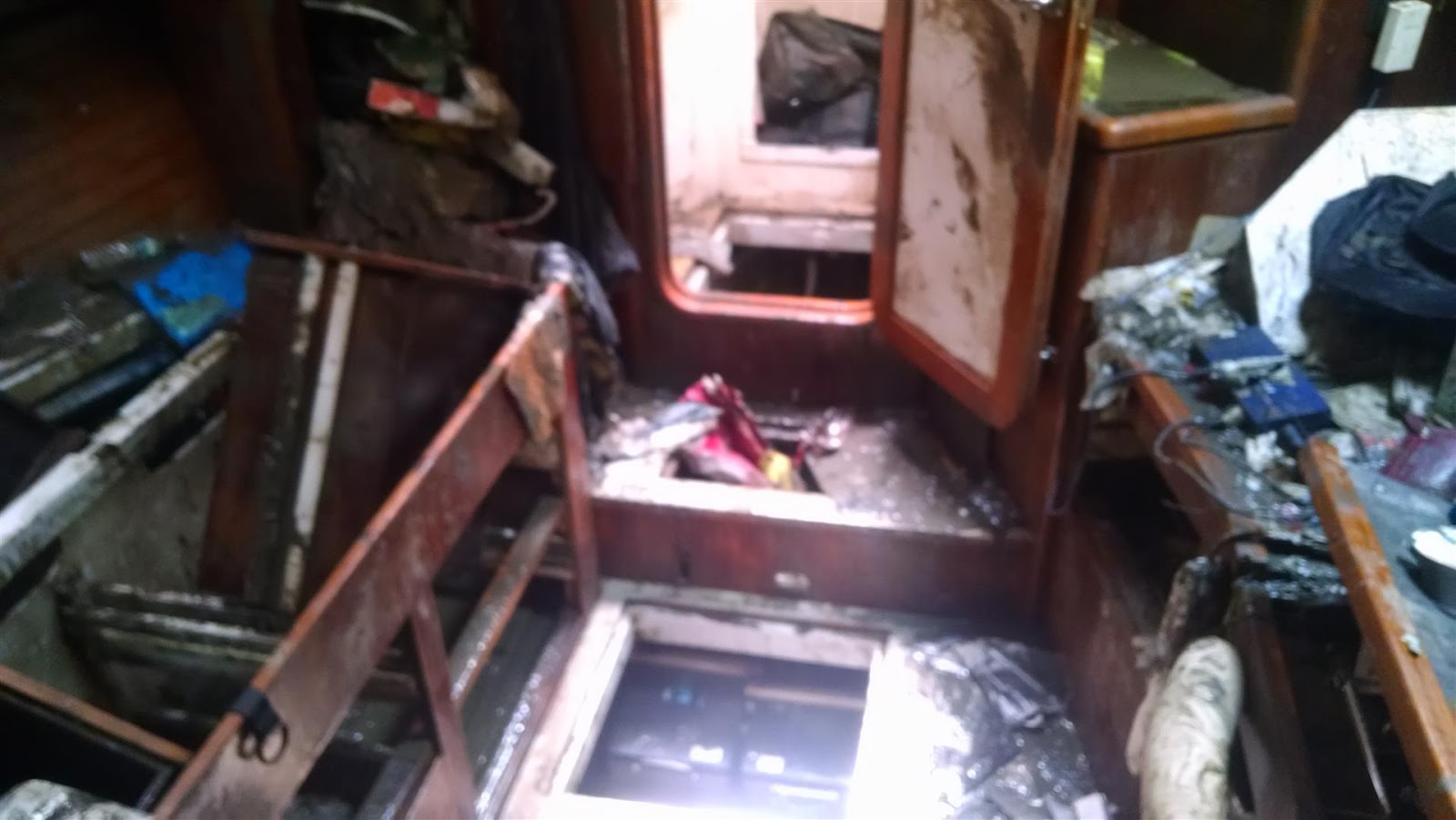
On Tuesday (16-Aug) they tried again….but it wasn’t until the next morning (Wednesday, 17-Aug) that they were able to fully raise the boat.  It was, as expected, an absolute mess.  The radar mast had snapped in half, the dinghy’s chaps had shredded, as had the fly bridge bimini top, most of the headliners inside were down, and everything was coated in silt & mud.  They applied a temporary patch to the holes in the hull, kept the dewatering pumps available (not needed as it turned out), and towed it on the barge’s hip down-river about 30 miles, then a few more miles up the Maurice River to one of Northstar’s facilities (Boat World) in Leesburg, NJ.  Before hauling it out, we and Phil Risko, owner of Northstar Marine, discussed pumping out the boat’s fuel and water tanks, removing the anchor, anchor chain and dinghy – all to reduce weight as much as possible given their travel lift would be close to its maximum capacity.

Hauled Out
We drove down to the salvage yard the next day (Thursday, 18-Aug) to meet the surveyor, examine the extent of the damage, and determine what of our personal belongings could reasonably be salvaged.  From an exterior perspective, the boat actually survived the ordeal reasonably well….it was certainly mud-stained, but still looked rather good above the waterline apart from the broken mast and several stretches of deck railings that were mangled or missing; the salvage crew admitted all that was due to the way the lifting straps were fitted, essentially strangling the boat as they lifted it (twice) with the barge crane.

Starboard Stabilizer Askew
As for below the waterline, the starboard side stabilizer fin was askew 90 degrees, and the port side stab was deflected about 10 degrees, but both were intact and had never developed any kind of leak.  The hull sported two holes….the first was directly on the nose, about 3 feet below the waterline, clearly at the point of initial impact; it had been patched with a concrete mix, but was relatively small – approximately 4” by 4”.  In retrospect, we’re fairly certain that is where the initial and relatively low volume water intrusion occurred; but as the stern had settled lower and the bow rose with the falling tide, it wasn’t long before that hole was well out of the water.
Busted Radar Mast

The second hole – and the one that eventually sunk the boat – was at the bottom of the keel at the amidships point….where the boat rocked and jostled on the jetty wall as the tide ran out and ship wakes rolled her.  Over time (e.g., 16 hours) that was just too much weight stress for even a Nordhavn’s thick and sturdy hull.  We often wonder what the outcome would have been had more air bag buoyancy been available under the stern.  (As an aside, both the surveyor - Steve Mason of Mason Marine - and the owner of Northstar Marine - Phil Risko - marveled at the sturdiness of the boat, relaying stories of other brands that simply buckled and fell apart under similar circumstances.)

Chelle in the Salon
Over the next three days (through Saturday, 20-Aug) we spent long, hot hours in hazmat suits retrieving and scrubbing personal belongings and various add-on equipment which had gone down with the boat.  Once you got past the stench, though, it wasn't too bad. The real challenge (and occasional debating point between us) was at what stage do you just say the hell with it and recognize there is a point of diminishing returns?  We finally both agreed we had reached that point late Saturday afternoon...we stuffed everything we had retrieved into our rental SUV, and said our final good-bye to Ghost Rider at 1630 on that Saturday.  We then spent the following three days driving back home to Fort Myers.

Post Mortem
Throughout this ordeal, apart from some scrapes and cuts on Rick’s hands and forearms sustained during futile attempts to plug the ragged hole(s), nobody was hurt – although our egos and psyches took a solid beating.  Eventually, after a period of several more weeks, the boat was formally declared a CTL - a constructive total loss.

Back in a July post Rick wrote this, plagiarized from an unknown author, and it seems oh so relevant once again:

Experience is a harsh teacher:  She gives the test first and then teaches the lesson later.”
What's Left of the Guest Stateroom
We’ve had some time to examine the events that led up to the tragic loss of Ghost Rider, and the thing that starkly stands out is a departure from our normal routine, in both the planning and the actual execution of that sortie.  Typically one of us would lay out the day’s route and the other would then review and perform detailed checks on depths, hazards, Active Captain comments, etc., switching among multiple chart types, making tweaks as needed.  In the days leading up to the event we had been changing destinations and routes on a daily basis; we ended up at the Summit North Marina the day before because our desired anchorage was both too small and too full.  We had barely squeezed into that particular marina due to its skinny depths, so the following day we decided to depart late afternoon to hit the highest tide possible during egress. 
View of the Muddy Engine Room Thru Salon Hatch

That meant the next day’s sortie was going to be very short…with a 1500-ish departure, and less than three hours to the next anchorage, since we did not want to run in unfamiliar inland waterways in darkness.  It was to be a short run with nothing but daylight, deep water and good weather along the route.  What could possibly go wrong?  Well...we had omitted our standard cross-check of multiple sources, and had also failed to cross-check them again as we approached the anchorage area…where Rick in particular became afflicted with target fixation (mostly depth contours.)  In the flying game, such a lax approach can produce even more dire results.

Looking back, we also feel the boat might have been saved; had the flotation bags been deployed earlier, and with much more inflation, the grinding of the hull on the pivot point on top of the jetty would have been mitigated, and the severity of the breach would have been less...and perhaps survivable.  Whether it could have also survived the large wakes that ultimately dislodged her from the rocks is pure speculation, but is certainly in the realm of possibility.

Regardless, the root cause still comes back to our mistakes.

The Hole That Sunk Her
We were both taught that if we weren’t making them, we weren’t trying hard enough. Risk taking had always been encouraged, as was the requirement to deal with the consequences of that….eventually you are defined by how you handle the consequences when under pressure.  We think we did OK with the latter, and eventually we will reconcile with the rest of it. (The other infamous thing Rick’s father once told him, only somewhat tongue-in-cheek, was “don’t beat yourself up over a mistake….unless of course I’m not there to do it for you.”  Roger that.)

So that’s the whole story, and this is our last post in the Ghost Rider chronicles.  Our thanks go out to all who have been so supportive throughout the ordeal.  There have been too many to mention here, we have an amazing support net.

Close-Up of the Hole
On this three month voyage we had journeyed 1,800 nautical miles.  Since last October, when we first started actively cruising Ghost Rider two months after acquiring her, we had covered over 3,000 miles, putting 700 hours on her main engine – which, by the way, never missed a beat.  We owned her for one year and one day before we lost her…and were just starting to think perhaps we had finally reached a comfort point in our knowledge of, and ability to, manage her complex systems, and just maybe had finally caught up with the break/fix expense curve.  Or maybe not…that all might be romantic or wishful thinking. 

Regardless, we’re going to be dirt dwellers at least for the foreseeable future, so it’s time to sign off and go through our grieving process, with both apologies and thanks to our four ghosts....who will, nevertheless, continue to inspire us.

If / when we get back into the boat market we may have to look at a submersible.

Chelle in Recovery Mode
Hauled Out for Salvage

The Hole in the Bow

A Damaged Ghost Rider in the Slings

Another of a Damaged Ghost Rider in the Slings

And Another

And Another

Fly Bridge Shot

Port Side View of  Hull Hole & Stabilizer Damage

Closer View of the Fatal Hole

Busted Mast on the Topside


Close Up of the Big Hole

Another Close Up of the Big Hole


Owner's Stateroom Aftermath

Pilot House Aftermath

Rear of the Pilot House

Pilot House - Starboard

Another Salon Shot