Tuesday, September 12, 2017

Early September 2017: Hurricane Irma

THROUGH 12-SEP
We are still sticking close to North Palm Beach marinas, although quite honestly we feel we and the boat are ready to start cruising.  But, as we had hinted with the last post, the bigger issue has been weather – of the tropical kind. 
A Busy Season in Tropical Storms.  All This Was After
Harvey Had FUBAR'd Southeast Texas.

As we began writing this post last week, Hurricane Irma had just spooled up to a category 5 storm and seemed to have intentions of plowing through the northern Antilles, the Bahamas, and then into the U.S. coastline.  It did all of that and took on Cuba as well.  But as we studied its potential paths we simply could not find a direction to sortie that did not put both boat and ourselves in jeopardy – any turn we could take after departing Lake Worth Inlet had a high probability of putting us directly in harm’s way. 
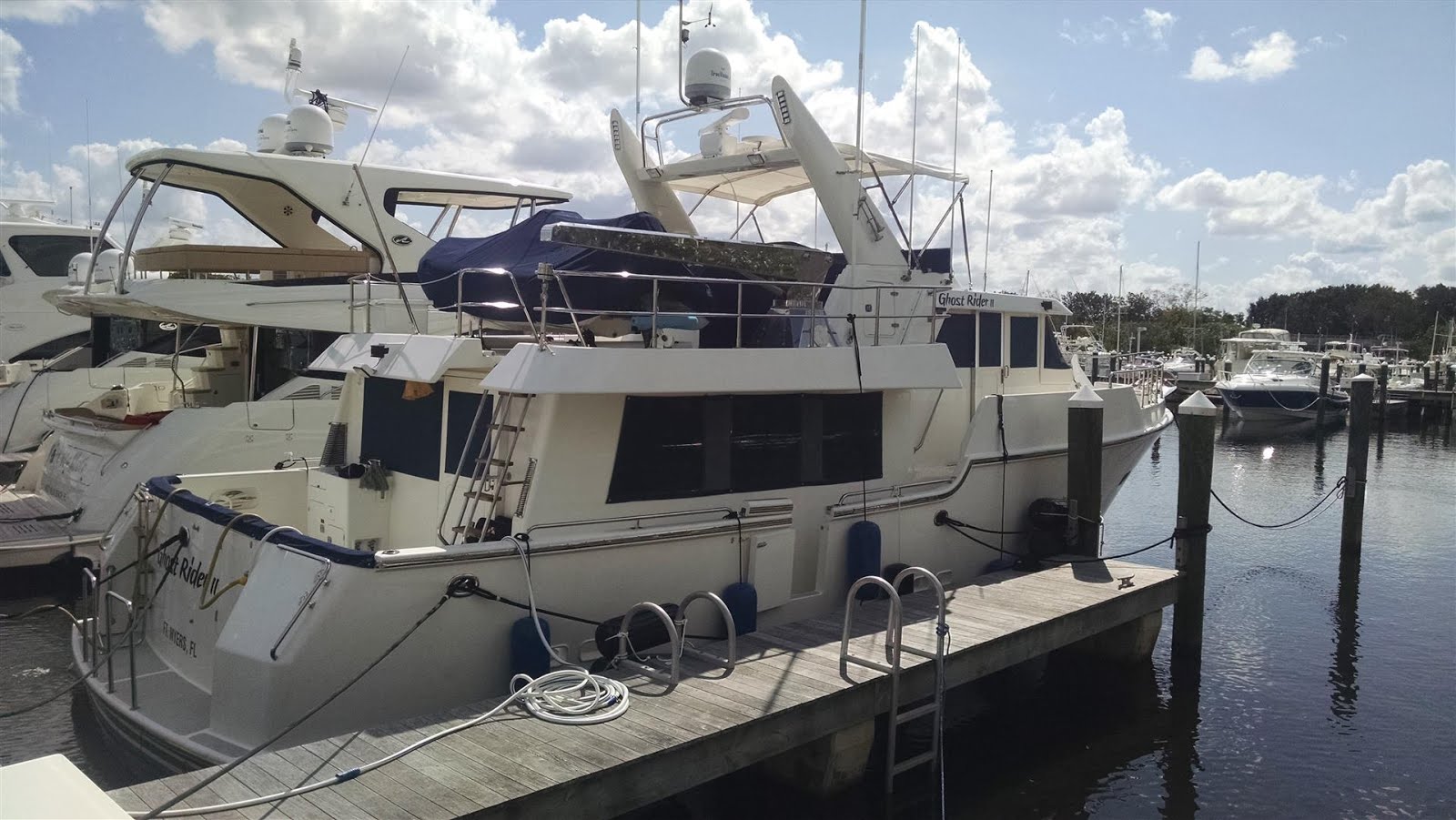
OPC Marina Empties Out Followig the Evac Order.  That's Ghost Rider
Looking Lonely in the Center of the Pic.  The Floating Docks There Are
Certified for a Hurricane - As Long As No Boats Are Tied to Them.
At Loggerhead We Had the Slip Just One Away from the Seawall, and Did Our Best
to Heavily Fender in Addition to Triple-Tying and Adding Chafe Proection Sleeves.
The Bimini Top is Also Collapsed & Rolled, Same for the RIB, and All Antennae
Are Down & Secured with Multiple Ties & Wraps.
So we sat, waited and watched. And we built our hurricane preparation checklist (which ended up taking up two full pages.) Old Port Cove marina issued evacuation orders late in the week, but we knew James had a slip for us up in Loggerhead Marina, a well-regarded hurricane hole just north of here and further up the more protected ICW.  We were one of the last to leave OPC, and the normally crowded marina had an eerie aura about it as we passed dozens of empty slips on the way out on Friday, 09-Sep at 0930.

A Closeup of the Radar Arch.  The Rolled & Taped Bimini is Visible; the Radar
Antenna is Tied & Taped; Those Vents are the Engine Room Exhaust, Covered with
Baking Mats and Taped.
The short trip up the ICW to Loggerhead was uneventful, even with some traffic congestion at the two drawbridges that we had to negotiate.  We had Ghost Rider tucked into her new Loggerhead slip by 1030, with several Yacht Tech folks and Bernie Francis greeting us there to lend a hand with our storm preps.  Bernie was kind enough to hang out with us for several hours to guide us in designing our “spider web” triple-tie-up.  Once that was done (we used 17 lines) and we had her defended with 12 properly inflated fenders, we went to work on everything else on the boat….tying up, taping up, taping down, or taking down stuff -- basically stripping the outside and giving it the lowest windage profile that we could.  After that we emptied the fridge and two freezers, taking all the perishables over to our friend’s nearby home.  Once we were satisfied that we had done all that we could to prep the boat – it took us two days – we cut the power and turned off the inverter and all circuit breakers except for the bilge pumps.

Gorgeous and Safe Place for a Hurricane Party
Late on Sat afternoon, 10-Sep, we piloted our rental car a short 15 minute drive to stay with our good friends, Bernie & Silvia Carballo, who have a beautiful two story home in Admirals Cove, Jupiter.  Their place is built like a fortress and has an enormous whole-house generator that’s plumbed to the city’s natural gas supply….apart from the adjacent canal system, it was the perfect place to ride out a big storm.  And they had successfully weathered Cat-3 Wilma there back in 2005.  We can't think of a better place for a hurricane party.

It was about this time NOAA / NHC began depicting a storm track that was shifting to the west following its hard turn to the north – better for us and the boat, not so much for our left coast friends, nor our Fort Myers condo and car.  The cone of uncertainty still pretty much covered the entire state of Florida, and with the size of this beast it was a given everyone in the state would encounter hurricane force winds.
What the RIB Tender Looked Like After Deflating & Tying Down.
By the time Irma slammed into the lower Florida Keys early Sunday, 10-Sep, it was a Cat-3, having been weakened a bit by its run along the northern Cuban coastline.  But its 120 MPH winds and surge nevertheless devastated the island chain.  It was still a Cat-3 storm when it barreled through Marco and Naples, but luckily for FMY Irma coasted inland a bit from there and weakened some more.  That’s about the time when we got the worst of it on the east coast as well – around 75 MPH sustained winds for several hours.  While the entire state got a wicked strafing, fortunately it wasn’t nearly as bad as the original forecast had predicted.
That's James Knight Prepping His Sailboat -- Moored Directly
Behind Ghost Rider at Loggerhead Marina.

Early on Monday morning, 11-Sep, we received a text message (around 0630) from James reporting that the boat looked fine; a short while later we picked our way through debris (in Bernie’s Navigator, since our rental car was still hidden away in a locked up parking garage) and made our way back to the boat at Loggerhead Marina around 0800.  Ghost Rider was looking very well indeed.  All the mooring lines, chafe protection and fenders were completely intact, as were all antennas and most other taped or secured areas.  The only (minor) issue we found was that the two engine room intake covers we had taped on had departed and are likely in another county by now.  (The lesson there is don’t use non-skid, non-stick baking mats for that – they truly are non-stick.  On the other hand, we now are even bigger fans of the 3M line of vinyl tapes.)  That resulted in some pooled water in the lazarette on top of the two aft fuel tanks, but was an easy shop-vac cleanup.

Rick Getting Dizzy Working on the Stuff Up Top.
It took us most of another day to de-rig all the storm preps, but that’s a lot easier and certainly more satisfying than making all those preparations.  To top it all off we also heard from good friends of ours who had stayed in our Fort Myers condo to escape the predicted surge levels there – they were safe, the condo was fine, and so was our car.  The same was true for their home, and those of all our good friends on the west coast of Florida.

In the end we just got really lucky.  Certainly there was luck with the storm path and decreased intensity as it headed north; but we are also lucky to have the friendship and counsel of people like James Knight, Bernie Francis and Silvia & Bernie Carballo.

That said, we are mindful that scores of others were not so fortunate with this bruiser of a storm, and they have a long, painful road to recovery ahead.  Our thoughts are with them.  And the randomness of this messy experience is very sobering.
Here is Ghost Rider AFTER the Storm.  Everything is Still in Prep Mode
But We Thought She Looked Pretty Damned Good.

This Hangs Over the Entry to Ghost Rider II's Stateroom Door.  When Cher Painted This for
Us She Was Either Prescient or Really Good at Asking for Intervention.  Either Way, It Sure
Seems an Appropriate Way to Conclude This Post, and We Thank Her.
Finally, here are some additional before, during and after pictures that hopefully will give you a sense of what is required when you are dumb enough to try and ride out one of these storms:

The Weather Channel Confirming We're About to Get Hammered.
Another View of Ghost Rider in a Nearly Empty OPC Marina.

Bernie & Chelle Begin Tying Off at Our Loggerhead Slip.
More of Bernie & Chelle at Work on the Lines.
And More of That.
The Bimini and Antennae on the Fly Bridge Get Lowered & Tied / Taped Down.
Wider View of Boat Deck Preps.
Another Shot of the Tender / Boat Deck / Radar Arch / Davit Preps.
Fly Bridge Helm Preps.
You Can Never Have Too Many Fenders.
Or Too Many Lines.
Another View of the Radar & Bimini Tie Downs.
The Dorade Vents on the Bow Have to Be Plugged -- Lacking a Plate, a Forespar
Truplug Will Fit Perfectly.
We Installed the Storm Panels on the Salon Windows.  And, No, Those
Fishing Rods Did Not Stay There, They Went Into the Laz.
James Had to Prep His Own Boat as Well as a Bunch of Nordhavns.
Post Storm:  Downed Tree at Loggerhead Marina.
Post Storm:  Ghost Rider Looking Very Good.
Post Storm:  Ghost Rider & Chelle Both Looking Happy
Post Storm:  Ghost Rider Cleaned Up & Put Back Together
Post Storm:  Another View of Ghost Rider Back in Pre-Storm Form.
And of course we once again want to thank our good friends and gracious hosts, Bernie and Silvia, for the safe refuge and fun hurricane parties.

Hurricane Party Preps in the Carballo Kitchen.

And the Resulting Yummy Hurricane Party Dinner.

Sunday, August 20, 2017

Late August 2017: Boat Business

THROUGH 21-AUG
It has been nearly a month since we wrote: “While in excellent condition for a 15 year old boat, we nonetheless have a potentially long punch list based on surveys, sea trial and our own personal preferences”.  Scratch the word “potentially”.  It’s a long list.
Ghost Rider in Her Maintenance Slip @ OPC...At The End
Of a Fairway, It Can Be a Tight Maneuver

That said, we – with lots of help from James Knight and his gang at Yacht Tech – have made great progress.  While we occasionally find ourselves in the not usual see-saw scenario (remove one item from the punch list, but add another) that lengthy list mostly now consists of things that have been lined through and are pending sea trial(s) to verify satisfactory completion.  Since we don’t plan to be hanging out near home port once we cast off the lines, we want to be fairly certain that the work done on the main engine, wing engine, generator, hydraulics and stabilizers provides solid ops-normal reliability.  And we want to be comfortable in our understanding of the supporting systems – electrical generation and distribution, fuel supply, air conditioning, etc. 

From a provisioning perspective we think we’re just about done.  Chelle will be complete with the galley and household side of that this week, and the same is true for Rick’s stockpiling of tools, boat supplies, generic spares and safety gear.  Still to be addressed is building the inventory of boat-specific spare parts – oil, filters, belts, water pumps, etc.

Our 70HP "Get Home" Wing Engine...Ran Great
on the Latest Sea Trial
So that brings us back to the sea trials.  On Saturday, 19-August, James and two of his techs joined us on board at 0900 with the goal of knocking out a fairly long list of mechanical, propulsion and system testing.  We planned to cruise a few miles down the ICW and then head offshore via the Lake Worth inlet.  After sleuthing and solving a main engine starter problem at the dock (loose wire at the solenoid), we maneuvered Ghost Rider II out of the marina and pointed south towards the inlet as planned.

Part of the day’s sea trial strategy was to initially run hard on the wing engine – Rick wasn’t satisfied that the survey sea trial had focused enough on that, particularly the shaft’s stuffing box.  In addition to being the “get-home” backup to the main engine, the wing is also used to supply hydraulic power to the bow and stern thrusters, as well as the windlass; thus we consider it fairly critical. So shortly after departing the marina we shut down the main engine and focused on stress-testing the wing power plant. 

The 300HP Main Engine Was a Different Story Without a Reliable Starter Motor
And that actually went well for the first 40 minutes, with Ghost Rider reaching 4.5 knots (even with the wing’s tiny two-bladed prop although a following current helped), with no leaks and overall good health metrics on the gauges and heat gun.  The next focus was to be the main engine’s stuffing box, which in two previous sea trials had run way too hot and had now been repacked twice.

But we could not get a relight on the main engine…there was no response at all from its starter motor.  We were still in a narrow stretch of the ICW, so Rick manned the helm to keep the boat between the buoys while James & Robert spent time in the engine room troubleshooting.  Battery voltage and electrical connections were fine, but solenoid and starter motor would not respond. So we made a 180 and headed back to the marina – at a leisurely pace of 3.3 knots into the current, which gave Rick plenty of time to think about – and discuss with James – how to dock the beast using only the wing engine for propulsion.

To the Left of the Wheel Are the Wing Engine Controls - Separate Levers
for Gearshift (Black) and Throttle (Red).  Thrusters Are to the Right of the Wheel.
Maneuvering on the wing engine presents a couple of challenges, especially in close quarters.  The shaft/prop is offset from the centerline, so steering straight isn’t a given.  The prop is tiny compared to the main, so thrust is limited. (Forget prop-walk.) And on Ghost Rider the wing is also used to power the bow and stern thrusters – but only when its throttle is advanced to something around 1800 RPM (it idles at 600-700 RPM.)  Approaching a dock in gear at that power setting would be poor form, unless you have air bags.

On top of all that, Ghost Rider does not have wing engine controls on the fly bridge, so the docking maneuver would have to be accomplished from the pilot house, where visibility isn't nearly as good.

James:  “I can take it if you want.”
Rick:  “I’ll give it a go….but stay close.”
James:  “Just throw up your hands if you want me to take over.”
Rick:  “How about if I just scream hysterically?”

Ghost Rider at Her New T-dock Berth
We had calm conditions and a protected marina, and it turns out if you go slow – really slow – you can spin the boat 180 degrees in a marina fairway and bring it alongside a T-head dock without casualties.  It went something like this:  stop the boat’s forward motion (reverse); preset the rudder hardover port; throttle to idle; gearshift to neutral, throttle up to 1800, thrust the stern to starboard; throttle to idle, gearshift forward; gearshift to neutral then reverse; gearshift back to neutral, throttle back up to 1800, thrust bow to port and/or stern to starboard.  Repeat until you’ve pivoted her 180 and are parallel (and hopefully close) to the dock.  Having Chelle on headset and providing distances to the aft and side was, as usual, a huge help.

Since the wing engine has separate (mechanical) levers for gearshift and throttle, it’s a bit like patting your head and rubbing your stomach at the same time, while walking a field sobriety test line.  For most veteran single-screw Nordy owners it’s a minor annoyance, but it was a first for these rookies.  Rick was glad James was there as coach.
The Tropics Are Getting Busy With Activity

At any rate, we got her tucked in and secured, and James went off looking for another starter motor and solenoid for the main engine. Meanwhile we headed back to Fort Myers to tend to some administrative and packing priorities, but will return to the boat late Monday…we have to be ready to move the boat to another “hurricane hole” marina further up the ICW if one of those tropical Invests spools up and aims at south Florida.

Tuesday, July 25, 2017

Late July 2017: Back On Our Own Boat

TUE 25-JUL
The Next Ghost Rider
We are back in familiar territory: sitting on our new-to-us boat at Old Port Cove Marina in Palm Beach, Florida, moving stuff aboard and discussing the punch list with Yacht Tech personnel.  Since arriving back in the USA on 03-July we had been busy checking out a Nordhavn 50 and ultimately, following surveys and sea trial, we purchased our second Nordy.  We are either stubborn or crazy….likely both.

Previously this boat had been known as Boundary Waters, then Sea Fox, and lastly The Getaway, and in each case had received lots of care and numerous upgrades.  We got lucky; we had seen Getaway when she accompanied the N60 (Relish) that we were taking to Nassau back in late April '17 in preparation for the Atlantic crossing (NAP-2017).  At the time we both had commented on her pristine condition and agreed if that boat ever came on the market again, we wanted a shot at it. Fast forward just two months, still aboard Relish as we were approaching our last Atlantic crossing port near Malaga, Spain. Michelle was trolling the Internet – still a few miles offshore – and quite serendipitously found her in a new listing.  Her relatively new owners wanted a bigger boat.  Just over a month later we were back in the USA and finalizing the purchase.

Ghost Rider II is a Nordhavn 50, constructed in 2002, hull number 21 (out of 26 produced before the model was discontinued in 2005.)  For more details and specs on her, click HERE to visit our “About the Boat” web site page.  You'll find links to a video and some pictures of the vessel there.
Chelle & Her New Toy During
the Survey Haulout

While in excellent condition for a 15 year old boat, we nonetheless have a punch list to work through based on surveys, sea trial and our own personal preferences.  We’re in the process of prioritizing (and quantifying) the list, and we expect that will take a few weeks to work through.  After that our near term plan is to spend a few months cruising the east coast of the USA - once again in shakedown mode - hopefully staying north of any tropical storm activity.  The Chesapeake area seems like a suitable destination given its attractions and options for repair yards should that be needed, plus we have good friends cruising there now.  And several more we'd like to visit along the way.  We'll come back to Florida later in the year once the weather and storms have cooled down, likely early November.

Based on our inability in the past to refrain from blogging, it's a safe bet we'll have more postings in the future as we progress down this new path.  So stay tuned.

Wednesday, July 5, 2017

July 2017: Madrid, Lisbon...Then Back to the USA

SAT 01-JUL
It was another leisurely morning for us as our train didn’t depart until late afternoon, so after a room service breakfast we checked out at noon and walked to the adjoining mall area for some shopping (wine and scotch mostly), and later a light lunch.
The Train Station in Malaga - Clean, Bright, Modern

The well-established train system in Spain has a solid and well-earned reputation for timely and reliable service, and our scheduled departure was a good example of that – with boarding as advertised promptly at 1530. Then without any fanfare or announcement it quietly glided away from the station at exactly at the scheduled time, 1555.  This was the high speed link to Madrid…reaching up to 271 kilometers per hour during the open stretches, or 168 MPH.  By the time you added up the comparative time to/from airports, standing in long airport security lines (which were a good deal more streamlined at the train station), and then the cumbersome boarding processes, the 2.5 hour train ride at half the price of an airline ticket sure looked to be a good idea.  Plus we had nearly first class seat and leg room, along with vistas of the Spanish countryside and Internet access most of the way.
The Digital Display in the Train Clocks Us at 271 KM/H

There were a few short stops along the way at interim stations, and we arrived in Madrid not at the scheduled 1841…but 10 minutes early at 1831.  The Madrid Atocha train station was another story – huge, not particularly good signage for foreigners, a maze of levels, exit and entry points, and packed with way too many people.  The reason for that became all too apparent a short while later.  From here it should have been a quick ten minute taxi ride to our next abode, the Hotel Europa, which we had selected based on its central location; plus it came highly recommended by Rick Steves’ guide books and by Bernie Francis, who had passed through there on his way back to the states ten days earlier.  But when we finally found the taxi stand thirty minutes later and asked a driver to take us there, his response (in Spanish) was “impossible”.  Eh? 

In his best broken English he explained that all streets between here and our hotel were closed for a “celebracion” – which turned out to be “World Pride Madrid 2017”….think Mardi Gras in New Orleans plus Fantasy Fest in Key West, then add a couple more million people.  It was an LGBT festival on a rather grand scale.  And we walked straight into it.  You can’t make this stuff up.
World Pride Festival in Madrid....Weaving Our Way Thru Massive Crowds

We’re pretty sure we walked through about a million of those partying throngs enroute to our hotel, which involved a fairly circuitous route given the closed streets and clogged crowds we had to negotiate, all while hauling our luggage packed with two months’ worth of travel gear.  We tend to think of ourselves as an American military family with generally conservative leanings on many issues, but have never believed in politics that dictate lifestyle.  So while we were frustrated at our own poor or unlucky planning, we saw this as just a big freaking party, and a well behaved one at that.  At any rate, it took us two full hours to make the trek to the hotel.  If it weren’t for Google Maps and the Spanish National Police – who are a no-nonsense but reasonably friendly sort in spite of the Uzis slung around their necks – we probably wouldn’t have made it to the Europa Hotel until sometime in August.

For a wildly jubilant and partying crowd of that size, and one with a somewhat culturally-charged change agenda, they admittedly were the best behaved mass of people that we have encountered in such quantities at a single time and place. At one point, as we were hand carrying all that luggage down a steep set of stairs, one of the revelers just grabbed a suitcase handle and helped Chelle get her gear to the bottom. If you care to know more about the event then click HERE. 

After Sunset the Crowds Continued to Grow as Did
the Decibel Levels
Of course the hotel room we had reserved was one of the few remaining premium rooms with a balcony overlooking the square – which was packed with more of the aforementioned crowds.  But now we also had a big outdoor stage that featured Spanish rock bands blasting percussive music at higher decibel levels than any jet engine Rick had ever encountered.  Given that we had reserved that room in ignorance, the hotel staff gave us the option of changing to a quieter room; but we said “oh what the hell”, let’s experience the whole damned thing.  So we did. 

We chose to eat dinner in the hotel restaurant around 2300 (11pm) more due to fatigue than culinary preference, although the steak was actually pretty good, and the place did offer some acoustic relief.  By the time we got back to the room and our balcony view, the crowd size had increased even further, and so had the decibels.  For the most part the recorded music and live bands were sticking with Spanish language contemporary rock, but when they played the USA version of “YMCA” (remember the Village People?) the place went more nuts….thousands dancing and singing in synchrony.  Chelle even joined in from four floors up.  We were exhausted by 0200, and by 0300 the celebration had finally wound down to something less than a riot level.  For a brief video (oh yes, and audio) of the event as viewed from our hotel balcony, click HERE.)

Watch out New York City – the World Pride festival is headed your way in 2019.

SUN 02-JUL
One of Several Elaborate Palaces in Old Madrid
By this time our circadian rhythm was totally wonky, and our feet, knees & backs ached, so we didn’t get even partially motivated until 0930-ish. And even then we just hung around the room catching up on some emails and the typically confusing news from the states right up until the noon checkout time.  We had a nice brunch at one of the nearby sidewalk cafes and decided we’d tour Madrid strictly by bus today….we were pretty spent, and definitely done with walking for a while.

Madrid has some very good touring buses with reasonably priced one or two-day pass options, and we were able to split the afternoon into two parts with a break in the middle: the first couple hours touring “old” Madrid; followed by a Sangria and Mohito break; and then a couple more hours touring “new” Madrid.  It was all quite enjoyable and informative, and didn’t involve much walking.
And Another Palace in Old Madrid

Madrid is Spain’s capital and largest city, with 3.5 million residents within the city, and well over 6 million in its metro area.  It is the EU’s third largest city behind only London and Paris.  While lacking the absolute charm and appeal of those “White Hill” towns we so enjoyed, it is still an impressive community.  Whether you’re in the new or old sections, for a big city it has more visual appeal and character than almost any U.S. large city environment.  Judging traffic was a bit difficult given it was Sunday, but overall it appeared to be well-managed with very good streets and thoroughfares.

New Madrid is Modern, Clean...and Green.
That evening we had an early dinner (and another Sangria) and then took a taxi to the Madrid airport to catch an easyJet flight to Lisbon, Portugal. That marked the unofficial end of our tourista days, since the only thing we’d have time to do in Lisbon would be to go to the hotel, sleep a few hours, then head back to the airport for the long ten hour flight back to the USA – crossing the big pond once again.

MON 03-JUL
The flight the previous night was blissfully boring, the hotel was more than adequate for the few hours of sleep we managed, and then we were back in the Lisbon airport by 0815 (GMT+1) for a mid-morning departure on a TAP Portugal Airbus A330.  By 1040 we were tucked into our comfy business class seats and airborne; and shortly after 1100 we were “feet wet” at 35,000 feet over the Atlantic Ocean, pointed directly at the Azores.  It was an interesting thought looking down at all that blue water – we had been almost exactly in that same spot in a fairly small boat – headed in the other direction – just 16 days ago.  This particular crossing would be faster, more comfortable, and boring as hell. 
Elaborate Fountains Are Also a Prominent Feature in Madrid

But as Chelle had said the night before, “I’m tired and done with living out of a suitcase; it’s time to go home.”  We had been traveling rather energetically in some shape or form since 10-May, or roughly for 54 consecutive days.  And we were running low on clean clothes as well as energy.

We never thought we’d say this about Miami, but it felt good to be back here as we disembarked the plane just after 1400 Eastern Time.  We wouldn’t get home for a few more days since we wanted to visit friends and tend to some boat business in Jupiter and Palm Beach.  We’ll keep you posted on what kind of adventure might develop from that.

SOME CONCLUDING & RATHER RANDOM OBSERVATIONS LOOKING BACK….

·        Crossing an ocean is more about preparations than the actual execution of the journey.  Assuming you selected a capable boat (and in the powered vessel world, that admittedly is a short list of brands) then most of the real work is in prepping the boat, and to some degree, the crew.  That includes vetting the boat’s mechanicals of course, but also loading up with the right consumables, tools, supplies, safety gear and provisions. Securing a good weather router with multiple means of communication falls into that prep category as well.

·       Speaking of provisions, Chelle did a fantastic job of planning and procuring those for Relish; we didn’t lack for anything, and not just coincidentally, we ate very well all along the way – even when sea conditions should have dictated much less time and effort in the galley.

·        If we were to make such a journey again – on our boat or someone else’s – we would want to do it with exactly four crewmembers (assuming the same or at least equivalent skill sets); three is too few (tiring); five is too many (crowded).

·        We highly recommend the Garmin inReach device to any long distance cruisers as well; it does not replace an EPIRB but its tracking and messaging capabilities are impressively flexible and reliable, and its backup SOS/SAR option is a smart redundancy.

·        We enjoyed each place we visited, but we ranked Gibraltar and Arcos as the top two; the former for its marina environments, Med access, and the international variety of interesting sights and sounds, plus its amazingly affordable prices on everything; the latter for its well preserved old world charm, stunning views and superb hospitality.

·        We were treated well at every stop we made along the way; and that’s saying something as Americans aren’t exactly viewed favorably these days by a good portion of the globe.  So kudos to the hospitality forces in Bermuda, Portugal, Gibraltar and Spain.

·        Of all the places we visited, the Spanish hospitality and service ethic in the small towns was the best of them all; you could tell they wanted you there and they wanted you to enjoy their unique experience.  And they delightfully lacked those hustle/bustle and stress factors that you can see in the eyes and hear in the voices of the big city staffs.

·        Iberian ham is fabulously delicious, especially when sliced thin like prosciutto and served with eggs and toast for breakfast or brunch.  If you are not familiar with it, read about it by clicking HERE; but when you taste it you can tell it takes up to four years to make it that way.

·        Our two new favorite fun drinks, particularly when made in Spain, are the Sangria and the frozen Mojito; it is easy to see why Hemingway fell in love with them during his time there.

·       And finally, re-crossing the Atlantic Ocean on a TAP Portugal A330 Airbus in business class is a very nice way to make the return trip across the pond both boring and fast.  Cheaper, too.

Frozen Mojito and Sangria -- CHEERS!

Sunday, July 2, 2017

June 2017: Cadiz, Sevilla & Ronda

TUE 27-JUN
Cadiz is a Port City with Many Park Areas
We spent just a single night in Arcos and headed out Tuesday morning, backtracking a bit south and further west to the coastal town of Cadiz.  This large city is mostly notable as a deep water port on Spain’s southwest coast (and thus is a handy stopover point when the weather in the Gibraltar Straits is nasty), but we wanted to check it out.  So we wandered around a bit – very pretty parks – had a coffee and juice in one of the sidewalk plaza cafes, and headed back north for Sevilla (aka Seville), another two hours of driving.

There are a couple of notable sights one will notice when driving the winding mountain roads of southern Spain.  The first is the number of large wind farms consisting of dozens of large – over 90 meters tall (300 feet) – power-generating wind turbines; there is always a breeze here and Spain has been one of the leaders in their deployment and use, currently ranked fifth in the world.  Also noticeable are the large, expansive fields of yellow sunflowers; the government long ago began encouraging their growth here to produce sunflower seed oil to compete with the more expensive olive oils that were in an oversupply state throughout the Mediterranean countries.  Spaniards are adaptive.
Not Your Don Quixote Windmills...These Turbines Produce
Prodigious Amounts of Electricity

The drive to Sevilla reminded us how lucky we were to have GPS and Google Maps available to us – we’re not at all certain we would have found any of the places for which we were searching without those aids. And when in the townships, if you can’t navigate the numerous roundabouts here, you will find yourself in an accidentally perpetual holding pattern.  As for the art or science of finding a place to park – we have not figured out that part yet.  When we arrived in “old” Sevilla and supposedly within a few hundred meters of our hotel, where once again many streets were the perfect width for an undernourished horse, we had to give up.  We found a garage about a klick away and walked with our luggage in tow to the hotel.
Our Room at Las Casas de la Juderia

But it was worth it.  Our hotel was a tourist destination all on its own.  The Hotel Las Casas de la Judería de Sevilla is comprised of 27 traditional houses and it has 134 different rooms which are linked through 40 patios, gardens and a labyrinth of small passageways.  It’s best to bring something to make a breadcrumb trail if you go wandering, as Chelle accidentally discovered.  She wrote the following that night in an email to her mum:

We were unable to successfully order a cheese platter from room service so I ventured out while Rick continued to work on boat contracts/negotiations.  I found my way out (yay).  Walked across the street to tapas bar, bought a bottle of wine and 2 tapas to go.  Then walked back to our hotel restaurant for a glass of ice for Rick’s scotch.  Tried an exit and staircase back to our room but got lost.  Backtracked to the restaurant, found the office again and the way to our elevator, found our floor then lost again.  Oh yeah, back outdoors (thru a tiny windowed door), across a rooftop terrace to our room – found it!  It’s an absolute maze.  We rec’d a map of the hotel which is as hard to decipher as a city map!  The room is really cool (big & funky, loft-like) but Rick’s bound to walk into a rafter or 2 before we leave.

Another Cafe & More Tapas
That last statement turned out to be painfully prophetic, but we still loved the room. That evening we enjoyed a leisurely stroll through some of these historic streets of the old town section, and helped out the local economy by consuming more tapas and drinks to wrap up another fine day.

WED 28-JUN
Chelle had booked one of Sevilla’s walking tours that come highly recommended in Rick Steves’ guides, so after a light breakfast of coffee and croissants we headed out at 1000 to meet our guide, Alphonso, in a nearby town square.  The square was coincidentally the site of a protest by sanitation workers (which would turn out to be slightly foreshadowing), reminding us that left-leaning unions are an integral part of Spain’s current culture with an approximate 20% density (about twice that of the U.S.). While peaceful, the demonstration was very noisy, so we had to re-start our tour a block or so away.

For the next two hours, however, we were thoroughly entertained as well as educated.  Alphonso’s English was quite good, as was his sense of humor, irony and history.  Once again we were treated to architectural and cultural reflections of Sevilla’s checkered history, from Carthaginians and the Roman Empire in the early period; then the Visigoths and Christians eras; followed by the Moorish Muslim conquest and ultimately the retaking of Spain by Christian King Ferdinand III circa mid 1200’s.  Alphonso also made it a point to show us how to find some of the more interesting areas of the city on our own after the tour.
Somewhere Underneath There's More to the Arches & Columns

At various points along our tour Alphonso also pointed out some recurring themes and symbols; for instance the oddly short look of the columns and arches….which are indeed at least a meter shorter than they were originally before sediment over the centuries built up and the resilient people of Sevilla began building on top of them.

An then there is the fairly prominent repetition of an anagram that reads “NO8DO” appearing on sewer lids, facades, service vehicles, the city’s coat of arms, and a number of other inauspicious places.  Our guide slyly observed that American author Dan Brown would have all sorts of fun with it, and that a number of attributions and legends exist. 

The NO8DO Anagram Appears Frequently in Sevilla
But the most popular is that it’s basically a pun, combining two Spanish syllables (NO and DO) and a drawing in between of the figure "8"; the figure represents a skein of yarn, or in Spanish, a madeja. When read aloud, "No madeja do" sounds like "No me ha dejado", which means "It has not abandoned me".  And that apparently is in reference to the retaking of Sevilla by Ferdinand III from the Muslim (Moors) in 1248.

After our tour concluded we had yet another leisurely lunch at yet another sidewalk café, accompanied by what Alphonso recommended as the best “local” beer, Cruzcampo. (Which, by the way, is actually Heineken’s premier brand in Spain.)  He also taught us that the locals drink it in small portions – not out of any sense of restraint, but because they prefer their brews very cold….so they end up eventually ordering several.
It's Easy to Find Several Centuries of Different Architectures
in a Single Complex in Sevilla

That led Rick right into a quality siesta time back at the room.  And of course Chelle went walking and shopping.

THU 29-JUN
Our goal the following day was to complete the drive and a visit to Ronda, another of the “White Hill Towns” in the Andalusia region.  Graced with another late checkout time (Rick was really digging on the “Spanish time” sensibilities) we meandered to the front desk to check out and, since we had managed to park our rental vehicle quite a distance away, hire a taxi vs. hauling our four bags across a chunk of the city.  That led to this exchange:

Rick:  Englais, par favor…we need a taxi.
Front desk:  Lo siento, senor…no taxis today….on strike, just today…from 9 until 3 o’clock.
Rick:  A labor strike….just here….only today?
Front desk:  Si
Rick:  Pardone….you’re just pushing my buttons…right?
Notice the Shade Coverings in Sevilla....It Gets
Hot Here in the Summers

Surprisingly all three of the friendly hotel staff at the front desk seemed to comprehend that very American idiomatic phrase as they all laughed and shrugged apologetically.  We chuckled with them, grabbed our bags and walked to the parking garage.

Driving the approach to Ronda was very similar to what we had experienced getting up to Arcos….twisting and steadily ascending two lane roads, terminating in another quaint mountain-top town perched on some interesting cliffs.  Our selected hotel here was a bit different in that it was more of a modern Spanish resort, plus it actually had its own parking lot with space available.  But its views were nonetheless yet another treat.

Another Hotel with Stunning Views in Ronda
While Ronda doesn’t have all the character of Arcos it still retains a lot of old world charm, with plenty of shops, cafes, restaurants, churches, convents and basilicas.  It seems to draw more tourist traffic than does Arcos, and part of that might be due to the newer resorts that cater to that, along with its famous and picturesque gorge.

The El Tajo Gorge is a gigantic gash in the ground, about 120 meters deep (nearly 400 feet) and formed by eons of natural erosion.  The current bridge spanning that river and gorge, connecting the “old” and “new” settlements of Ronda, was started in 1759 and took 34 years to build. The one previous to that had fallen down after only six years, so presumably they learned a lot in that process.
The El Tajo Gorge and the Bridge That Spans the "New"
and "Old" Town Sections

Ronda is also home to the oldest bull ring stadium in Spain, the Plaza del Toros, built in the 18th century (started in 1761 and completed in 1783) and still in use today.  While bullfighting has historical roots that date back to ancient Greece and Rome, its popularity as a competitive blood sport really only goes back to the 1700’s when Spanish Royalty popularized it via theatrically costumed displays that drew both commoner and privileged attention as entertainment and aspirational value.

It’s also easy to find social events here in Ronda that feature the famous Flamenco dance.  We didn’t have to look far or hard, as our hotel had musicians and a dancer performing in their open air courtyard when we returned from our touring for the day.

FRI 30-JUN
Some Flamenco Dancer Action at Our Ronda Hotel
We slept in, enjoyed a leisurely breakfast in the hotel restaurant (a quality buffet of local dishes), then jumped back into the rental car for the drive back to Malaga. (Dropping the car in Malaga was not our preference in the beginning, but leaving it in a different location was amazingly pricey; and dropping in Lisbon, our original preference, would have been well over a thousand Euros.  Rick tried to explain that we did not want to buy the damned thing, we just wanted to borrow it for a few days…but to no avail.)

While only 102 km away, it took nearly two hours for the drive to Malaga as the roads were largely two lane and winding through the picturesque foothills. Passing slower autos on some of the blind switch-backs seemed to be a daredevil sport to those Spaniards with the higher end vehicles. We dropped the rental car back at the airport, grabbed a taxi there for the short ride to our hotel, the Barcelo Malaga.  It was a comfortable modern place and immediately adjacent to the Zambrano rail station, where we planned to catch a train to Madrid the following afternoon.
Malaga Doesn't Have the Charm But it Has the Shopping

Malaga isn’t normally a recommended stop in southern Spain except as a transportation hub, as that’s about the only consistent thing going for it.  But if you need to catch a flight or train to just about anywhere else in western Europe, it will serve that purpose well enough. Chelle was certain, however, that Malaga had more to offer, so off she went hunting the big city streets for something more redeeming than a few overcrowded beaches, and some planes and trains….while Rick enjoyed another siesta before tending to more administrative business that still beckoned from back home.

Whole Grouper Prepared at the Table....It Was Quite Good
Ultimately she did find a city center area that was clean, inviting and quite vibrant – large crowds of locals and tourists meandering walkways both wide and narrow – the wide ones mostly had modern retail storefronts, the narrow ones were lined with the (equally new and modern) tapas cafes and restaurants.  It was a better place to spend the evening than the hotel.  While lacking the old time charm that we so enjoyed in Sevilla, Arcos and Ronda, the service was still excellent and so was the food.  We split a bottle of wine and a whole grouper (e.g., it still had the head and tail); but our waiter was meticulous about preparing it at our table for easy consumption.  And in true Spanish style we didn’t complete our meal until around 2230 (10.30pm).