We departed Key West
on Sunday the 22nd around 1030 (after pancakes for breakfast!) and started the journey towards the east
coast. Today’s destination was Marathon
(again), a short run of around 40 nautical miles. We had perfect weather – sunny, warm, and
humid, with a light breeze out of the west and flat water running up Hawk
Channel inside the reef. Since both
stone crabs and lobsters are currently out of season, the number of trap pots
to dodge was as close to zero as it gets in the Keys. And once again we had several large sea turtle sighting and bottlenose dolphins in the bow wave off and on during this leg. If you're curious as to why the dolphins do what they do, so was I and found this helpful article online:
Bow-Riding-Marine-Mammals.
 |
Placard Details How to Position Fuel
Valves for Consumption Test |
With the boat was humming along nicely with no major chores
demanding attention, we spent some time doing a fuel consumption test while enroute.
On an expedition boat such as
Ghost Rider
one doesn’t rely on fuel/fuel flow gauges for either measuring fuel on board or
fuel burn rates. Instead it is done with
fuel tank sight gauges. And while our
Murphy PowerView digital display provides very accurate gallons-per-hour fuel
flow data in real time (via the engine’s ECU), it does
not also measure
what the
generator is consuming.
The only reliable method of obtaining actual total burn rate is to time
the actual fuel burn in tenths of gallons measured on the supply tank’s sight
gauge.
 |
Supply Tank Sight Gauge
With Graduated Scale |
Over a 30 minute period we measured a burn of 1.55 gallons
at 1635 RPM making 7.0 knots SOG. That
extrapolates to an hourly burn of 3.1 gallons per hour. For comparison, the Murphy PowerView display
was reporting a main engine burn rate of 2.7 gallons per hour. That meant that the genset was drinking 0.4
gallons per hour. Extrapolating those
numbers, theoretically at least, with a full load of diesel fuel (1470 gallons)
we could cover 3,319 nautical miles.
With a 10% reserve that gets reduced to 2,987 miles.
To be fair (and realistic) this consumption test was
performed in absolutely ideal conditions – wind and current on the tail, flat
seas, and only a moderately loaded genset (air conditioning was cranked up, but
no water heater, water maker or other 240V appliances running.) We obviously need to repeat the test in
sloppy weather / seas to get more real-world planning numbers, as well as with
and without the genset running.
 |
| Approaching Seven Mile Bridge (Again) |
We pulled into Marathon Marina around 1545, but then got
surprised by a current absolutely ripping along the outer fairway where our
assigned slip was located. I saw 1700
RPM on the tach by the time I was able to get the boat moving into the current –
at maybe a half knot. With barely a boat
length of width between those western docks and the shallows, I decided the
situation was too adverse for a safe docking maneuver. So I backed out to the main channel and
Chelle checked the nearest current station (Mosher Channel), which was calling
for 2 knots – but we were hitting much more than that.
 |
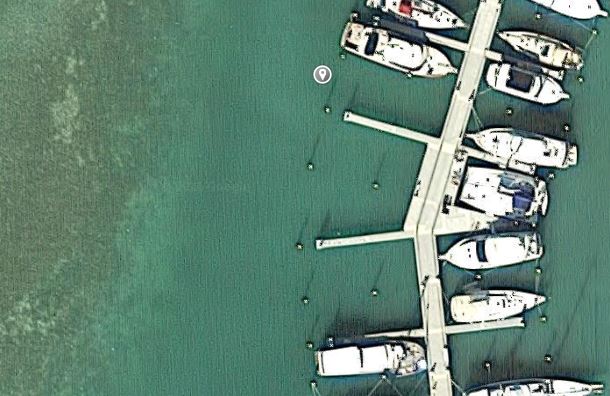
The pin marker is where we were supposed to dock...note
the shallows to the left / west. |
As Falstaff says in Shakespeare’s Henry IV, “The better part of Valour is Discretion.” Or in fighter pilot jargon, “extend and live
to fight another day.” So basically we
got the hell out of there and dropped the hook out in the open water next to
Boot Key. Had we been able to get a slip
on the (protected) east side of that dock we likely would have been more protected
from the current, but that wasn’t an option with all the construction going on
at the marina. We enjoy being at anchor,
but the generator use that entails means we’re going to be bumping up against
its next oil change interval sooner than desired.
 |
| A Load of Trash Line Retrieved from the Bottom |
On Monday the 23rd we
pulled up the hook just before 1000 and began the day’s run (sans generator) towards
Tavernier to the ENE. As we pulled the
anchor up we noticed it had fouled on a lengthy piece of 3/8” line, nearly
pulling the anchor back into the hull as it came tight – with a little reverse
maneuvering Chelle gained us some slack.
Once we got it untangled we spent a little time retrieving the entire
length of the trash line to hopefully spare someone else that same fate in the
future. (It did not appear to be
attached to anything, or if it was we yanked it loose. And it had a nasty odor, thus the plastic garbage bag you see in the picture.)
Seas were forecast at 2 feet or less and the winds were
light with a high overcast providing some relief from the sun. So rather than running in close via Hawk
Channel we first took a southeast heading and went outside the reef into 300+
feet of water and trolled two lines off the stern of
Ghost Rider fishing for some mahi.
Radio chatter among the local fishing boats didn’t sound too promising –
in water from 300 to 800 feet they were getting skunked.
We didn’t drag the lures for very long….maybe an hour or so,
and then we lost bottom reading on both depth finders (Ghost Rider has two transducers) so we went into troubleshooting
mode; it took us a while to figure it out, but the short of it is that the
Furuno Sonar display had an incorrect “Mode” setting, and that one was
rectified easily enough. But the Furuno
digital readout on the RD30 instrument is still a mystery – it seems to lose
bottom lock in depths of 200 to 400 feet.
 |
| Our Whacky SPOT Track |
If you look at our SPOT track for the day, it was a real
zig-zag as we navigated from deep to shallow and back out to deep water trying
to troubleshoot the depth sounder issues.
Once we got the basic problems either solved or framed up, we deployed
fishing lines again – but like the pros who were further offshore, we too got
skunked.
 |
| Sunset Moored Behind Tavernier Key |
Even with all the zig-zagging, we arrived at Tavernier Key
in good time – it was another nice downhill run today with strong pushing currents
from residual Gulf Stream effect – and set the anchor in very shallow water
(less than 2’ under the keel) at low tide on the northwest side of the island
in time for another magnificent sunset.
 |
| Tavernier Key Off the Bow |
Boat stuff:
·
Rick spent the early evening investigating a raw
water pump leak on the generator; it’s quite slight (and intermittent) for now, but will require
attention by the time we reach Palm Beach at the end of the week.
· The air handler in the main state room isn’t
cooling (also intermittent) ; am guessing its water ball valve is stuck closed, similar to the issue
that occasionally afflicts the PH air handler; another Palm Beach maintenance
item.
We awoke on Tuesday
the 24th to a calm, clear and warm morning and got an early
start (for us) around 0830 and headed north past Key Largo and towards Biscayne
Bay just south of Miami. The original
plan was to anchor in the bay, but since we spent an extra night on the hook at
Marathon, we opted to dock up at Dinner Key Marina. Two hours out they gave us a slip assignment
with a 16’ width – which won’t work for a boat with a 16.1’ beam. So Michelle scrambled for an alternate and we
diverted to Grove Isle Marina.
 |
| Entry Channel to Grove Isle |
 |
| Grove Isle Looking Towards Biscayne Bay |
Thunderstorms had started popping over distant waters to the
east as well as on the mainland, but we were easily able to run between them
until we angled into Biscayne Bay, where one got a bit close as we approached
Grove Isle. Practically speaking, the
entry channel to the marina was more of a concern than the storm cell – it is
surely the most convoluted & skinny water entrance we’ve had to maneuver in
any of our boats, and saw as little as 1.5’ of depth under the keel approaching
a low tide.
Anyway, we docked up without issues and spent a relaxing
although occasionally wet night there.
On Wednesday the 25th
we departed Grove Isle Marina and Biscayne Bay and headed north to Fort
Lauderdale….with a 15 to 20K wind out of the northeast, the main challenge of
the day was figuring out how to depart the t-dock without leaving Chelle behind
as she untied our lines. We looped a
couple of side ties that could be removed from the boat to solve that.
Offshore the winds were cranking and seas were beam to
quartering on the starboard bow at 3 to 5 feet and 4 second intervals – sloppy
but apart from getting very salty Ghost Rider
had no problems with it.
 |
At Pier 66...We Were One of the Smallest
Boats There |
The Fort Lauderdale (Port Everglades) entrance channel was a
sloppy mess with an outgoing current and incoming 4 to 5 foot steep-faced
rollers; the channel is wide and deep, but it was still a busy time keeping
Ghost Rider pointed in the right
direction – it’s got a broad ass end that can get pushed around in big
following seas, so one has to really have to pay attention. I’ve come to appreciate the Simrad
autopilot’s follow-up jog lever (basically a joystick) in such circumstances,
finding that I can hold a heading better with that than either the AP’s
auto-heading mode or with manual steering.
It reminds me of the B-52’s autopilot-assisted air refueling mode
(which, to be honest, I hated and almost never used.)
 |
Ghost Rider Docked Up @ Pier 66....Really
Nice Floating Concrete Docks |
We had to delay our entry to the Hyatt Pier 66 Marina a few
minutes to troubleshoot a Bluetooth headset issue – the boom mic on Rick’s had gone
missing. (Headsets are much better than
shouting at each other during close quarters maneuvering, which is why they are
called “marriage savers”.) We substituted
a small spare mic and got docked up with no issues in spite of the stiff
winds. Later, when washing down the
boat, we found the missing boom mic wedged under the boarding ladder on the swim
platform aft of the transom (soaking wet).
It probably dislodged from the headset while on the fly bridge shortly
after departure, and got wind-blown to the aft end – how it stayed on the
transom during those lumpy seas is a small miracle – and in spite of the
soaking, it still works. Lucky break.
BTW, Pier 66 is a very nice marina -- close to the ocean inlet, very protected just off the ICW, new concrete floating docks, recently upgraded Wi-Fi, pool, gym, clubhouse and a Hyatt hotel on the property.
 |
| FLL Can Be a Busy Port |
Thursday the 25th
started with another clear and warm morning and a steady 10-15K breeze out
the northeast; we were underway before 0900 with Chelle manning the helm and
Rick handling the deck duties this time. The Port
Everglades inlet is typically a busy shipping lane and that was true this
morning, but Chelle weaved us through the traffic, which included a close pass
with the beast of a container ship pictured here.
We once again avoided the ICW inside route and took
Ghost Rider outside into 3 foot seas for
the leg up to Palm Beach. We’d rather
deal with lumpy water rather than all the bridges, narrow passages and amateur
boat drivers that frequent the ditch. Seas built to 4 feet by the time we arrived at the Lake Worth inlet at 1545 making for another sloppy inlet ride and more jog-lever steering, but after we rounded Peanut Island we enjoyed a smooth run on the final few miles leading to Old Port Cove (OPC) Marina in Palm Beach.
 |
| Old Port Cove Looking East |
This is our first trip back to OPC since we purchased the
boat last August and had all of Ghost Rider’s refit work done here by Yacht
Tech. It’s good to be back as we have a
healthy punch list for them before we continue our journey north in about 2
weeks. Rick also has to change oil and
filters on both the main engine and the genset.
While here we’ll also be taking a side trip, flying to St. Louis to
visit with family and partake in a charity fund raising event for the Lt. Dan Scholarship
Fund. We’re looking forward to that and
being dirt-dwellers for a short break.