Wednesday, July 5, 2017

July 2017: Madrid, Lisbon...Then Back to the USA

SAT 01-JUL
It was another leisurely morning for us as our train didn’t depart until late afternoon, so after a room service breakfast we checked out at noon and walked to the adjoining mall area for some shopping (wine and scotch mostly), and later a light lunch.
The Train Station in Malaga - Clean, Bright, Modern

The well-established train system in Spain has a solid and well-earned reputation for timely and reliable service, and our scheduled departure was a good example of that – with boarding as advertised promptly at 1530. Then without any fanfare or announcement it quietly glided away from the station at exactly at the scheduled time, 1555.  This was the high speed link to Madrid…reaching up to 271 kilometers per hour during the open stretches, or 168 MPH.  By the time you added up the comparative time to/from airports, standing in long airport security lines (which were a good deal more streamlined at the train station), and then the cumbersome boarding processes, the 2.5 hour train ride at half the price of an airline ticket sure looked to be a good idea.  Plus we had nearly first class seat and leg room, along with vistas of the Spanish countryside and Internet access most of the way.
The Digital Display in the Train Clocks Us at 271 KM/H

There were a few short stops along the way at interim stations, and we arrived in Madrid not at the scheduled 1841…but 10 minutes early at 1831.  The Madrid Atocha train station was another story – huge, not particularly good signage for foreigners, a maze of levels, exit and entry points, and packed with way too many people.  The reason for that became all too apparent a short while later.  From here it should have been a quick ten minute taxi ride to our next abode, the Hotel Europa, which we had selected based on its central location; plus it came highly recommended by Rick Steves’ guide books and by Bernie Francis, who had passed through there on his way back to the states ten days earlier.  But when we finally found the taxi stand thirty minutes later and asked a driver to take us there, his response (in Spanish) was “impossible”.  Eh? 

In his best broken English he explained that all streets between here and our hotel were closed for a “celebracion” – which turned out to be “World Pride Madrid 2017”….think Mardi Gras in New Orleans plus Fantasy Fest in Key West, then add a couple more million people.  It was an LGBT festival on a rather grand scale.  And we walked straight into it.  You can’t make this stuff up.
World Pride Festival in Madrid....Weaving Our Way Thru Massive Crowds

We’re pretty sure we walked through about a million of those partying throngs enroute to our hotel, which involved a fairly circuitous route given the closed streets and clogged crowds we had to negotiate, all while hauling our luggage packed with two months’ worth of travel gear.  We tend to think of ourselves as an American military family with generally conservative leanings on many issues, but have never believed in politics that dictate lifestyle.  So while we were frustrated at our own poor or unlucky planning, we saw this as just a big freaking party, and a well behaved one at that.  At any rate, it took us two full hours to make the trek to the hotel.  If it weren’t for Google Maps and the Spanish National Police – who are a no-nonsense but reasonably friendly sort in spite of the Uzis slung around their necks – we probably wouldn’t have made it to the Europa Hotel until sometime in August.

For a wildly jubilant and partying crowd of that size, and one with a somewhat culturally-charged change agenda, they admittedly were the best behaved mass of people that we have encountered in such quantities at a single time and place. At one point, as we were hand carrying all that luggage down a steep set of stairs, one of the revelers just grabbed a suitcase handle and helped Chelle get her gear to the bottom. If you care to know more about the event then click HERE

After Sunset the Crowds Continued to Grow as Did
the Decibel Levels
Of course the hotel room we had reserved was one of the few remaining premium rooms with a balcony overlooking the square – which was packed with more of the aforementioned crowds.  But now we also had a big outdoor stage that featured Spanish rock bands blasting percussive music at higher decibel levels than any jet engine Rick had ever encountered.  Given that we had reserved that room in ignorance, the hotel staff gave us the option of changing to a quieter room; but we said “oh what the hell”, let’s experience the whole damned thing.  So we did. 

We chose to eat dinner in the hotel restaurant around 2300 (11pm) more due to fatigue than culinary preference, although the steak was actually pretty good, and the place did offer some acoustic relief.  By the time we got back to the room and our balcony view, the crowd size had increased even further, and so had the decibels.  For the most part the recorded music and live bands were sticking with Spanish language contemporary rock, but when they played the USA version of “YMCA” (remember the Village People?) the place went more nuts….thousands dancing and singing in synchrony.  Chelle even joined in from four floors up.  We were exhausted by 0200, and by 0300 the celebration had finally wound down to something less than a riot level.  For a brief video (oh yes, and audio) of the event as viewed from our hotel balcony, click HERE.)

Watch out New York City – the World Pride festival is headed your way in 2019.

SUN 02-JUL
One of Several Elaborate Palaces in Old Madrid
By this time our circadian rhythm was totally wonky, and our feet, knees & backs ached, so we didn’t get even partially motivated until 0930-ish. And even then we just hung around the room catching up on some emails and the typically confusing news from the states right up until the noon checkout time.  We had a nice brunch at one of the nearby sidewalk cafes and decided we’d tour Madrid strictly by bus today….we were pretty spent, and definitely done with walking for a while.

Madrid has some very good touring buses with reasonably priced one or two-day pass options, and we were able to split the afternoon into two parts with a break in the middle: the first couple hours touring “old” Madrid; followed by a Sangria and Mohito break; and then a couple more hours touring “new” Madrid.  It was all quite enjoyable and informative, and didn’t involve much walking.
And Another Palace in Old Madrid

Madrid is Spain’s capital and largest city, with 3.5 million residents within the city, and well over 6 million in its metro area.  It is the EU’s third largest city behind only London and Paris.  While lacking the absolute charm and appeal of those “White Hill” towns we so enjoyed, it is still an impressive community.  Whether you’re in the new or old sections, for a big city it has more visual appeal and character than almost any U.S. large city environment.  Judging traffic was a bit difficult given it was Sunday, but overall it appeared to be well-managed with very good streets and thoroughfares.

New Madrid is Modern, Clean...and Green.
That evening we had an early dinner (and another Sangria) and then took a taxi to the Madrid airport to catch an easyJet flight to Lisbon, Portugal. That marked the unofficial end of our tourista days, since the only thing we’d have time to do in Lisbon would be to go to the hotel, sleep a few hours, then head back to the airport for the long ten hour flight back to the USA – crossing the big pond once again.

MON 03-JUL
The flight the previous night was blissfully boring, the hotel was more than adequate for the few hours of sleep we managed, and then we were back in the Lisbon airport by 0815 (GMT+1) for a mid-morning departure on a TAP Portugal Airbus A330.  By 1040 we were tucked into our comfy business class seats and airborne; and shortly after 1100 we were “feet wet” at 35,000 feet over the Atlantic Ocean, pointed directly at the Azores.  It was an interesting thought looking down at all that blue water – we had been almost exactly in that same spot in a fairly small boat – headed in the other direction – just 16 days ago.  This particular crossing would be faster, more comfortable, and boring as hell. 
Elaborate Fountains Are Also a Prominent Feature in Madrid

But as Chelle had said the night before, “I’m tired and done with living out of a suitcase; it’s time to go home.”  We had been traveling rather energetically in some shape or form since 10-May, or roughly for 54 consecutive days.  And we were running low on clean clothes as well as energy.

We never thought we’d say this about Miami, but it felt good to be back here as we disembarked the plane just after 1400 Eastern Time.  We wouldn’t get home for a few more days since we wanted to visit friends and tend to some boat business in Jupiter and Palm Beach.  We’ll keep you posted on what kind of adventure might develop from that.

SOME CONCLUDING & RATHER RANDOM OBSERVATIONS LOOKING BACK….

·        Crossing an ocean is more about preparations than the actual execution of the journey.  Assuming you selected a capable boat (and in the powered vessel world, that admittedly is a short list of brands) then most of the real work is in prepping the boat, and to some degree, the crew.  That includes vetting the boat’s mechanicals of course, but also loading up with the right consumables, tools, supplies, safety gear and provisions. Securing a good weather router with multiple means of communication falls into that prep category as well.

·       Speaking of provisions, Chelle did a fantastic job of planning and procuring those for Relish; we didn’t lack for anything, and not just coincidentally, we ate very well all along the way – even when sea conditions should have dictated much less time and effort in the galley.

·        If we were to make such a journey again – on our boat or someone else’s – we would want to do it with exactly four crewmembers (assuming the same or at least equivalent skill sets); three is too few (tiring); five is too many (crowded).

·        We highly recommend the Garmin inReach device to any long distance cruisers as well; it does not replace an EPIRB but its tracking and messaging capabilities are impressively flexible and reliable, and its backup SOS/SAR option is a smart redundancy.

·        We enjoyed each place we visited, but we ranked Gibraltar and Arcos as the top two; the former for its marina environments, Med access, and the international variety of interesting sights and sounds, plus its amazingly affordable prices on everything; the latter for its well preserved old world charm, stunning views and superb hospitality.

·        We were treated well at every stop we made along the way; and that’s saying something as Americans aren’t exactly viewed favorably these days by a good portion of the globe.  So kudos to the hospitality forces in Bermuda, Portugal, Gibraltar and Spain.

·        Of all the places we visited, the Spanish hospitality and service ethic in the small towns was the best of them all; you could tell they wanted you there and they wanted you to enjoy their unique experience.  And they delightfully lacked those hustle/bustle and stress factors that you can see in the eyes and hear in the voices of the big city staffs.

·        Iberian ham is fabulously delicious, especially when sliced thin like prosciutto and served with eggs and toast for breakfast or brunch.  If you are not familiar with it, read about it by clicking HERE; but when you taste it you can tell it takes up to four years to make it that way.

·        Our two new favorite fun drinks, particularly when made in Spain, are the Sangria and the frozen Mojito; it is easy to see why Hemingway fell in love with them during his time there.

·       And finally, re-crossing the Atlantic Ocean on a TAP Portugal A330 Airbus in business class is a very nice way to make the return trip across the pond both boring and fast.  Cheaper, too.

Frozen Mojito and Sangria -- CHEERS!

Sunday, July 2, 2017

June 2017: Cadiz, Sevilla & Ronda

TUE 27-JUN
Cadiz is a Port City with Many Park Areas
We spent just a single night in Arcos and headed out Tuesday morning, backtracking a bit south and further west to the coastal town of Cadiz.  This large city is mostly notable as a deep water port on Spain’s southwest coast (and thus is a handy stopover point when the weather in the Gibraltar Straits is nasty), but we wanted to check it out.  So we wandered around a bit – very pretty parks – had a coffee and juice in one of the sidewalk plaza cafes, and headed back north for Sevilla (aka Seville), another two hours of driving.

There are a couple of notable sights one will notice when driving the winding mountain roads of southern Spain.  The first is the number of large wind farms consisting of dozens of large – over 90 meters tall (300 feet) – power-generating wind turbines; there is always a breeze here and Spain has been one of the leaders in their deployment and use, currently ranked fifth in the world.  Also noticeable are the large, expansive fields of yellow sunflowers; the government long ago began encouraging their growth here to produce sunflower seed oil to compete with the more expensive olive oils that were in an oversupply state throughout the Mediterranean countries.  Spaniards are adaptive.
Not Your Don Quixote Windmills...These Turbines Produce
Prodigious Amounts of Electricity

The drive to Sevilla reminded us how lucky we were to have GPS and Google Maps available to us – we’re not at all certain we would have found any of the places for which we were searching without those aids. And when in the townships, if you can’t navigate the numerous roundabouts here, you will find yourself in an accidentally perpetual holding pattern.  As for the art or science of finding a place to park – we have not figured out that part yet.  When we arrived in “old” Sevilla and supposedly within a few hundred meters of our hotel, where once again many streets were the perfect width for an undernourished horse, we had to give up.  We found a garage about a klick away and walked with our luggage in tow to the hotel.
Our Room at Las Casas de la Juderia

But it was worth it.  Our hotel was a tourist destination all on its own.  The Hotel Las Casas de la Judería de Sevilla is comprised of 27 traditional houses and it has 134 different rooms which are linked through 40 patios, gardens and a labyrinth of small passageways.  It’s best to bring something to make a breadcrumb trail if you go wandering, as Chelle accidentally discovered.  She wrote the following that night in an email to her mum:

We were unable to successfully order a cheese platter from room service so I ventured out while Rick continued to work on boat contracts/negotiations.  I found my way out (yay).  Walked across the street to tapas bar, bought a bottle of wine and 2 tapas to go.  Then walked back to our hotel restaurant for a glass of ice for Rick’s scotch.  Tried an exit and staircase back to our room but got lost.  Backtracked to the restaurant, found the office again and the way to our elevator, found our floor then lost again.  Oh yeah, back outdoors (thru a tiny windowed door), across a rooftop terrace to our room – found it!  It’s an absolute maze.  We rec’d a map of the hotel which is as hard to decipher as a city map!  The room is really cool (big & funky, loft-like) but Rick’s bound to walk into a rafter or 2 before we leave.

Another Cafe & More Tapas
That last statement turned out to be painfully prophetic, but we still loved the room. That evening we enjoyed a leisurely stroll through some of these historic streets of the old town section, and helped out the local economy by consuming more tapas and drinks to wrap up another fine day.

WED 28-JUN
Chelle had booked one of Sevilla’s walking tours that come highly recommended in Rick Steves’ guides, so after a light breakfast of coffee and croissants we headed out at 1000 to meet our guide, Alphonso, in a nearby town square.  The square was coincidentally the site of a protest by sanitation workers (which would turn out to be slightly foreshadowing), reminding us that left-leaning unions are an integral part of Spain’s current culture with an approximate 20% density (about twice that of the U.S.). While peaceful, the demonstration was very noisy, so we had to re-start our tour a block or so away.

For the next two hours, however, we were thoroughly entertained as well as educated.  Alphonso’s English was quite good, as was his sense of humor, irony and history.  Once again we were treated to architectural and cultural reflections of Sevilla’s checkered history, from Carthaginians and the Roman Empire in the early period; then the Visigoths and Christians eras; followed by the Moorish Muslim conquest and ultimately the retaking of Spain by Christian King Ferdinand III circa mid 1200’s.  Alphonso also made it a point to show us how to find some of the more interesting areas of the city on our own after the tour.
Somewhere Underneath There's More to the Arches & Columns

At various points along our tour Alphonso also pointed out some recurring themes and symbols; for instance the oddly short look of the columns and arches….which are indeed at least a meter shorter than they were originally before sediment over the centuries built up and the resilient people of Sevilla began building on top of them.

An then there is the fairly prominent repetition of an anagram that reads “NO8DO” appearing on sewer lids, facades, service vehicles, the city’s coat of arms, and a number of other inauspicious places.  Our guide slyly observed that American author Dan Brown would have all sorts of fun with it, and that a number of attributions and legends exist. 

The NO8DO Anagram Appears Frequently in Sevilla
But the most popular is that it’s basically a pun, combining two Spanish syllables (NO and DO) and a drawing in between of the figure "8"; the figure represents a skein of yarn, or in Spanish, a madeja. When read aloud, "No madeja do" sounds like "No me ha dejado", which means "It has not abandoned me".  And that apparently is in reference to the retaking of Sevilla by Ferdinand III from the Muslim (Moors) in 1248.

After our tour concluded we had yet another leisurely lunch at yet another sidewalk café, accompanied by what Alphonso recommended as the best “local” beer, Cruzcampo. (Which, by the way, is actually Heineken’s premier brand in Spain.)  He also taught us that the locals drink it in small portions – not out of any sense of restraint, but because they prefer their brews very cold….so they end up eventually ordering several.
It's Easy to Find Several Centuries of Different Architectures
in a Single Complex in Sevilla

That led Rick right into a quality siesta time back at the room.  And of course Chelle went walking and shopping.

THU 29-JUN
Our goal the following day was to complete the drive and a visit to Ronda, another of the “White Hill Towns” in the Andalusia region.  Graced with another late checkout time (Rick was really digging on the “Spanish time” sensibilities) we meandered to the front desk to check out and, since we had managed to park our rental vehicle quite a distance away, hire a taxi vs. hauling our four bags across a chunk of the city.  That led to this exchange:

Rick:  Englais, par favor…we need a taxi.
Front desk:  Lo siento, senor…no taxis today….on strike, just today…from 9 until 3 o’clock.
Rick:  A labor strike….just here….only today?
Front desk:  Si
Rick:  Pardone….you’re just pushing my buttons…right?
Notice the Shade Coverings in Sevilla....It Gets
Hot Here in the Summers

Surprisingly all three of the friendly hotel staff at the front desk seemed to comprehend that very American idiomatic phrase as they all laughed and shrugged apologetically.  We chuckled with them, grabbed our bags and walked to the parking garage.

Driving the approach to Ronda was very similar to what we had experienced getting up to Arcos….twisting and steadily ascending two lane roads, terminating in another quaint mountain-top town perched on some interesting cliffs.  Our selected hotel here was a bit different in that it was more of a modern Spanish resort, plus it actually had its own parking lot with space available.  But its views were nonetheless yet another treat.

Another Hotel with Stunning Views in Ronda
While Ronda doesn’t have all the character of Arcos it still retains a lot of old world charm, with plenty of shops, cafes, restaurants, churches, convents and basilicas.  It seems to draw more tourist traffic than does Arcos, and part of that might be due to the newer resorts that cater to that, along with its famous and picturesque gorge.

The El Tajo Gorge is a gigantic gash in the ground, about 120 meters deep (nearly 400 feet) and formed by eons of natural erosion.  The current bridge spanning that river and gorge, connecting the “old” and “new” settlements of Ronda, was started in 1759 and took 34 years to build. The one previous to that had fallen down after only six years, so presumably they learned a lot in that process.
The El Tajo Gorge and the Bridge That Spans the "New"
and "Old" Town Sections

Ronda is also home to the oldest bull ring stadium in Spain, the Plaza del Toros, built in the 18th century (started in 1761 and completed in 1783) and still in use today.  While bullfighting has historical roots that date back to ancient Greece and Rome, its popularity as a competitive blood sport really only goes back to the 1700’s when Spanish Royalty popularized it via theatrically costumed displays that drew both commoner and privileged attention as entertainment and aspirational value.

It’s also easy to find social events here in Ronda that feature the famous Flamenco dance.  We didn’t have to look far or hard, as our hotel had musicians and a dancer performing in their open air courtyard when we returned from our touring for the day.

FRI 30-JUN
Some Flamenco Dancer Action at Our Ronda Hotel
We slept in, enjoyed a leisurely breakfast in the hotel restaurant (a quality buffet of local dishes), then jumped back into the rental car for the drive back to Malaga. (Dropping the car in Malaga was not our preference in the beginning, but leaving it in a different location was amazingly pricey; and dropping in Lisbon, our original preference, would have been well over a thousand Euros.  Rick tried to explain that we did not want to buy the damned thing, we just wanted to borrow it for a few days…but to no avail.)

While only 102 km away, it took nearly two hours for the drive to Malaga as the roads were largely two lane and winding through the picturesque foothills. Passing slower autos on some of the blind switch-backs seemed to be a daredevil sport to those Spaniards with the higher end vehicles. We dropped the rental car back at the airport, grabbed a taxi there for the short ride to our hotel, the Barcelo Malaga.  It was a comfortable modern place and immediately adjacent to the Zambrano rail station, where we planned to catch a train to Madrid the following afternoon.
Malaga Doesn't Have the Charm But it Has the Shopping

Malaga isn’t normally a recommended stop in southern Spain except as a transportation hub, as that’s about the only consistent thing going for it.  But if you need to catch a flight or train to just about anywhere else in western Europe, it will serve that purpose well enough. Chelle was certain, however, that Malaga had more to offer, so off she went hunting the big city streets for something more redeeming than a few overcrowded beaches, and some planes and trains….while Rick enjoyed another siesta before tending to more administrative business that still beckoned from back home.

Whole Grouper Prepared at the Table....It Was Quite Good
Ultimately she did find a city center area that was clean, inviting and quite vibrant – large crowds of locals and tourists meandering walkways both wide and narrow – the wide ones mostly had modern retail storefronts, the narrow ones were lined with the (equally new and modern) tapas cafes and restaurants.  It was a better place to spend the evening than the hotel.  While lacking the old time charm that we so enjoyed in Sevilla, Arcos and Ronda, the service was still excellent and so was the food.  We split a bottle of wine and a whole grouper (e.g., it still had the head and tail); but our waiter was meticulous about preparing it at our table for easy consumption.  And in true Spanish style we didn’t complete our meal until around 2230 (10.30pm).

Friday, June 30, 2017

June 2017: Malaga, Gibraltar & Arcos

SAT 24-JUN
After Silvio dropped us at the Malaga airport and we grabbed the (Hertz) rental car – which was an interesting and somewhat frustrating treasure hunt given how well Spanish airports disguise their car rental offices – we decided to tour the city of Malaga by car.  Our eventual goal was to find a nice seaside restaurant for a late lunch.  There were plenty of inviting eateries that would have fit the bill just fine, but finding a place to park even the small car we had rented was beyond challenging.  It apparently was, as previously noted, the peak of the summer vacation season in southern Spain.  There simply was no place to park the vehicle.

Wind Turbines in the Spanish Hills
We tired of the traffic and multiple U-turns (the numerous roundabouts helped to some degree) and ultimately said “screw it” and jumped on one of the main freeway arteries to head towards Marbella, a very attractive coastal resort area to the southwest.  As we were headed in that general direction Chelle got on the phone and started dialing hotels in that area.  After about six “no room at the inn” results we said “to hell with that” as well, and just kept going all the way back to Gibraltar.

A note on Spanish highways….they are excellent roadways, usually tolled, divided four lane affairs (two in each direction) with speed limits ranging from 80 to 120 kilometers per hour (about 50 to 75 mph).  And they drive on the right side of the road.  Additionally, the drivers are quite polite and professional – unlike Florida, Spanish drivers fully respect the protocol that the left lane is for fast passes, and everyone else sticks to the right lane. Except for the motorbikes -- they go anywhere they want or can fit.  The spans through the Baetic mountains are scenic in their own way – somewhat barren due to the very dry climate, but interesting elevation changes, numerous tunnels, and frequent arrays of modern power-generating wind turbines (more on that later.)

View from Our GIB Hotel Room
So our trip back to Gibraltar was relatively quick at 136 klicks and two hours.  Since drivers there also use the right-side driving protocol, and the customs checkpoint is barely a formality, we checked into the Sunborn Hotel there by late afternoon and had a very relaxing evening only a few hundred meters from where we had been Med-moored on Relish the week before.

The Sunborn (see link to Marina and Hotel HERE) is another interesting feature of The Rock….in particular its lack of real estate on which to build new structures.  Indeed, a good portion of the land here – anything below the original and very prominent seawall – is fill from dredging or rock excavations.  The Sunborn is actually a cruise ship built in 2014 specifically to serve as a floating hotel since there simply wasn’t enough land left in Gibraltar to accommodate such a structure.  Nice place. 

SUN 25-JUN
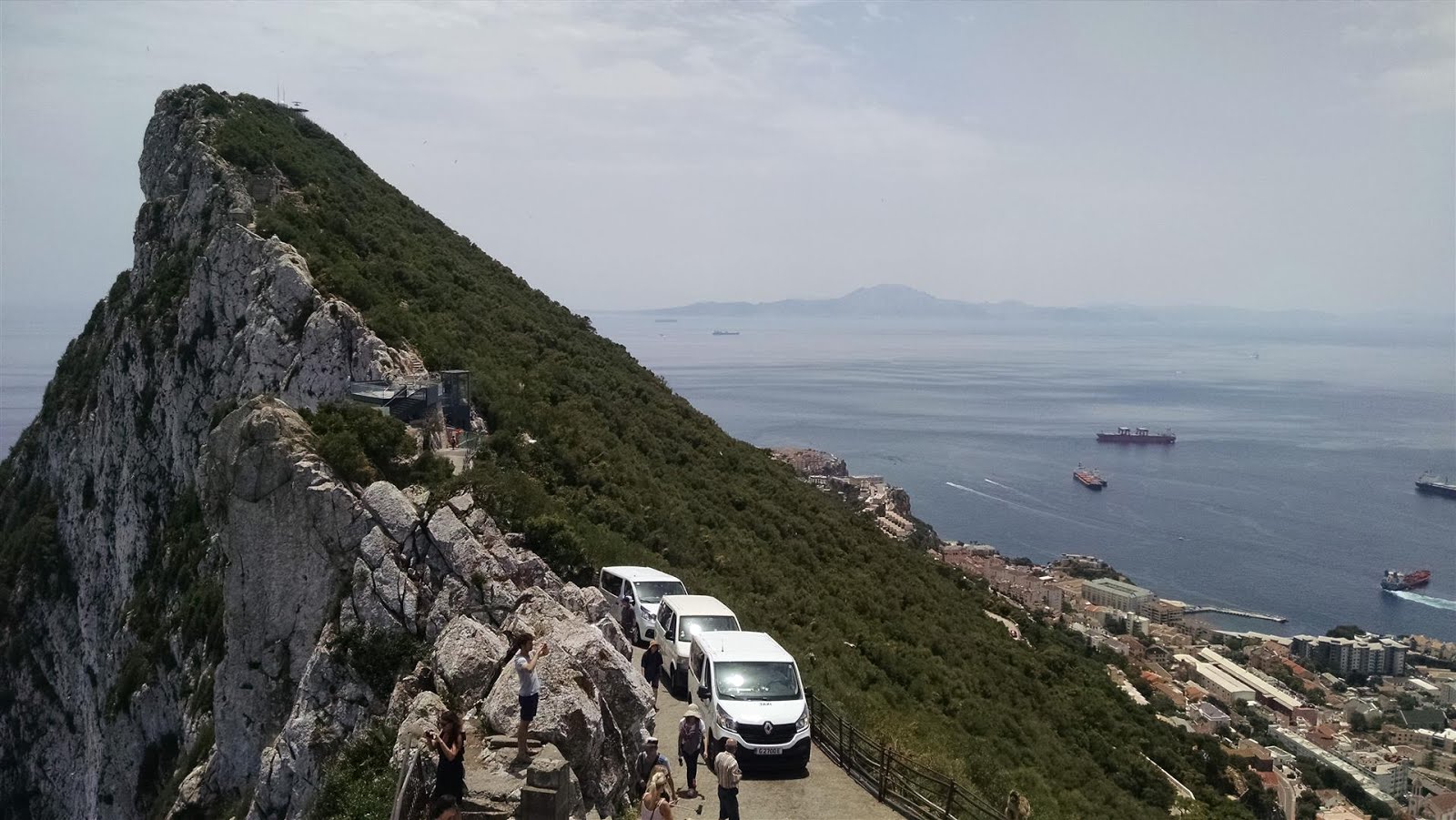
From The Rock Looking Across the Straits....You Can See
Morocco in the Distance
This was a day to sleep late & tour The Rock…something we didn’t have a chance to do when we first passed through here aboard Relish.  We’re glad we returned.

Gibraltar is steeped in interesting history, and you can experience quite a bit of it by touring the various features of its most prominent point….but hire one of the experienced tour drivers in the city’s main square, don’t even think about driving up the Rock on your own.  Gibraltar is a “British Overseas Territory” and has been since 1713 when the results of the War of the Spanish Succession were formalized in the form of a treaty, and in perpetuity.  Spain would still like to have it back; and the Brits’s response is still “bugger off” as they point to that perpetuity clause.  Over the centuries before that treaty, this small area has seen occupation by the Roman Empire, Visigoths, the Moors and a few others, in addition to the Spaniards.  But the citizens here seem to like the place just as it is now, and have no desire or intention of letting go.  It was a very strategic allied stronghold during World Wars I and II, and a lot of that military significance is easy to see when you tour The Rock.
A Female Macaque with Her Infant....These Small Apes
Are All Over the Rock.  And If You Have Food Visible,
It Will Soon Be Theirs

Another very nice aspect of the Gibraltar area is the number of fine restaurants within an easy walk.  Whether it be Argentinian, Chinese, Indian, French, Italian or some other continental cuisine, it isn’t difficult to find nearby eateries offering quality fare.  And that’s a good thing since, as Silvio said, nobody ever visited England for the food. We found two Argentinian steakhouses, one called “Gauchos”, and both had some of the best beef steaks we’d tasted in recent memory.  We remembered and toasted our own Gaucho – he would have loved the simple and great-tasting “meat and potatoes” protocol.

MON 26-JUN
Our morning was dedicated to catching up on personal things….Rick got a much needed haircut (it had been two months and the shagginess was not comfy), and Chelle had an appointment with a local doc to diagnose / treat a mild double ear infection.  What little we saw of the healthcare system in GIB impressed us….readily available, efficient and inexpensive.

The Top of the Rock of Gibraltar
After a brief pit stop at one of the many sidewalk cafes in GIB for a light lunch, we piled into our rental car once again for a drive to Arcos de la Frontera, one of several “White Hill Towns” that dot the Andalusia region of southern Spain.  This area of Spain is what Rick Steves calls a “charm bracelet of cute villages [that] gives you wonderfully untouched Spanish culture.”

It was only about a two hour drive up into the mountains, and in the final 20 km it was easy to tell we were approaching an old town perched on the side of a cliff…streets – if you could call them that – weren’t just narrow, they were almost claustrophobic.  We were very glad that our rental was a compact vehicle, because it’s no exaggeration when we say that both of us could reach a hand out the window and touch building walls on either side….at the same time. Clearly most of them had been built for horse or foot traffic.
View From Our Arcos Hotel Balcony

Neither “old” nor “historic” quite describe it when you consider they’ve discovered archaeological remains here from the Neolithic, Bronze Age, Tartessian, Phoenician and Roman periods, with plenty of written history for the following Moorish and Christian periods.  Thankfully it hasn’t changed much in the past few hundred years.

We Drove Down This "Street"
Chelle Went Back to Measure It.
Old town Arcos is an engaging and attractive labyrinth of cobbled rock streets that lead up to a sandstone castle, the Castillo de los Arcos. And when you finally get up there you are treated to a spectacular vantage point, with exhilarating views over the town and the rolling plains below.  It was easy to spend a couple of hours just strolling through the historic old-town area and sampling the sumptuous local food at the numerous outdoor cafes.

A word about eating habits and protocols here.  If you go seeking a restaurant for your evening meal any time before 2000 (8pm) you’ll find nothing except a nice menu posted outside a locked door.  Before then, however, you can easily find numerous cafes, mostly sidewalk style, than offer a wide variety of tapas (appetizers), wine, liquor and beer.  And desserts, too – they seem to love their ice cream (most hand-churned) here.  The real dinner hour in these parts seems to start around 2100 (9pm), and then the younger folks take over the streets.  The nightclub scene cranks up around 0300 and goes to just after dawn.  And now you know how and why the afternoon siesta came about.

Next up:  a few days in Cadiz, Sevilla and Ronda.  In the meantime, a few more pics follow from our enjoyable stay in Arcos de la Frontera:

Another View From Our Hotel
And Another from Our Balcony
We Could Also See this Old Church from the Hotel Patio
Another Typical "Street" in Old Arcos
That's Our Hotel (Parador).  Notice the Parking in the Square.  It Was Full.
We Parked Med-Mooring Style with the Rear Wheels on a Sidewalk.
Which Apparently is Fine as Long as You Have a Note on Your Dash from the Hotel and
Don't Block Another Vehicle.
A View of the Cliff and Our Hotel from the Bottom of
the Ravine.
Did We Mention the Narrow "Streets"?
Now That's How Sangrias are Made....
....At This Place.  Great Tapas, Too!


Sunday, June 25, 2017

June 2017: From Gibraltar to Malaga

THU 22-JUN
View of Harbor as Relish Departs....That's the Gibraltar Airport's
Runway on the Left - More on That in an Upcoming Post
We awoke early and had Relish away from her Med-Mooring and tied up at the fuel dock even before it opened at 0800, and by 1000 had topped off her tanks with 1,680 gallons of diesel.  We also added a healthy dose of Stanadyne PF treatment in each tank since it would take Silvio considerable time to burn through 2800+ gallons now that he’s done crossing oceans.  (Diesel fuel doesn’t store well after about 90 days unless you add a quality additive such as Stanadyne.)

By 1015 we were underway once again.  We picked our way through the numerous ships anchored in or near the Port of Gibraltar, rounded the Rock’s peninsula, and pointed the bow northeast towards Malaga, Spain.  The sea conditions were perfect – barely a breeze and an almost imperceptible gentle swell.  No stabilizers required!
View of The Rock From the Other Side as We Departed

Relish continued to perform flawlessly, and we cruised at a leisurely 7+ knots along the southern coast of Spain marveling at the calm sea state contrasted again the coastline and its impressive relief of Spain’s Baetic mountains (LINK).  Air and sea temps gradually increased to 29C and 24C respectively (84F and 75F), and that warmth felt very good.

Just before 1800 local time we pulled into Benalmadena Puerto Marina (LINK) just to the southwest of Malaga.  Silvio did a masterful job of backing Relish into its tight Med-Mooring slot….right next to Moxie.  We greeted Bob once again as he helped us run the slime lines forward, and Michel and Rick got the forward lines tied off to the bow.  It didn’t take us long to get Relish washed down – no salt spray today and by now we were getting pretty good at it.
Southern Coast of Spain Enroute to Malaga

We enjoyed a pleasant evening relaxing on the cockpit deck, chatting with Bob and his wife, Kim, who had flown in the previous day to join him for a summer of cruising in the Med.  Eventually we did venture out of the marina for a late meal at one of the many local eateries that dotted the carnival-like strip along the beach.  You could tell that the silly summer season had arrived along the Costa del Sol based on the crowds of tourists.

Michel had a very early flight to catch that would require an 0330 wake up – so we said our goodbyes that night.  We were lucky to have Michel along for this last leg in several ways – it gave us a 4th with whom to share shifts, he is very knowledgeable about boating in general and Nordhavns in particular, and he has a MacGyver-like skillset for fixing stuff; but more importantly we made another good friend that we hope to hook up with again soon.
Together Again - Relish & Moxie Med-Moored Together at
Benalmadena Marina Near Malaga

FRI 23-JUN
This was a lazy day for us….we slept in, ate a late brunch, caught up on laundry and took care of the few minor maintenance items that remained for Relish.  We would be departing tomorrow knowing that she had been cared for very well and is in very good shape for her coming season of cruising the Med.

We also began to (finally) make some travel plans.  We had several options that involved some mix of driving and flying – Gibraltar (again), Malaga, Lisbon, Madrid and Barcelona were on our list.  But we had just recently become aware of another boat-buying opportunity in the U.S. that just might cause us to return there earlier than originally planned.  So as we were also working on that potential deal we decided to rent a car and stay relatively close to the Malaga and Lisbon airports for now.
Silvio, Chelle, Bob, Michel & Rick

SAT 24-JUN
It was time to pack up our gear and let Silvio have Relish back all to himself and his family (due to arrive soon.)  So Silvio drove us to the Malaga airport where we had a rental car awaiting us and we said our good-byes.  Technically this also marked the end of our boating adventure across the Atlantic Ocean.

That journey had been a blast, a bucket list highlight full of adventure, challenges and just sheer fun.  We learned even more about voyaging, Nordhavns and ourselves, and more importantly we made many new friends with whom we share much in common.

And while we also thoroughly enjoyed being aboard Relish, we came to value Silvio’s friendship even more.  Throughout the entire journey he was always a gentleman – kind, courteous, thoughtful and patient, even under the most trying of circumstances.  In addition to being an accomplished boat handler, he was also just plain fun to be around – a great sense of humor, with whom we share many common interests, including aviation as well as boating (and cigars).  We were delighted to be of assistance to him in preparing the boat, as well as helping him learn his boat a bit better.  Overall it was an absolute pleasure helping him get his beautiful Nordy back to his home waters in the Med.
Map of the Next Area Traveled

That said we also knew that Silvio was ready for this journey to be over and to get his boat back to himself.  Living with two to three other people in such close quarters for over a month gets a bit old, as do the 24 by 7 demands of crossing an ocean.  So while we parted ways somewhat regretfully on Saturday, June 24th, in Malaga, we did so with the rare privilege of having made a new and good friend.

Finally…we’d be remiss if we didn’t thank our four Ghost Riders for sticking with us and getting us “back in the saddle” once again and in a grand fashion.

We will have some more posts as we travel the local area and eventually make our way back home, so stay tuned.
The Tracking Site's Depiction of Our Last Leg Aboard Relish