Friday, March 12, 2021

Jan-Mar 2021: Sold the Nordy, Bought a Grady

We concluded our previous blog entry in December with this:  With the arrival of December and south Florida’s version of winter, we’re now at a point where we may start contemplating what Rick calls “a different kind of boat.”

 Selling a Boat

Well, it all happened rather quickly.  Just a few days after discussing the potential sale of the Nordhavn with our broker, Jeff Merrill of JMYS (LINK), he brought us a very committed buyer.  The boat never even got formally listed.  Following two full days of surveys and sea trials in mid-January, the sale of N5021 Ghost Rider closed on 05-February, 2021.  After five and a half years, an ocean crossing, and over 10,000 nautical miles of Nordhavn “trawlering”, we had begun to miss the more casual ad-hoc boating and fishing style of earlier days.  And between the two of us we had developed three bad knees that were beginning to complain with pain. 

N5021, Ghost Rider, Getting Hauled out for the Survey

So, it was time to move on to a boat that didn’t have as many steps and levels, and which provided more southwest Florida flexibility.  But before describing what that looks like further below (hint: it looks a lot like our boats from 2005 to 2015), we first extend our very best wishes to the new owners of hull #21 of the Nordhavn 50 line of trawlers, Scott and Heidi Smith.  They are approaching their retirement later this year and plan to live aboard and sail extensively along the west coast of the US and Mexico.  They are quite excited and enthusiastic to embark on their new adventure, and we know the former Ghost Rider – now named Mi Casa – is in great hands.  N5021 will get many more miles under her keel and plenty of TLC under their watch.  We wish them smooth seas, sunny skies and a fabulous retirement. 

On the Fly Bridge of N5021 After the Offshore Closing:  Heidi on the Left, Scott on the Right, and
John Hoffman of the JMYS Brokerage in the Middle.

Buying a Boat

Over these past couple of months, we had been hunting for our next ride, focusing on an express style cabin boat in the 30-to-36-foot range, designed for both cruising and fishing, and with outboard power.  We first sea trialed an Edgewater 33 over in Palm Beach, and liked what we saw in terms of style and quality.  Powered by a pair of Yamaha 350 4-stroke engines, and built like a tank, it felt just a tad sluggish but handled a very sloppy mess out in the open Atlantic with ease. 

We also traveled to Key Largo to view and test drive an Everglades 36 with triple Yamaha 300 4-strokes; that, too, was a high-quality boat and handled exceptionally well.  Unfortunately, its cockpit configuration was set up more for entertaining, was a bit short on headroom in the cabin, and wasn’t particularly conducive to our fishing plans, so we passed on that.

Finally, we went back to our Grady-White roots and tested out a late model 330 Express that had a pair of Yamaha 425’s hanging off the back….and fell in love with that.  But good boats are going fast these days, and that one got gobbled up before we could make an offer.  Fortunately, we found another a short time later, and it was loaded with almost every option the factory offered.  Ultimately, after a smooth survey and sea trial, we closed on that on Monday, 01-March. 

The New Ghost Rider, a 2019 Grady-White 330 Express

Moving the New Boat

Unfortunately, our new-to-us boat was located in Ponte Vedra Beach on the east coast of Florida (near Jacksonville), which resulted in a 400-mile shakedown cruise to get the new Ghost Rider to our home base in Fort Myers.  So, on Tuesday, 02-March we splashed the boat around 1100 and began the trek south.

The weather was lousy – a cold front had moved through the area the night before, dropping temps into the upper 50’s, with rain showers and a brisk north wind…which also churned up the Atlantic into a frothy mess.  Busting through seas forecasted at seven feet wasn’t an appealing prospect, so we decided to take the inside ICW route.  We kept our first day short, going only about 70 miles to Halifax Harbor Marina in the Daytona area.  There we topped off the fuel tanks, reset the trip computer (it’s WAY more accurate than any fuel gauge) and tied up on a T-dock for a relaxing stopover.  While we still had grey skies and cool temps, the rain had finally stopped.

Leaving Ponte Vedra & Heading South on the ICW on a Cool & Rainy Day

Any experienced boater will tell you that a shakedown cruise is actually a breakdown cruise, and accordingly on the morning of Wednesday, 03-March we were greeted by nearly-dead starting batteries for the starboard engine.  Since we had a long 170 mile run to Stuart ahead of us, we decided to just join both battery banks together to start the #2 engine and get underway at 0900, delaying the troubleshooting until that evening.

Skies had cleared and temps has warmed considerably, but with some very long stretches of go-slow zones on this leg (we got passed by several dolphins), we didn’t arrive at Pirate’s Cove Marina in Stuart until 1700.  After situating the boat with a quick washdown and topping off the fresh water tank, Rick went to work on the battery issue.  All four AGM’s had stayed at normal charge levels throughout the day, suggesting that the engine-driven alternators and the batteries were not the issue.  A quick glance at the onboard battery charger revealed the problem: its red “Fault” and “Reverse Polarity” LEDs were glowing brightly, and the unit would not respond to the reset button. Since the device had checked out fine on the survey, and we verified our AC power connection was of the correct polarity, we were fairly certain a circuit board had gone wonky over the last 48 hours.

Our Route From Ponte Vedra to Fort Myers.  The Red Line is the First Day's Path When the inReach
Tracking Device Refused to Track.  The Blue Lines are Actual Tracks Following a Reset-Reboot
of the Misbehaving inReach Unit.

With prudent DC power conservation overnight (lots of flashlight usage) the batteries retained enough juice to provide normal start operations the next morning, Thursday, 04-March.  We were underway by 0815, with a plan to cross the state via the Okeechobee Waterway (Lake O) and reach Legacy Harbour in Fort Myers before sunset. While morning temps were still cool (jacket weather) winds were light under partly cloudy skies.  We reached the first lock – St. Lucie – at 0930….and we were still there at 1145.  So much for the day’s planned schedule. 

 With its 14 feet of level change, passing through the St. Lucie lock is never a quick process, but there was a lot of dredging going on just east of that lock, and the barges got prioritized over all recreational traffic.  So we sat dormant for several lock cycles before finally locking through.  The only bright side to that frustrating morning was that the Yamaha Helm Master’s fly-by-wire “Stay Point” feature got thoroughly tested, and it worked well; just stab that button on the joystick and the computer-controlled engines automagically hold a position for you. 

Locking Through St. Lucie

There were a few more, although less onerous, delays at the next three locks, and in between a very sloppy Lake Okeechobee gave the Grady a chance to show off its rough water capabilities (holding a steady 30 MPH / 26 knots, albeit with lots of trim tab deflection.)  But even the Grady’s power and speed couldn’t compensate for the lost time at the first lock; that long delay meant we would be about 15 minutes late for the last lock-through time of 1630 for the final Franklin lock facility.  And that meant we would not make it to Fort Myers until the next day. 

Of course, that also resulted in a mad scramble to find a place to park the boat for the night.  Marina facilities are scarce along that particular stretch of the waterway, but eventually Michelle found a vacant slip at the LaBelle City Docks.  While far from fancy – no finger pier, no 50 amp power, no shore facilities – the price was right (free.)  We had to park Ghost Rider bow-in because of skinny depths at the shoreline, and then get creative with the dock lines, but we made it work.  We also had to run the genset all night for AC power, but overall it sure beat trying to anchor in a dark and narrow ICW channel. 

Tied Up at the LaBelle City Docks Along the Okeechobee Waterway

We awoke to bright sunshine, light breezes and warming temps on Friday, 05-March, tossed off the lines around 0830 and continued west towards the final lock and then Fort Myers.  We decided to stop at Calusa Jack’s cozy little transient marina for fuel, and enjoyed a conversation with the attendant and his two parrots, Billy and Nauti while pumping in 245 gallons.  After enduring several more lengthy no-wake zones (it’s manatee season in south Florida) eventually we made it to our new home port, Sanibel Harbor Yacht Club (SHYC LINK), at the eastern end of the Sanibel Causeway just after high noon. 

We Stopped at Calusa Jack's Small Marina (Fuel Dock) to Top Off Tanks and Have a Chat with
the Parrots Billy & Nauti (the One Hanging Out on Chelle's Arm.)

We chose SHYC for several reasons, one of which was every other yard within a hundred miles was at capacity and with long waiting lists.  But their hurricane rated storage barn, proximity to the Gulf, similar proximity to our condo (10 minutes), and broad range of quality splash, concierge and maintenance services also checked all the right boxes.  Javier, the yard manager, and his crew forklifted the boat and spent about an hour fitting the storage barn bunks to Ghost Rider’s hull.  In the interim, our good friends, Jim & Susan Hill, ferried Chelle back to our condo to pick up our SUV, and then we spent another hour transferring all our gear from boat to car.  It was good to be home.

The New Ghost Rider Getting Forklifted at Sanibel Harbor Yacht Club

About the ‘New’ Boat

This is our third Grady-White, although at 33.5 feet long (more with the outboard engines & bow pulpit) it’s the biggest of those.  There is one aspect of this vessel that Rick is not wild about, and that’s the blue hull….down here in south Florida, that will be prone to fading in the hot sun, and it retains heat; we’ll eventually find out how well the air conditioning works.  But Michelle loves it, and that was the end of that discussion.

The original owner had tricked it out with every option but one.  The options list includes: a motorized sunshade for the cockpit area; an electric sunroof above the helm area; air conditioning for the helm as well as the cabin berth; an electric grill in the cockpit area; refrigerated chill plates for the big fish box at the stern and a for a cooler under the port side passenger seat.  The boat also sports custom SeaDek flooring on all exterior decks (LINK).  The one option it is missing is outriggers, which Rick is already planning to add. 

The Big Forklift About to Insert the Big Grady into its Slot in the Barn.

For propulsion power it sports a pair of Yamaha’s latest and largest outboard engines, a pair of 4-cycle, 8-cylinder 425 HP beasts.  Standard power on the 330 Express is a pair F350’s, but Rick wanted to avoid those given their history of flywheel issues.  (Yamaha gave up trying to correct that issue and now just installs new flywheels on them at no charge at regular maintenance intervals.  But we did not want that hassle.)  The 425 XTO 4-stroke engine is all fly-by-wire, and that includes both the throttles and the steering – there is no helm pump, and no hydraulic lines between the wheel and the motors.  That, in turn, enables the use of joystick steering via Yamaha’s “Helm Master” control suite, with independent movement of each engine.  That enables very precise close-quarters maneuvering capability without the use of a bow thruster, as well as the aforementioned “Stay Point” feature.

The nav/comm equipment, however, is pretty average consumer-grade Garmin gear.  The 8616 MFD is serviceable, and the additional CL7 display provides some redundancy, but in typical Garmin fashion it’s all touch screen, and you are subjected to “death-by-layered-menus” to do anything other than basic navigation.  It does, however, integrate very nicely with the Garmin autopilot (GHC 20 control head with Reactor 40 computer.)  The VHF is also a Garmin device (a 215 model) with GPS and (theoretically) AIS…the latter has yet to be tested; regardless, it’s the lowest of low-end VHF options on the market, and hopefully will eventually become just a backup to a higher quality radio.  Finally, there is a Garmin Fantom 24 dome radar on the hardtop; after considerable tuning it seemed capable.  The network backbone is all NMEA 2000, and that also interconnects with a Fusion sound system. 

Sanibel Harbor Yacht Club

It all works well enough for coastal cruising, offshore fishing and occasional trips to the Bahamas.  But If any of the Garmin stuff ever dies, Rick will be happy to rip it out and install come commercial-grade Furuno gear.

Punch List?

Oh yes, there’s always a punch list, even on a lightly used two-year old vessel.  The main item right now is getting the battery charger replaced, and we’ve got a new unit on order.  The survey produced a relatively short list of more minor infractions that need to be remediated, and we’ll have more on that in the next blog post.  A pair of outriggers are also high on the list, along with a Sirius/XM weather overlay for the chart plotter.

What’s Next?

Once we get this boat reconfigured, our goals are more frequent sorties, including coastal cruising, marina hopping and fishing trips.  We’ve targeted mid-May for the first journey back down to the Florida Keys and a week-long stay in the Marathon area for some serious dolphin and tuna trolling excursions.  The summer season cruising plans will, of course, be gated at least partially by how active the hurricane season gets (likely to be another active one), but there’s plenty of time to figure that out later.  Stay tuned.

Chelle Relaxes in the Spacious Helm Area While Docked at LaBelle

Afterword:  After the recent reminder that American democracy is still very much an experiment and still quite fragile…shouldn’t we try a little harder not to fuck it up?  Mask up & get your shots, we're not out of the woods just yet.

Sunday, November 29, 2020

November 2020: More Tropical Wx & Boat Stuff

 Foreword:  In 1787 Thomas Jefferson wrote to James Madison that “a little rebellion now and then is a good thing.”  To date the USA has experienced two.  The first created our constitution & the republic, with 25,000 American lives lost.  The second in the 1860’s nearly ripped the country apart, took 655,000 souls, and failed.  Those now trying for a third will lose, too, but there will still be a cost.

The Drunken Path of a Confusing Storm
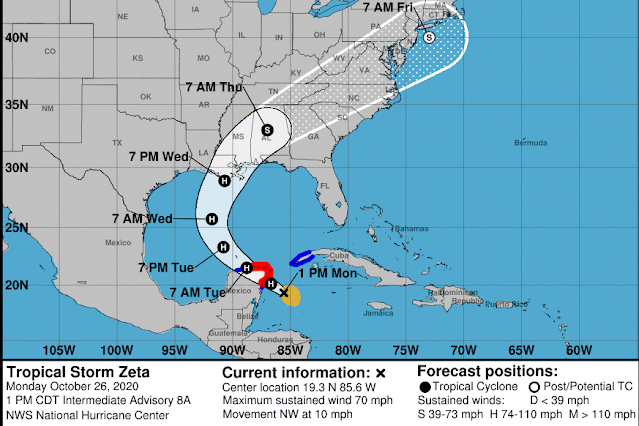
What was once Hurricane Eta morphed into a tropical storm after clobbering Nicaragua and the Honduras as a Cat-4 storm, then plowed into Cuba and eventually made two separate landfalls in Florida.  It had a couple of shots at Fort Myers and missed both times, although not by much.  Its path was as convoluted as it gets, giving the forecasters fits.  And that meant Ghost Rider had to be prepped for a possible Eta fly-by.

We had already deployed extra lines and fenders, so this time our preps were focused on securing canvas on the boat deck and flybridge, lowering antennae, and stowing all loose gear on the main deck into the lazarette.  On the night of 08-November Eta passed about 80 miles to our south, bringing rain and occasional gusts to 45.  After heading west into the Gulf of Mexico, then bending south before turning back to the northeast, Eta cruised past us again on 11-November, this time as a Cat-1 hurricane about 80 miles to our west.  That brought us another round of rain and wind, with gusts up to 60 MPH, and an extra four feet of sea surge.  It was an annoying way to celebrate our Veterans Day. 

Flybridge Cover Taped Down, Bimini Rolled Up & Non-fixed
Antennae Lowered & Tied for Storm Preps

By the morning of 12-November Eta had made its fourth landfall just north of Tampa as it turned to the northeast, and proceeded to strafe the coastlines of Georgia and the Carolinas before continuing out to sea a few days later.  We spent a day putting Ghost Rider’s gear back to a normal state, hoping we had seen our last tropical threat of the season.  There was another forming down in the Caribbean again (which became Iota, a record-breaking 30th this year) but the long-term models did not predict a northern trek in our direction.  Eventually Iota spun up into a Cat-5 and clobbered the same areas of Nicaragua and Guatemala that had been whacked by Eta on its first landfall two weeks prior.  We count our blessings. 

Break/Fix 

Nothing broke this month.  Honest.  Really. 

Regular Maintenance 

It was a light month overall, and apart from the humdrum repetition of numerous, minor Wheelhouse preventive tasks, the main task this month was the bi-annual coolant flush for the wing engine.  In addition to serving as our “get home” auxiliary propulsion unit, that Lugger 984 also powers the hydraulics for our bow and stern thrusters, in addition to the Maxwell 3500 windlass.  It’s almost as important at the main engine, so we pay attention to its care and feeding requirements. 

But unlike the generator and main engine diesels, we had never tackled a coolant system flush for that powerplant – our friends at Yacht Tech had handled the last one two years ago.  Still, the principles were the same, so after a review of the technical manuals, Rick went after it.  Overall it was pretty straightforward, with the main key being the use of the flexible “Form-a-Funnel” – actually two of them; otherwise we would have ended up with all the coolant in the bilge instead of a drain bucket.  After that we flushed with fresh water until the drain ran clear and replaced the drain plug. 

Form-a-Funnels Make Draining Coolant a Much More Precision Operation

While he was at it, Rick also attacked a thorough cleaning of the heat exchanger core, and even that turned out to be reasonably easy:  remove the pencil zinc and drain plug, then both cap ends, take a wire rod and router it into each of the many honeycomb passages, pick out the old pieces of sacrificial zincs, and slap it all back together with a new pencil zinc. 

End Cap Removed on One End of the Heat Exchanger

After adding back about three gallons of the Peak Fleet Charge 50/50 premix (the Luggers are picky about their coolant), the engine checked out under load with no leaks, and kept a steady 180F on the temp gauge.  

Project Work 

There was only one small project that we got to this month, and that was the annual detailing of the dinghy.  To say the dinghy was dingy doesn’t quite cover it.  Cleaning and waxing of the interior FRP surfaces was fairly straightforward, but scrubbing the Hypalon inflatable tubes took several passes with different cleaning solutions before it was anywhere close to acceptable. 

Final (?) Tropical Weather Check 

Almost December & the Tropics Aren't Done Yet

The official hurricane season runs from 01-June to 30-November.  That’s actually an arbitrary definition that simply brackets the months in which most tropical systems (about 97%) have historically formed.  But there isn’t a month when a tropical weather system has not formed.   After Hurricane Eta we were hoping we were done with them for this year, but then the day after the US Thanksgiving holiday two more areas got flagged for potential development.  Fortunately neither were anywhere close to us. 

Departing the Boat 

And lastly, the reconstruction efforts at the condo progressed far enough to make it sufficiently livable.  Chelle had actually been spending more time there than on the boat – busy with project oversight and numerous complementary projects that dovetailed with the overall renovation scheme – while Rick had made a conscious effort to avoid most of the mayhem, enjoying the quiet of the boat.  But by the time the Thanksgiving holiday rolled around most of the major work had been completed, and we both returned to dirt-dwelling. 

The Major Renovation Work Progressed Enough to Allow a Thanksgiving Back at the Condo

Finally, a big thanks to our friends Martin and Stephanie Maurer aboard N60, Blossom, who stopped off at Legacy Harbour on their way from RFYC to their home in St. Petersburgh.   They hosted us for two enjoyable evenings in the spacious open-air cockpit of Blossom, and the rare social experience was a wonderful break from the rigors of the pandemic. 

With the arrival of December and south Florida’s version of winter, we’re now at a point where we may start contemplating what Rick calls “a different kind of boat.”  But that’s an evaluation still in the very early stages, with more to come in the future.  Stay tuned. 

Afterword:  During any crisis the only thing more dangerous than a leadership void is blaming conspiracy theories for those failures of leadership.  That’s a downward spiral from which the weak-minded never functionally recover.  And from which pandemic victims get sick or die.  We’re supposed to be better than this, but unlike previous generations, too many are proving they are not up to the challenges.

Wednesday, November 4, 2020

October 2020: Back on the Boat

Coping with Covid can often feel like déjà vu….as in, what day is it?  It’s today.  Still.  It’s like a really bad version of the movie Groundhog Day, but with annoying masks, no hugs, and a pathetic plot.  Rick gave up on remembering days of the week and now calls each day “Blursday.”

View of the Portion of the Condo Where Kitchen & Wall &
Floor Tile Were All Ripped Out

Chelle got so bored she decided to demolish about half of our condo as a distraction. Presumably that was in preparation for a remodeling effort, and Rick evacuated to the boat just before the jack hammering started.  That turned out to be good timing as we had a lot going on in terms of Ghost Rider activity.

Break/Fix

Rick had invited Craig of VIP Marine out to the boat to evaluate a cooling problem with the A/C unit for the pilot house.  That’s a relatively new compressor/evaporator combination (barely two years old) but its cooling output was trending 10F warmer than all the other units.  That’s enough deficit to greatly impact the pilot house with all its greenhouse-like glass.  Craig showed up on day one of the condo exodus and slapped the gauges on the suspect compressor.  That revealed a lack of refrigerant pressure and volume, so he pumped it up with the R410A stuff, providing an immediate improvement.  We did not find any leaks in the obvious plumbing places, so we’ll run it for a while in the south Florida swelter and see how it holds up over time.

Jerry & Ross Trying to Figure Out How to Fit the New HPU
Assembly into the Too-Small Space in the Base

At about the same time Ross and Jerry of Class Yacht Services showed up with the heavily altered HPU for the davit/crane.  The machine shop mods to the fastener holes, fluid ports and hydraulic adaptors still allowed installation room in the base of the davit, but it was a very tight fit.  Sleuthing the electrical connections took a while as we did not have the benefit of a good schematic, but Ross was able to cobble together a reverse engineering of the wiring.  New hydraulic hoses were then fashioned and connected.  All that took a few days.

Then it was time to add hydraulic fluid (about two gallons of ISO 68), apply power through the circuit breaker, connect the control pendant and test it all out.  We got good movement of the hook up and down, and of the boom to port, starboard, and down – but it would not raise.  Suspecting that particular control valve had a blockage in the “up” direction, they again removed the valve manifold and took it to the shop for individual valve testing.  Some debris was found and removed but upon reassembly back at the boat we still faced the same problem.

So, we all stood there and stared at the crane for a while, waiting for some inspiration.  It came to Jerry:  while the motor would run with the “boom up” command the valve might not be opening via the magnetic coil actuation, or in other words, it was an electrical issue. We had previously requested an updated wiring schematic for this later version HPU from the manufacturer (Aritex) in Taiwan, but had received no response.  Revisiting the control box wiring with a Fluke volt meter eventually led to the discovery of a well-hidden orphan ground wire.  Once it was connected, we were back in business.  The final touch was for Rick to clean and polish the base, and to drill an additional drain hole at the rear of the davit’s base.

This is How the New HPU Assembly Looked Before We Turned it Over to the Machine Shop
for Some Significant Modifications

The Machine Shop Removed the Valve Manifold Assembly and Crafted a New Mounting Base
So That it Could be Installed Off to the Side of the HPU

In Place of Where the Valve Manifold Used to be, the Machine Shop Created a New and
Smaller Interface Block to Mate with the Relocated "Remote" Valve Manifold

Regular Maintenance

It was also time for Ghost Rider to get her periodic spa treatment.  Based just on visual evidence she was actually overdue – while the light gray vertical hull surfaces below the gunwales still looked pretty good, after 11 months the white FRP surfaces above that were getting that dull weathered look.   And keeping it clean was becoming a real chore.

The Bow of Ghost Rider Getting Detailed

We engaged Frank of Ultimate Marine (LINK) once again to tackle the enormous job of washing and waxing the entirety of the boat’s exterior.  Over a period of six days he and a few helpers got Ghost Rider looking spiffy once again, with the aid of electric buffers and copious amounts of Collonite Fleetwax on the FRP and Flitz on the brightwork.

Next up was the bi-annual service for Ghost Rider’s two Vacuflush toilets.  We had been experiencing minor and periodic issues with a temperamental water valve on one of them, along with a slow vacuum leak on the other, so Rick lobbed a call to the local Dometic shop. Travis and Gary from Fleet Repair (LINK) tore down and replaced the key serviceable parts for both heads, and also serviced the two vacuum pumps with motor mount adjustments and new duckbill valves.  It’s always good to have a smoothly operating waste water system.

Ghost Rider Looked a Lot Better After Frank & His Crew Finished Up

Project Work

Rick focused on a short list of “little stuff” this month….touching up paint scars in the engine room, refreshing Denso tape wraps on some hydraulic fittings, polishing corrosion from the pilot house Stidd chair base, and drilling a new drain hole for a fly bridge storage box.  The gas tank and spare gas cans for the dinghy also got reinforcing shots of Sta-Bil fuel conditioner – that stuff loses its potency after about a year. The overall punch list actually – finally – got a tad shorter this month.

Rick Got Some Cleaning & Detailing Work Done in the Engine Room, Too

The Steering Box & Stern Thruster Hydraulic Manifold in the Lazarette....Along with the Bow
Thruster Compartment, It Also Got Cleaned Up and New Denso Tape Wraps

Tropical Weather Check!

Hurricane Epsilon spun up into a major storm but fortunately stayed out in the open Atlantic, even missing Bermuda (barely) as it curved away from the U.S. and far to the northeast.  Then, as expected, yet another tropical system spooled up in the Caribbean this month and eventually made its way into the Gulf of Mexico.  Now deep into the Greek alphabet names, Hurricane Zeta got steered away from us by a high pressure system to our east and took initial aim at the Yucatan.  And then, following a disturbing pattern this season, once again the Louisiana coastline was bore sighted.  It would be their fifth of 2020.

After Five of These We're Guessing Land in Louisiana & Mississippi is Getting Pretty Cheap

As October came to a close yet another system was just spinning up, and didn’t take TD29 very long to morph into Tropical Storm Eta.  It was forecast to ping pong around the Caribbean before potentially turning north towards us….but as you can tell from the scattered model plots in the graphic below, they really have no clue where this one would end up going.  We’ll be monitoring closely.

The Early Track Forecasts for the Next Storm are Literally All Over the Place

And finally, to bring October to a proper close, we enjoyed a marina-style celebration of Halloween.  By 31-October our temps had moderated to a pleasant 80F, with a pleasant breeze and mostly clear skies. That allowed B-dock adults to gather for happy hour docktails, and then at sunset the youngsters in our little liveaboard community enjoyed a fun, albeit masked and socially distanced “Trick-or-Treat” experience.

Trick-or-Treating on the Docks at Legacy Harbour Marina

Afterword: As we went to press with this blog entry the latest tally of the US election results was still underway.  One candidate was lobbying to stop counting votes and declare himself the winner.  We suppose there's something to be said for being a consistent cheat.  Meanwhile the virus seemed to be exploding (again) nearly everywhere.  Be very careful out there.

Friday, October 2, 2020

September 2020: Same Old Stuff, Only Different

The intrepid sailor and circumnavigator, Eric Hiscock, once said “the only way to get a good crew is to marry one”, and there’s tonnage of truth in that.  And if you know anything about Ghost Rider’s crew, then you know our Chief-of-the-Boat (Michelle) is a list-maker.  All kinds of lists.  There’s always the “to do” list, but also lists of recipes, ingredients, galley supplies, durable foodstuffs, fresh produce, frozen food, shoes, whatever. And the shopping list.  She may have lists of lists. Fortunately, some time ago she discovered an application, called “AnyList” (LINK), which makes all that enumerating and cataloging very efficient.

An "AnyList" Screen Shot

Chelle has also been a long-time fan of the “The Boat Galley” web site (LINK) where Carolyn Shearlock has long advised cruisers on tips and tricks for the voyaging couple.  Carolyn asked Chelle to write an article on how she uses the “AnyList” app, and you can find the result of that collaboration at this LINK.  Note that while it’s mentioned as an option, we do not use the app for tracking boat parts or spares.  (For us that still remains in the realm of our Wheelhouse software.)

Break/Fix (Davit Update)

As for the davit’s new HPU, Ross’s machine shop is just now completing its modification work, which is fairly extensive.  

The HPU Manifold Assembly is Requiring Significant Surgery

Two aluminum blocks were machined to match the fluid ports and fastener holes on the new pump and manifold.  Those blocks also had fluid ports machined to accept o-ring boss hydraulic adapters.  Then the blocks were bolted to the pump and manifold, and a base is being fabricated for the valves. 

Next up will be to install the modified HPU after which it will be necessary to make up new hydraulic hoses for the pressure and return flow.  So there is still a lot of work left before we’ll know if we can make it all work.

Salon Ceiling Panel Removed to Reveal Water Leak Location (Yellow Arrow)


Along the way, the removal of the old HPU from within the base of the davit housing had exposed an electrical wiring run which goes through the boat deck level and down into the salon ceiling void area.  And that had started to leak rainwater inside the boat on the starboard side of the salon.  We took down the ceiling panel to locate the source, and then it was an easy task to apply some silicone caulk (at the boat deck level, inside the davit base) to resolve the issue.

More Break/Fix (Main Engine Water Pump)

While we were not exactly sure it was “broken”, the main engine’s raw water pump had developed a small oil leak at its engine block adapter.  That usually means a deformed o-ring, although there was the lingering doubt about more significant internal pump issues.  So Rick decided to remove and replace it with our spare pump with a new impeller.  That sounds simple, but access is a real bear, and it took him several hours over a couple of days.  Subsequent testing demonstrated the leak was resolved, and Rick then sent the leaking pump to the Depco Pump Company (LINK) in Clearwater for evaluation.  They were – as usual – very prompt, and recommended that both the pump’s internal water seal and oil seal be replaced; for $190 (on a $1600 pump) that was worth it.  It took all of three days to ship it, have it examined and rebuilt, and get it back into the spares bin.

The Old Raw Water Pump Being Removed....Not a Fun Job

Project Work

When you acquire a boat – any boat – whether you acknowledge it or not it comes with its list of projects.  Whether you write them down or not is also immaterial to the reality, that list is there.  There is also a Murphy’s (maritime) Law that states any time you cross one project off the list, two more will appear to take its place.  It’s maritime magic.  If the Greek mythologists were more attuned they would have made Sisyphus a sailor.

Next up on our docket of boat projects was related to a time-based deadline, specifically the expiry date for the boat’s pyrotechnic signaling devices – primarily red flares and orange smoke.  For the record, those things expire at 42 months from the manufacturing date.  Our inventory included not only the hand-held flares and smoke devices, but also flare gun cartridges and SOLAS certified parachute flares, along with sea dyes.  An inventory refresh for a well-equipped voyaging vessel can easily run around $500 USD.

We have periodically tested expired pyrotechnics – New Year’s Eve and Independence Days are the best nights in the USA unless you want to entertain the consequences of an accidental SAR mission – and they’ve always worked.  Testing or practicing at any other time requires USCG and LEO notifications, and a securité call on VHF channel 16.

When we crossed the Atlantic back in 2017 we also had five vessels fire off an impressive variety of expired devices one night (quite literally in the middle of the Atlantic Ocean) and they all performed well.  The SOLAS parachute flares, by the way, were by far the most impressive given their brilliance, illumination time, and altitude / visible range.

The Array of Signaling Devices We Carry in Our Ditch Bag...with the New eVDSD Device in the Middle

The bottom line is if you store your pyrotechnic devices properly (waterproof container) and inspect them regularly (checking for damage), they will last for years beyond the expiry date.  But should you rely on expired stuff when safety is at risk?  Probably not.

But there is now another sensible alternative, and that’s the electronic Visual Distress Signal Device (eVDSD).  It’s only in recent years that these have received USCG and SOLAS approvals, sporting powerful LEDs which automatically emit the visual Morse code for SOS, built-in flotation, and user-replaceable batteries.  Replace the latter once a year and they never expire.  Combined with the standard daytime distress flag – and an arsenal of expired pyrotechnics – you can remain legal and safe for a one-time outlay of $89.95 (plus a few bucks annually for batteries.)  We chose the Sirius brand, but Orion makes a decent one, too.  There’s a good explanatory article at this LINK.

The next project was one that we had been debating for a while, and that was whether to upgrade our navigation software.  On Ghost Rider we use Furuno TimeZero Touch2 (TZT2) MFDs and also Nobeltec’s TimeZero Professional on the ship’s PC.  As you might guess from the shared “TimeZero” labeling, the software for both systems share an integrated architecture, so care must be taken to insure version compatibility between the two.  When Nobeltec introduced V4 of their TZ PC software in early 2020 it included a warning that its Furuno integration would break without the next version of TZT2 (version 7), so we waited for that.  Then the debate was whether the price was worth the gains.

These Types of Screens Make You Hold Your Breath....But It All Went Smoothly

In the end the price tag was nominal (Furuno’s upgrade was a freebie, Nobeltec’s was not) and we did not want to be in an upgrade-limited box canyon, so we pulled the trigger this month.  While it was a distinct pain-in-the-ass to upgrade both systems, overall it went fairly smoothly.  The Furuno side of it required separate upgrades for each MFD (involving downloads to both microSD and USB flash memory) and took a couple of hours.  The Nobeltec side of it was predictably less time-consuming – it basically was your typical PC-based software upgrade, although we did hit the limit on number of routes it could convert and support (200), easily overcome by removing duplicates and unused “what if” routes.

The New (V4.1) TimeZero Animated Weather Screen is Cool....Leaves No Doubt Where the Gulf Stream Current is Ripping Along.
Post-upgrade testing showed all functions to be ops normal, and Rick spent some time playing with most of the new features on both subsystems, all satisfactorily.

Finally, it was time once again to test out all of Ghost Rider’s bilge pumps.  The nuisance water pump (a Whale Gulper 320) gets a daily workout just expelling air conditioner condensate, but the other three dewatering devices require a special effort to verify their operation.  So Rick ran a dock hose down to the engine room, turned the nuisance pump breaker off, and flooded the bilge until the high water pump float switch kicked off the next pump (a Rule 3700) and triggered the high water alarm.  That revealed a problem, which turned out to be a blockage near the through-hull at the stern of the boat back in the lazarette; repeated cycling of the through-hull handle along with a coat hanger auger and a high pressure water hose took care of that.  (There’s a lesson here: we’ve discovered that any through-hull that has a 90 degree bend near its exit port needs periodic testing and cleaning.)

The Pacer Hydraulic (Crash) Bilge Pump....Capable of Expelling 10,000 Gallons per Hour

Next up was the manual pump (an Edson 638) which primed and pumped as advertised.  And last was the hydraulically powered emergency crash pump (a Pacer centrifugal model rated at 180 gallons per minute)….we leave that until last because that beast will completely empty a flooded bilge cavity in a matter of seconds – and it did (after priming.)  In the process our Monnit high water remote sensor also dutifully alarmed and sent its remote notification, so we declared victory.

Weather Check!

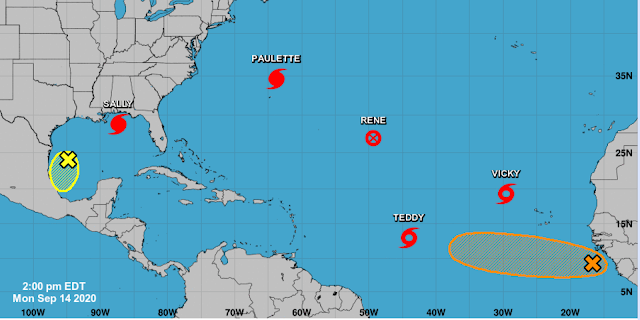
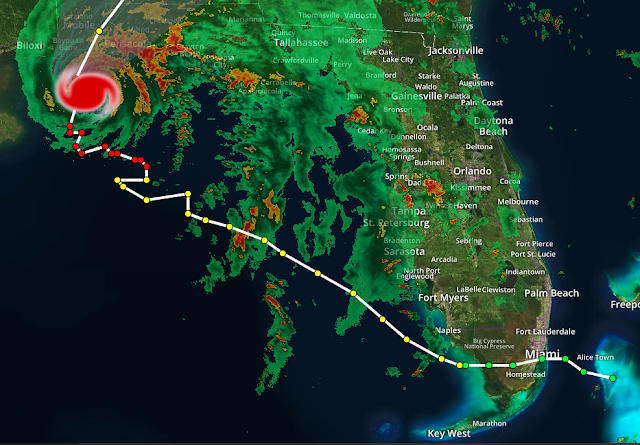
To say that the tropics were – as predicted – heating up this month would be quite the understatement.  By mid-September the NHC's map of the Atlantic basin and adjacent seas looked like a video game of tropical pinball.  Here in Fort Myers we got all of 24 hours of notice when TD18 formed just east of Miami, and by the time it cruised past us a day later became Tropical Storm Sally, mainly as a rain event.  But by the time it reached the next shoreline at the Mississippi-Alabama border it had reached hurricane status and dumped about a year’s worth of rain there as it slowed to a crawl for several days.

Tropical Storm Pinball...as of 14-Sep-2020

Luckily all those other named storms got steered out into the Atlantic, pin wheeling towards Bermuda or otherwise heading into vast open ocean areas.  As the month progressed the number of storms finally exceeded the normal allocation of names (all 21) and progressed into the letters of the Greek alphabet.  Even the Mediterranean and the coast of Portugal encountered tropical systems this month. 

Sally Skirted Us as a Tropical Storm then Moved on to Clobber Alabama as a Cat-2 Hurricane

Wait, why do we only use 21 letters of the alphabet, why not all 26?  Naming these systems has a long and tortured history, but first note that it isn’t NOAA/NHC in the USA that decides such things – it’s the World Meteorological Organization (WMO) international committee that does that.  They actually maintain lists of storm names for four separate ocean basins (one for the Atlantic/Caribbean/GOM, then three others for the different Pacific Ocean regions).  And there are actually six such lists for the Atlantic basin which rotate on a six year basis – except for when a really nasty storm gets its name retired.  The Atlantic list doesn’t use the letters Q, U, X, Y or Z because there just aren’t enough available (and recognizable) names that begin with those.

Towards the end of the month the tropics settled down for a spell, but we expect the activity will pick up again in October.  To make it more entertaining, that’s the time of year when such storms tend to originate closer to home – in the Caribbean and GOM – which tends to give folks less prep time.  We’re two-thirds of the way through hurricane season, but there’s more to come.

Afterword:  It’s only slightly humorous that many in the USA are acting shocked that their government has been lying to them about Covid-19 since late January.  As if that was a new phenomenon.  Just as interesting were those twisting themselves into knots trying to explain it away as some bizarre and nouveau form of leadership. We continue to look to science, wear our masks, keep our distance, and long for competent governance.