Sunday, June 26, 2016

26-Jun: Weather Delay

Lousy Weather with More Coming
Well crap.  We awoke this morning surrounded by TRWs with more building on our planned route.  Apparently that cold front has more teeth than the forecasters originally thought.  So we’re staying here in St. Augustine another day.

We'll just relax today and head into town to enjoy the local area. There are worst places to be delayed...St. Augustine is the oldest established settlement in the U.S. and has plenty of history, entertainment and eateries to keep one enjoyably occupied.

Saturday, June 25, 2016

20-Jun to 25-Jun: Palm Beach to St. Augustine

On Monday 20-Jun we tossed off the lines and finally boogied out of Palm Beach, taking the “inside” route up the ICW, heading north once again in the general direction of St. Augustine, with interim layovers planned at Fort Pierce, Cape Canaveral and Ponce de Leon.  We had to deal with quite a few bridges on this initial leg, but nonetheless still made reasonably good time, arriving at Fort Pierce City Marina by 1530 after a 0900 departure from Old Port Cove.

Along the AICW
Negotiating the ICW in this part of Florida entails a lot of “hand flying” – you can’t just punch the auto-heading or nav function on the autopilot and hope to keep it between the beacons for very long….so it isn’t as relaxing as running on the outside.  Still, we got some good fly bridge time, and the few inlets that we got a look at as we passed them made it obvious that the inside route was the right move – the winds were cranking out the ENE @ 20K+ and the Atlantic was boiling at 7 to 9 feet.  While the boat can punch into those head seas with no problem, it isn’t comfortable for its occupants.  Likewise, running any of those inlets (in either direction) would have been dicey at best.
Fort Pierce City Marina

The boat ran well the entire leg, with just one burp from the port side stabilizer fin (cleared up on its own).  Entry to the Fort Pierce City Marina was uneventful in spite of the winds and a frisky current.  The marina is very nice, and the adjacent downtown area looks very appealing….we’ll need to spend more time here at some point in the future, perhaps on the return trip.  The new floating concrete docks that were added are superb, and although there had been reports of the new GCFI system causing breaker trips, we had no issues, even at the dock’s relatively low 110/220V output.  And their Wi-Fi signal was excellent.


Merritt Island Anchorage
We departed Fort Pierce on Tuesday 21-Jun but not until around 1000.  Since our plan was to spend the next night at anchor, we weren’t in any rush.  The breeze was still fairly stiff out of the northeast at around 13K, but certainly better than yesterday.  Seas were forecast at 4 to 6 feet, but we stuck with our plan for going up the inside.  It was a pleasant day with highs in the low to mid 80’s and relatively low humidity (58%) for Florida, so we spend the entire day on the fly bridge.

With a following current much of the way we made good time running between 7 and 8 knots, and dropped the anchor around 1730 just east of the ICW a few miles south of Cape Canaveral near Merritt Island.  It was well protected from the easterly wind and we had a relaxing night hanging on the hook.  Apart from still finicky air handlers (that eventually start working) from what we can tell, nothing else on the boat broke today.  Hoorah.

Canaveral in the Distance
On Wednesday 22-Jun we picked up the hook shortly after 0930 and continued motoring north towards our next planned anchorage In the Ponce Inlet area.  The ICW has a lot of twists and turns in this general area, but not too many bridges, and we managed to keep it between the beacons.  The water quality, though, was turbid, especially so in Mosquito Lagoon – the winds were kicking up a lot of bottom silt and it looked more like chocolate milk than sea water.

Once we got to the Ponce Inlet area we were challenged to find a usable anchorage….all options were either already full-up or not nearly deep or wide enough for our comfort zone.  We ended up continuing north for another two hours into the Daytona area only to find the same situation.  It was nearing 2000 hours and sunset, and we weren’t crazy about the idea of continuing towards St. Augustine in the dark in such narrow and skinny waterways.  So we launched a “Hail Mary” phone call to the after-hours number for Halifax Harbor Marina – and sure enough, they answered, gave us a great slip on the end of a floating concrete t-dock, and we got tucked in for the night just as the sun set.

The next morning (Thu, 23-Jun) we continued the trek north to St. Augustine.  Winds were calm, the ICW was absolutely glass smooth, and we were wishing for an inlet to get us back outside in the big water where Ghost Rider belongs.  Alas, there is no such option in this area, so we stayed with the inside route plan.  We negotiated openings with a few bridges along the way with no significant delays, but we were bucking currents occasionally – I think we got passed by a manatee and a sea turtle at one point.  
View of Conch House
Marina from Our Fly Bridge

However, as we neared the St. Augustine vicinity the current reversed sharply, and we had over a couple of knots on the tail.  Even with that helping push we just missed the Bridge of Lions opening at 1630 by 5 minutes and had to wait nearly another hour for the next one.  A cigar and some Brad Paisley music helped pass the loitering time. Nonetheless, we arrived without incident at Conch House Marina in St. Augustine and were docked up around 1800 hours.  It was low tide with a decent remnant current, and it was a bit of a squeeze in a tight fairway, but we pulled it off without bouncing off of anything.

We finished the day with an enjoyable visit from Kathy Clark, who along with hubby Bradley Rosenberg are here aboard their Nordhavn 72, Shear Madness.  Although Bradley was back home in Naples taking care of some family business, it was still good to meet up with more of the Nordy community and learn from them.

Shear Madness, a Gorgeous Nordhavn 72, Also
Moored at Conch House Marina
Friday the 24th was a fairly lazy day, a combination of taking some down time – bits of administrative stuff, plus Chelle and Kathy played golf – and catching up on some routine scheduled boat maintenance.  That included topping off the fresh water tank, replacing a faulty gauge on the electrical panel, playing with the inverter and battery monitor settings (still a work in progress), resetting some of the A/C air handlers to factory specs (hoping that addresses some of our intermittent cooling issues), and a few other minor things.  Apart from the stock market panic over the Brexit silliness, all in all it was a good day.
Kathy & Chelle, with Shear Madness
in the Background

 On Saturday (25-Jun) we enjoyed hosting another visitor, this time John Stanton, who classifies himself as a “Nordhavn Dreamer”, and drove from Gainesville to St. Augustine for a look at a N47, but mostly to glean some experiences from former-dreamers-turned-owners.  We had a good 3-hour discussion on the pros, cons and some “gotchas” to watch for, and we hope it was helpful for him in his upcoming pursuit of his own Nordhavn 47.  Chelle and Kathy also got in another round of golf - they must really like that game, the heat index was 102F here today!  To complete our final full day in St. Augustine we then had the pleasure of Kathy’s company for dinner.  If you ever visit here, check out the Blackfly restaurant (http://www.blackflytherestaurant.com/) - acoustics are lacking, but the food is really good.
 
Tomorrow we plan to depart St. Augustine and make an overnight run up to Hilton Head Island in South Carolina to hang out there for a couple of days before continuing on to Edisto Island to meet up with some friends.  The enroute weather forecast is reasonably good, with only a fairly weak cold front and some scattered showers to deal with along the way.

Saturday, June 18, 2016

Mid-June: Service Wrap-Up and Sea Trial


Stripped Bottom After Soda Blasting...Down
to the Gelcoat
We finally got all the players and parts aligned for the bottom painting over the past weekend / week….the soda blasting wrapped up after two days, then the layers of new paint started going on the hull – we went with two coats of barrier epoxy (Pettit Protect 4700), and then 2 coats of Pettit ablative (Hydro Eco), observing the dry / apply windows per the experts.  In other words, that all took 5+ days.  And we opportunistically decided to renew all the sacrificial (zinc) anodes while we were on the hard.

First Coat of Barrier Paint (Grey)...Second
Coat Was White
But while that was going on we kept working on the other punch list items (in spite of the heat…air conditioning doesn’t work when the boat is out of the water.  Geez, it was hot.)  That included upgrading some of our faucets, as well as replacing the Racor water sensor gauge which suddenly was glowing red, theoretically indicating there was water in the fuel at the bottom of the supply tank.  (Our fuel system design makes it easy to verify that – and there was no H2O in there.)
Getting Ready to Splash
One of the good things about being laid up in the boat yard is that we ran into our friend and mentor Captain Bernie Francis, who was there helping the new owner of a Nordhavn 78 learn his new boat (Ammonite) and also getting some repairs done there.  It was good to see Bernie again, and also meet another new Nordy owner, Kaj Liljebladh, who hails from Sweden.

We finally splashed the boat on Thursday (16-Jun) around noon (video here) and ran some sea trials enroute from the Cracker Boy yard to Old Port Cove Marina to verify all service work done to date.  Along the way we ran aground – twice – in the middle of the channel; it was low tide and stiff west winds were blowing water out, so that made for some skinny water in that northern part of Lake Worth.  The bottom was very soft sand, so we managed to wiggle loose each time with a hefty dose of backing down and some thruster pivots.  Not a good way to treat your new bottom paint.  To top it off along the way we also lost functionality in the starboard stabilizer fin.  Let’s say we’ve had better days.  But at least Ghost Rider also got a much needed bath after we docked up at Old Port Cove….being on jacks in a boat yard for 2 weeks results in an extremely dirty vessel.
Rebuilt Stuffing Box on the Wing Engine...
Who Would Have Guessed Such a Small
Thing Could Cause Such Grief?

It took an extra day to fine-tune the stuffing box adjustments on the wing engine – but we got good water flow and have conquered the shaft overheating issue (at last.)   And then we required yet another day to fix the stabilizer issue (new solenoid & potentiometer.)

Today is Father’s Day, and forecast to be another stormy day here in south Florida, so we’ve declared it a day of rest and pre-departure preps.  And watching the U.S. Open.  We’ve got a decent weather window starting tomorrow – well, at least in terms of reduced thunderstorm activity….the winds will be cranking offshore with seas at 7 to 9 feet, so we’re going to slog up the inside route via the ICW for a few days. 

Regardless, it will be good to get moving again.

Thursday, June 9, 2016

Early June: Service & a Side Trip

The day after we arrived at Old Port Cove in Palm Beach, Rick changed the oil & oil filters on both the main engine and the generator as a part of our routine maintenance regimen (250 and 200 hour intervals respectively); that’s pretty straightforward stuff given the convenience of the Reverso oil drain pump, but between the two diesels they consumed 28 quarts of fresh 15W-40 engine oil.
Tivoli Looking Good @ OPC

The evening before we left Palm Beach for St. Louis we hooked up with Clayton and Deanna, owners of N50 Tivoli, who were docked next to us at OPC.  They were just wrapping up their own Yacht Tech punch list, and headed north towards Maine for the summer.  As always it was fun to meet other Nordy owners and learn from their experiences.

Danielle Wake Surfing Behind
Their Tige Boat
Nick Wake Surfing at Lake
 of the Ozarks
Our side trip to St. Louis was fabulous…a little golf and a lot of family time, including a weekend at the Lake of the Ozarks with Nick, Danielle & our three grand kids, all with excellent weather.  It actually felt a little odd taking a spin in a boat that could reach 40 MPH, and it was a blast watching them wake-surfing.  It was even more fun watching Danielle surfing with 4-year-old Grace tucked in between her legs.  (EDIT: here's a YouTube video link of that.)

But while we were away from Ghost Rider, and now having returned to Palm Beach, we’ve also been getting a lot of work done on the boat courtesy of James Knight’s gang at Yacht Tech.  We have a lengthy punch list, including:

·        R&R the wing engine’s stuffing box…after 8 months of mucking around with multiple adjustments in a vain effort to cool it down, in the end the boat had to be hauled out and the wing shaft pulled, engine lifted, followed by modification and repacking of the stuffing box.

·        Re-wire the engine room intake fans to the battery bus bar (vs. a single battery) and install a new inline 24V converter.

·        Repair / rewire the LinkPro battery monitor gauge & reconfigure for our 24V system.

·        Replace the raw water pump on the generator; it had an intermittent leak at the rear seal; it also turned out the impeller was starting to come apart, too, and we were careful to retrieve the missing chunks from the heat exchanger.

·        The slow transmission oil leak at the base of the dipstick turned out to be a worn out crush washer which was replaced.

·        We also decided to address some minor plumbing issues with the fresh water system (low pressure at a couple of faucets – replacing with new assemblies.)

·        Strip & repaint the bottom….the latest ablative coat was simply not adhering to the previous coats of bottom paint (see pics); bottom line (I suppose that’s a pun) is that bottom paint is a consumable that needs to be periodically replenished; the soda blasting, however, is an expensive procedure & hopefully never needed again.
Peeling Bottom Paint

Most of these items are getting knocked out efficiently, but as I write this the boat is still up on jacks in the boatyard for all the bottom paint work that needs to be done; getting all the players and supplies coordinated for that has been like herding cats.  Plus the weather is not cooperating – all this rainfall is not conducive to quality outdoor painting.  We are guessing at approximately a week’s delay as a result.  Even that may be optimistic, but a revised departure date of 18-Jun is the current plan.
Bagging the Bottom to Prep for
the Soda Blasting
The good news is that our great friends Bernie and Sylvia are located nearby in Jupiter, and have given us a place to crash as well as a car (a Jaguar, not bad for a free rental, eh?)  Their hospitality has been and remains amazing….although we may accidentally found out how long they can tolerate us.

In the interim I’m contemplating an addition to my “bucket list”….while we’ve made good progress with acquiring the right vessel and pursuing the desired adventures, am wondering if operating that vessel for at least a period of time without an open punch list might also be achievable.  Once in a while you have to howl at the moon and tilt at a windmill, right?

Thursday, June 2, 2016

A More Interactive Tracking Map?

Ghost Rider's Track Summary
from 09-May to 26-May, 2016
While enjoying some family and "down time" in St. Louis, I started playing with the concept of a more interactive tracking map.  By downloading a KML format of our Spot track, and then uploading to Google's "My Maps", I came up with something that might be useful for summarizing our tracks over certain periods of time.

Click HERE for Ghost Rider's track summary from 09-May through 26-May, 2016.

You can click on any track point on the resulting map to see a date & time stamp associated with each position.

Monday, May 30, 2016

May 30th: Memorial Day

Here in the U.S. today is a special day where 
Lt. Dan, Our Lead Ghost Rider, is Still Out In
Front And On The Point
we remember and honor those who gave their lives serving our country in the armed forces.  Practically speaking, for obvious reasons, every day is a day of remembrance for our family.  But we are always heartened by the special sentiments we receive on this day from so many others expressing their sincere gratitude.  Our thanks go out to all of them.  Likewise our gratitude and thanks go out to all the Gold Star families - we will never forget. It's the very spirit of Ghost Rider.

Friday, May 27, 2016

May 22nd – 26th: Key West to Palm Beach

We departed Key West on Sunday the 22nd around 1030 (after pancakes for breakfast!) and started the journey towards the east coast.  Today’s destination was Marathon (again), a short run of around 40 nautical miles.  We had perfect weather – sunny, warm, and humid, with a light breeze out of the west and flat water running up Hawk Channel inside the reef.  Since both stone crabs and lobsters are currently out of season, the number of trap pots to dodge was as close to zero as it gets in the Keys. And once again we had several large sea turtle sighting and bottlenose dolphins in the bow wave off and on during this leg.  If you're curious as to why the dolphins do what they do, so was I and found this helpful article online: Bow-Riding-Marine-Mammals.

Placard Details How to Position Fuel
Valves for Consumption Test
 With the boat was humming along nicely with no major chores demanding attention, we spent some time doing a fuel consumption test while enroute. On an expedition boat such as Ghost Rider one doesn’t rely on fuel/fuel flow gauges for either measuring fuel on board or fuel burn rates.  Instead it is done with fuel tank sight gauges.  And while our Murphy PowerView digital display provides very accurate gallons-per-hour fuel flow data in real time (via the engine’s ECU), it does not also measure what the generator is consuming.  The only reliable method of obtaining actual total burn rate is to time the actual fuel burn in tenths of gallons measured on the supply tank’s sight gauge.

Supply Tank Sight Gauge
With Graduated Scale
Over a 30 minute period we measured a burn of 1.55 gallons at 1635 RPM making 7.0 knots SOG.  That extrapolates to an hourly burn of 3.1 gallons per hour.  For comparison, the Murphy PowerView display was reporting a main engine burn rate of 2.7 gallons per hour.  That meant that the genset was drinking 0.4 gallons per hour.  Extrapolating those numbers, theoretically at least, with a full load of diesel fuel (1470 gallons) we could cover 3,319 nautical miles.  With a 10% reserve that gets reduced to 2,987 miles.

To be fair (and realistic) this consumption test was performed in absolutely ideal conditions – wind and current on the tail, flat seas, and only a moderately loaded genset (air conditioning was cranked up, but no water heater, water maker or other 240V appliances running.)  We obviously need to repeat the test in sloppy weather / seas to get more real-world planning numbers, as well as with and without the genset running.
Approaching Seven Mile Bridge (Again)

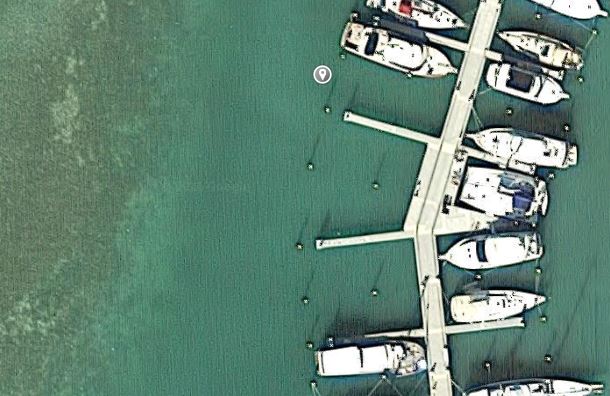
We pulled into Marathon Marina around 1545, but then got surprised by a current absolutely ripping along the outer fairway where our assigned slip was located.  I saw 1700 RPM on the tach by the time I was able to get the boat moving into the current – at maybe a half knot.  With barely a boat length of width between those western docks and the shallows, I decided the situation was too adverse for a safe docking maneuver.  So I backed out to the main channel and Chelle checked the nearest current station (Mosher Channel), which was calling for 2 knots – but we were hitting much more than that.
The pin marker is where we were supposed to dock...note
the shallows to the left / west.
As Falstaff says in Shakespeare’s Henry IV, “The better part of Valour is Discretion.”  Or in fighter pilot jargon, “extend and live to fight another day.”  So basically we got the hell out of there and dropped the hook out in the open water next to Boot Key.  Had we been able to get a slip on the (protected) east side of that dock we likely would have been more protected from the current, but that wasn’t an option with all the construction going on at the marina.  We enjoy being at anchor, but the generator use that entails means we’re going to be bumping up against its next oil change interval sooner than desired.

A Load of Trash Line Retrieved from the Bottom
On Monday the 23rd we pulled up the hook just before 1000 and began the day’s run (sans generator) towards Tavernier to the ENE.  As we pulled the anchor up we noticed it had fouled on a lengthy piece of 3/8” line, nearly pulling the anchor back into the hull as it came tight – with a little reverse maneuvering Chelle gained us some slack.  Once we got it untangled we spent a little time retrieving the entire length of the trash line to hopefully spare someone else that same fate in the future.  (It did not appear to be attached to anything, or if it was we yanked it loose.  And it had a nasty odor, thus the plastic garbage bag you see in the picture.)

Seas were forecast at 2 feet or less and the winds were light with a high overcast providing some relief from the sun.  So rather than running in close via Hawk Channel we first took a southeast heading and went outside the reef into 300+ feet of water and trolled two lines off the stern of Ghost Rider fishing for some mahi.  Radio chatter among the local fishing boats didn’t sound too promising – in water from 300 to 800 feet they were getting skunked.

We didn’t drag the lures for very long….maybe an hour or so, and then we lost bottom reading on both depth finders (Ghost Rider has two transducers) so we went into troubleshooting mode; it took us a while to figure it out, but the short of it is that the Furuno Sonar display had an incorrect “Mode” setting, and that one was rectified easily enough.  But the Furuno digital readout on the RD30 instrument is still a mystery – it seems to lose bottom lock in depths of 200 to 400 feet.

Our Whacky SPOT Track
If you look at our SPOT track for the day, it was a real zig-zag as we navigated from deep to shallow and back out to deep water trying to troubleshoot the depth sounder issues.  Once we got the basic problems either solved or framed up, we deployed fishing lines again – but like the pros who were further offshore, we too got skunked.
Sunset Moored Behind Tavernier Key 

Even with all the zig-zagging, we arrived at Tavernier Key in good time – it was another nice downhill run today with strong pushing currents from residual Gulf Stream effect – and set the anchor in very shallow water (less than 2’ under the keel) at low tide on the northwest side of the island in time for another magnificent sunset.
Tavernier Key Off the Bow

Boat stuff:
·         Rick spent the early evening investigating a raw water pump leak on the generator; it’s quite slight (and intermittent) for now, but will require attention by the time we reach Palm Beach at the end of the week.

·       The air handler in the main state room isn’t cooling (also intermittent) ; am guessing its water ball valve is stuck closed, similar to the issue that occasionally afflicts the PH air handler; another Palm Beach maintenance item.

We awoke on Tuesday the 24th to a calm, clear and warm morning and got an early start (for us) around 0830 and headed north past Key Largo and towards Biscayne Bay just south of Miami.  The original plan was to anchor in the bay, but since we spent an extra night on the hook at Marathon, we opted to dock up at Dinner Key Marina.  Two hours out they gave us a slip assignment with a 16’ width – which won’t work for a boat with a 16.1’ beam.  So Michelle scrambled for an alternate and we diverted to Grove Isle Marina.

Entry Channel to Grove Isle
Grove Isle Looking Towards Biscayne Bay
Thunderstorms had started popping over distant waters to the east as well as on the mainland, but we were easily able to run between them until we angled into Biscayne Bay, where one got a bit close as we approached Grove Isle.  Practically speaking, the entry channel to the marina was more of a concern than the storm cell – it is surely the most convoluted & skinny water entrance we’ve had to maneuver in any of our boats, and saw as little as 1.5’ of depth under the keel approaching a low tide.

Anyway, we docked up without issues and spent a relaxing although occasionally wet night there.

On Wednesday the 25th we departed Grove Isle Marina and Biscayne Bay and headed north to Fort Lauderdale….with a 15 to 20K wind out of the northeast, the main challenge of the day was figuring out how to depart the t-dock without leaving Chelle behind as she untied our lines.  We looped a couple of side ties that could be removed from the boat to solve that.

Offshore the winds were cranking and seas were beam to quartering on the starboard bow at 3 to 5 feet and 4 second intervals – sloppy but apart from getting very salty Ghost Rider had no problems with it.

At Pier 66...We Were One of the Smallest
Boats There
The Fort Lauderdale (Port Everglades) entrance channel was a sloppy mess with an outgoing current and incoming 4 to 5 foot steep-faced rollers; the channel is wide and deep, but it was still a busy time keeping Ghost Rider pointed in the right direction – it’s got a broad ass end that can get pushed around in big following seas, so one has to really have to pay attention.  I’ve come to appreciate the Simrad autopilot’s follow-up jog lever (basically a joystick) in such circumstances, finding that I can hold a heading better with that than either the AP’s auto-heading mode or with manual steering.  It reminds me of the B-52’s autopilot-assisted air refueling mode (which, to be honest, I hated and almost never used.)

Ghost Rider Docked Up @ Pier 66....Really
Nice Floating Concrete Docks
We had to delay our entry to the Hyatt Pier 66 Marina a few minutes to troubleshoot a Bluetooth headset issue – the boom mic on Rick’s had gone missing.  (Headsets are much better than shouting at each other during close quarters maneuvering, which is why they are called “marriage savers”.)  We substituted a small spare mic and got docked up with no issues in spite of the stiff winds.  Later, when washing down the boat, we found the missing boom mic wedged under the boarding ladder on the swim platform aft of the transom (soaking wet).  It probably dislodged from the headset while on the fly bridge shortly after departure, and got wind-blown to the aft end – how it stayed on the transom during those lumpy seas is a small miracle – and in spite of the soaking, it still works.  Lucky break.

BTW, Pier 66 is a very nice marina -- close to the ocean inlet, very protected just off the ICW, new concrete floating docks, recently upgraded Wi-Fi, pool, gym, clubhouse and a Hyatt hotel on the property.

FLL Can Be a Busy Port
Thursday the 25th started with another clear and warm morning and a steady 10-15K breeze out the northeast; we were underway before 0900 with Chelle manning the helm and Rick handling the deck duties this time.  The Port Everglades inlet is typically a busy shipping lane and that was true this morning, but Chelle weaved us through the traffic, which included a close pass with the beast of a container ship pictured here.

We once again avoided the ICW inside route and took Ghost Rider outside into 3 foot seas for the leg up to Palm Beach.  We’d rather deal with lumpy water rather than all the bridges, narrow passages and amateur boat drivers that frequent the ditch.  Seas built to 4 feet by the time we arrived at the Lake Worth inlet at 1545 making for another sloppy inlet ride and more jog-lever steering, but after we rounded Peanut Island we enjoyed a smooth run on the final few miles leading to Old Port Cove (OPC) Marina in Palm Beach.
Old Port Cove Looking East

This is our first trip back to OPC since we purchased the boat last August and had all of Ghost Rider’s refit work done here by Yacht Tech.  It’s good to be back as we have a healthy punch list for them before we continue our journey north in about 2 weeks.  Rick also has to change oil and filters on both the main engine and the genset.  While here we’ll also be taking a side trip, flying to St. Louis to visit with family and partake in a charity fund raising event for the Lt. Dan Scholarship Fund.  We’re looking forward to that and being dirt-dwellers for a short break.

Saturday, May 21, 2016

May 16th-20th : Key West to Dry Tortugas (and Back)

We departed Key West on Monday the 16th around 0830 and pointed Ghost Rider’s bow due west toward the Dry Tortugas.  The weather was very good – a bit humid (70%) and temps starting in the low 80’s (later up to 90) with a light breeze out of the east and a following sea of that varied between 1 and 3 feet, with perhaps an occasional 4 foot roller…it was comfy. 
Approaching Fort Jefferson

We cruised out of cellular range about 2 hours after departure and tuned the SSB radio to 2182.0 (short range distress frequency.)  And we were definitely going downhill – our SOG was 8K+ knots most of the way at just under 1700 RPM, and when we did our daily WOT run we hit 9.7K, which is flying low for Ghost Rider.

It’s a pretty lonely stretch of ocean between the Marquesas and DT – didn’t see another soul for several hours during the middle of the leg except for the occasional dolphin in the bow wave and a couple of large sea turtles.  But when we reached Fort Jefferson (just before 1700) it looked more like a marina than a remote island with no services.  There were 9 fishing boats anchored on the shoal just south of the fort, and 11 bigger boats in the main anchorage next to the fort…and those were way too close together with too-short scopes on their anchor rodes for our taste, so we did a 180 and motored over to the Bird Key Harbor anchorage.  There we were the only boat, so in 28 feet of water we dropped the hook, let out 200’ of chain, and then set it hard backing down at 1300 RPM.  Once we had the snubber deployed, we had more than enough scope and plenty of swing room.

Sunset Over Loggerhead Key
We also began testing a new method for monitoring the anchor set – which is to fire up the Nobeltec nav software on Rick’s laptop PC with an attached GPS antenna puck, and use the software’s built-in anchor alarm circle function.  The same can be accomplished with the boat’s built-in electronics, but this approach is more portable and allows us to shut down energy consumers. 
Ghost Rider In Bird Key Anchorage

Sunset was a bit obscured by high clouds but still stunning over Loggerhead Key.  The wind picked up to around 15K with gusts to 20K, and while we bobbed a bit as we weathervaned into the stiff breeze, we held secure and had a comfy although occasionally rolly night.

More boat stuff today: 
·         We’ve developed a solid theory on why those 2 house batts are trending so much warmer than any of the others in the bank:  the large engine room (intake) cooling fans we had installed when we first acquired the boat are hard-wired directly to those two batteries; that’s looking more and more like a bad design.  The likely solution is to reroute that wiring over to the battery bus bar, and spread the load over all 6 house batts; not sure I have enough wire of the correct gauge on board, but it looks like that can wait until we make Palm Beach later in the month.

·         We ran without the genset (and no air conditioner) for the first 6 hours today, but when the mercury hit 90 we cranked it up & turned on the A/C.  The pilot house air handler, however, wasn’t cooling; that turned out to be a stuck valve (which I cured with a hammer).

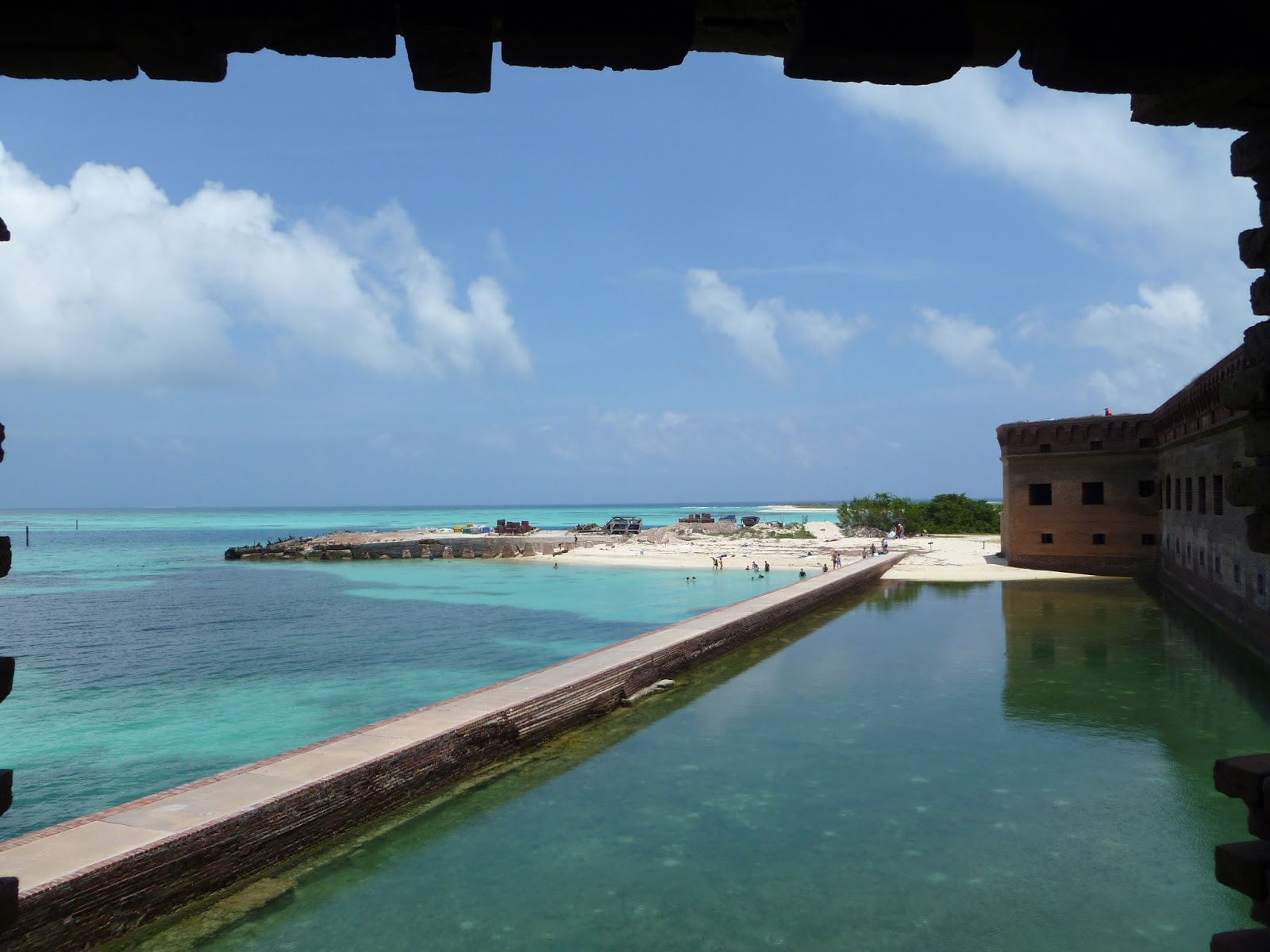
The Fort's Moat and Snorkeling Beach
On Tuesday (5/17) we tended to a few chores in the morning, then launched the dinghy and made our way over to Fort Jefferson first for the obligatory check-in with the National Park Ranger Office, and then of course to tour the big fort.  It’s a very large and interesting place….the only way to get here is via boat or seaplane (there are frequent hops you can catch from Key West.)  And according to one of the park rangers, they have a salt water crocodile occupying the grounds making the most of the food supply in the protected sanctuary.  Supposedly Carlos the croc (and they’ve named him) doesn’t hassle the humans.

Casper Beached at the Fort
Originally intended to be part of the country’s coastal and sea lane defense strategy, construction of the massive structure began in 1846, but was never fully completed – the U.S. Army abandoned its efforts there in 1878.  In reality it served more as a prison during the civil war than as a fort – it’s where the infamous Dr. Samuel Mudd was incarcerated before being pardoned.  Architecturally speaking it’s butt ugly, but the engineering for its time is quite impressive.  Today this entire area of outlying islands is primarily a wildlife sanctuary, with thousands of previously threatened sea birds and nesting sea turtles calling it home, and it features numerous large areas where anchoring, fishing and sometimes even boating or walking the shore line are completely off limits.

Inside the Fort
Inside the Fort
Bird Sanctuary on NE Side of the Fort
Later in the afternoon when we returned to Ghost Rider Michelle gave Casper a bath, and then we went for a swim…the water quality here is startling – visibility is outstanding.  That made it good conditions for Rick to dive under the boat and check the bottom and running gear – the latter looked good, and mostly so did the bottom except for a stretch around the boot stripe that has some peeling and bubbling going on.  We’ll have that checked out by Yacht Tech when we reach Palm Beach.
Diving on the Running Gear
As for boat stuff today: 
·         Casper-the-friendly-ghost-dinghy’s 40 HP Yamaha still isn’t quite right, even after a full service completed on it back in Fort Myers a week ago; idle is a tad rough, but it also bogs down seriously between 2500 & 3300 RPM.  I may go looking for a fuel-injected engine vs. messing around with this ancient carbureted stuff.

The next day (Wednesday 5/18) began a bit early when a hefty line of thunderstorms blew through the area from 0100 to 0200 – we swung 180 degrees on the anchor but held fast; I was glad we weren’t in the more crowded anchorage, but it rained hard and was a bit lumpy out there.

Flopper Stopper Deployed
So one of the things we did today – should have earlier – was to deploy the “flopper stopper” – which is basically a big slab of aluminum that hangs off several tethers at the end of a horizontal swing-out boom on the port side of the boat.  It’s basically a fixed stabilizer, similar to, but smaller than, a paravane. I personally want to thank Jeff Merrill (once again) for making us label those lines and attachment points during our initial training, otherwise it would have taken us a lot longer to figure out how to deploy the thing.

After that we took the dinghy over to Loggerhead Key, about 2 NM west of our anchorage, beached Casper on the northeast end of the island and went swimming and snorkeling.  Michelle also picked up a conch shell and an interesting chunk of coral rock while beachcombing.  After a couple hours we returned to Ghost Rider for a late lunch, cleaned up Casper and secured her back on the boat deck in preparation for the sortie back to Key West.  We had another fine evening on the fly bridge looking at miles of azure water, listening to Jimmy Buffet and enjoying yet another happy hour in paradise.

On Thursday 5/18 we awoke to some light showers and a quick weather check via the radar set and XM satellite revealed a broad area of showers and thunderstorms to our southeast and stretching to Key West and beyond.  We had an extra “weather day” built into our planned itinerary, but decided we didn’t need it – we pulled the anchor just before 0900 and tucked Ghost Rider in behind the line of weather, confident the storms were moving east faster than we could.
Departure Weather

We took the lower route back to Key West, passing on the south side of the Marquesas.   Seas were forecast at 2 to 4 feet, and initially they were; but at about the 3 hour mark winds cranked up to 20K out of the southeast, with higher gusts, and seas increased steadily and we found ourselves punching into 5 to 7 footers, from beam to quartering on the starboard bow, and with very short intervals. So it was definitely a lumpy ride up until around the 7 hour mark, and then the wind died down to around 10K and seas tapered off to 1-2 feet.  But between the head seas and currents, our pace wasn’t good – it took us 2 hours longer on the flip-flop.
Shrimp Road Grill at Stock Island Marina

We wanted to try a different port in Key West this time, so we put into Stock Island Marina (about 5 miles west of downtown Key West on the Atlantic side) shortly after 1900.  Ghost Rider just hummed all the way with no issues, and got a much needed bath after arrival….we and the boat were a salty mess.  Stock Island is a nice marina, but lacks cable TV at the slips, which is a bummer as Rick needs his news and sports fix.

Chelle Shopped for Coffee
We’re spending Friday & Saturday here catching up on sleep, email, snail mail and some administrative stuff, and of course Chelle's shopping fix, before heading up the island chain towards the east coast of the U.S.
A "Blue Moon" Over Stock Island

More to come in the near future.

Sunday, May 15, 2016

May 11th-15th : Marco Island to Key West

Chelle Maneuvering in Close Quarters
We spent Wednesday (the 11th) hanging out at Marco Island (The Marina at Factory Bay….nice place with floating concrete docks and friendly staff, but the Wi-Fi was a bit dated and the cable TV feed appeared to be tango uniform).  We had a few maintenance items to tend to in the morning, and then in the afternoon we spent a couple of hours doing donuts in the marina – Michelle got some good practice maneuvering the boat in close quarters, including back-and-fills as well as stern-in and parallel docking maneuvers.  The admiral is getting quite good at it.  Afterwards we got cleaned up and we walked to one of favorite restaurants, the Marco Pub & Grille, and enjoyed a great evening meal there.

Black Simmer in Action
For the 2nd consecutive evening on the fly bridge we witnessed the grace and precision flying of the Black Skimmer…these sea birds fly fast and low to the water, so low that they dip their beaks into the water as they fly at speed, just millimeters above the water, and in close formation to boot.  Makes us old USAF pilots a bit jealous.

On Thursday (the 12th) we continued our journey south, making our way across Florida Bay to the Little Shark River….we departed at 0900 and had a smooth sortie to the south with flat seas, temps in the mid 80’s and reasonable humidity.  Once again we piloted the entire leg from the fly bridge.  At one point we were joined in close formation by a trio of dolphins who decided our bow wave was a good place to cruise for about 10 minutes.
Dolphins in the Bow Wave
Anchored Near Little Shark River
We dropped the hook at 1700 about a mile offshore from the mouth of the Little Shark River to avoid the bugs that are overly abundant in the Everglades this time of year.  The westerly sea breeze died out shortly afterwards and winds resumed from the east, and we had a pleasant night at anchor.  We were even able to spend an evening happy hour on the fly bridge with only an occasional bug strafing the bridge.

As for boat stuff: 
·         The water maker (an FCI Aquamiser with a 480 GPD rating) initially would not power up; on a second try later in the day it came back to life, but then it started to cut out at frequent intervals; it turned out to be a loose wire in the unit's control box back in the lazarette, which was an easy fix, although it took me a while to find it.

·         The #2 battery group in the house bank (Lifeline GPL-8DL, located in the lazarette) had temps trending up again even though they are new.  While still within theoretical limits, we are concerned about the trend and the delta vs. the other batts.

Anchored Near Boot Key Harbor
On Friday (the 13th) – we are not superstitious – we sortied further south, this time another short hop (6 hours) to Marathon.  Weather again was excellent, and Florida Bay was absolutely flat, so it was another drive-from-the-fly bridge day.  And we once again were intercepted by a formation of bottlenose dolphin that enjoyed cruising along with us in Ghost Rider's bow wave.

Marathon Marina never returned our calls for a slip reservation request (something about dock renovations), so we blew them off and just dropped the hook a short distance from the entrance to Boot Key Harbor.  It worked out well, as we spent a comfortable evening at anchor, albeit in some fairly shallow water (for us.)

More boat stuff:
·         Nobeltec Odyssey, which is our primary nav software (runs on the ship’s PC separate from the Furuno chart plotters) was doing a very poor job of calculating ETA…turns out it was receiving an erroneous (low) STW signal & once that was turned off, its SOG and ETA calculations returned to normal.  An easy fix, but it took me a whole day to figure it out.

·         The #2 battery group in the house bank is still a sore point and source of concern….after 13 hours of continuous charging its temp (for batt B) was @ 95F….within specs but well above the other batt temps; we have no clue as to why, and continue to monitor.

·         In troubleshooting the battery heat problem I changed some settings on our Xantrex LinkPro battery monitor (trying to get a remote temp readout) but pretty much FUBAR’d the damned thing in the process; will be re-reading the owner / operator manual in my spare time trying to get it back to ops normal.

On Saturday (the 14th) we departed Marathon and headed down-chain towards Key West, pulling the hook at 0915 and cruising down Hawk Channel.  It was another perfect weather day with nothing more than a light chop inside the reef.  For the third day in a row we flew formation with dolphins in the bow wave.

We made Conch Harbor Marina by 1500, squeezed into our assigned slip with no issues, and gave Ghost Rider a thorough fresh water shower.

Luna -- a Very Big Boat
As an aside, we passed a yacht named Luna on our way into Key West harbor (see pic); the thing is monstrous at 377 feet LOA.  Its beam exceeds Ghost Rider’s length.  It even has its own Wikipedia page: https://en.wikipedia.org/wiki/Luna_(yacht)

Conch Harbor is Crowded
Today (the 15th) we hung out at the marina while tending to some boat chores -- topping off fresh water, pumping out the holding tank, and loading routes into the computer for the Dry Tortuga legs.

And more boat stuff:
·         That irksome # 2 house battery group peaked at 105F and then backed down to 99-101F at the end of this last sortie; today it had settled in at around 95.  We will continue to monitor.

·         The LinkPro battery monitor is now dead, with no power to the gauge.  Checked all fuses.  
Maybe we're better off without the damned thing.

Tomorrow we plan to head further west out to the Dry Tortugas National Park, assuming we don't have any more battery issues.  That means we'll be off the grid until the end of the week.  Weather looks a bit spotty but good enough for us.  We'll check in via the Spot tracker each day, plus will be cranking up the single side band radio.